
What Did Ancient Boxers Wear on Their Hands? From Leather Straps to Deadly Weapons
Ancient boxing gloves weren't designed to protect opponents — they were often built to inflict maximum damage. Discover the full evolution of hand protection in ancient combat sports: from Sumerian hand wraps and Greek himantes to the brutally weaponized Roman cestus, and the only surviving pair of Roman boxing gloves ever found.
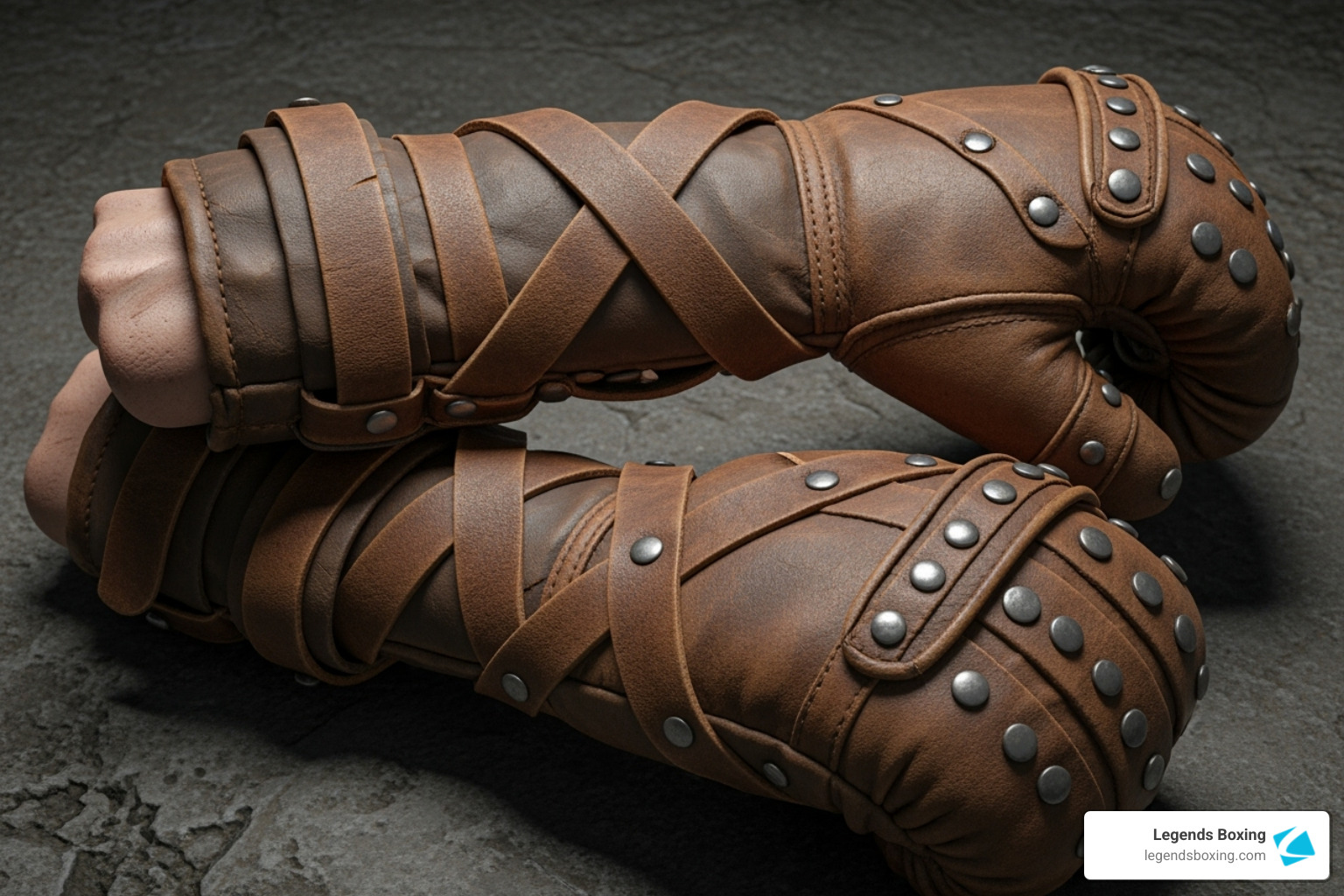
From Leather Straps to Deadly Weapons: The Evolution of Ancient Hand Protection
Ancient boxing gloves weren't designed to protect opponents — they were often built to inflict maximum damage. Here's a quick look at how hand protection evolved in ancient combat sports:
Quick Answer:
- Ancient Greece (688 BCE): Leather straps called himantes wrapped around hands and wrists
- Practice gear: Sphairai were padded gloves used for safer sparring
- Roman era: The cestus — a brutal glove fitted with metal studs, spikes, or plates
- Purpose: Early hand coverings protected the fighter's hands while increasing striking power
- Archaeological evidence: The only surviving Roman boxing gloves were found at Vindolanda fort (c. 117–119 CE)
Long before boxing was called the "sweet science," ancient fighters wrapped their hands in leather strips and later wore gloves studded with metal, turning their fists into weapons. Depictions of boxing date back to 3000 BCE in Sumerian and Egyptian artifacts, and by 688 BCE it was an official Olympic sport in ancient Greece. The equipment evolved from simple wraps to deadly weapons like the Roman cestus, which could kill with a single blow.
I'm Robby Welch, National Head Coach at Legends Boxing. While ancient boxing gloves were designed for brutality, modern boxing focuses on technique, fitness, and safety — values I bring to every training program I develop.

The First Hand Wraps: From Simple Straps to Brutal Weapons
The story of hand protection in boxing begins thousands of years ago, evolving from simple wraps to weaponized gloves. What started as a way to protect a fighter's hands also became a way to inflict more damage.
Around 3000 BCE, Sumerian and Egyptian art shows fighters with simple hand wraps for support. By 1500 BCE, Minoan frescoes depict more structured hand coverings. The real evolution came in ancient Greece when boxing became an Olympic sport in 688 BCE. Fighters used himantes — long leather strips wrapped around the hands. These protected the knuckles but also created a harder striking surface that could cut an opponent.
The Greek Himantes and Sphairai: The First Ancient Boxing Gloves
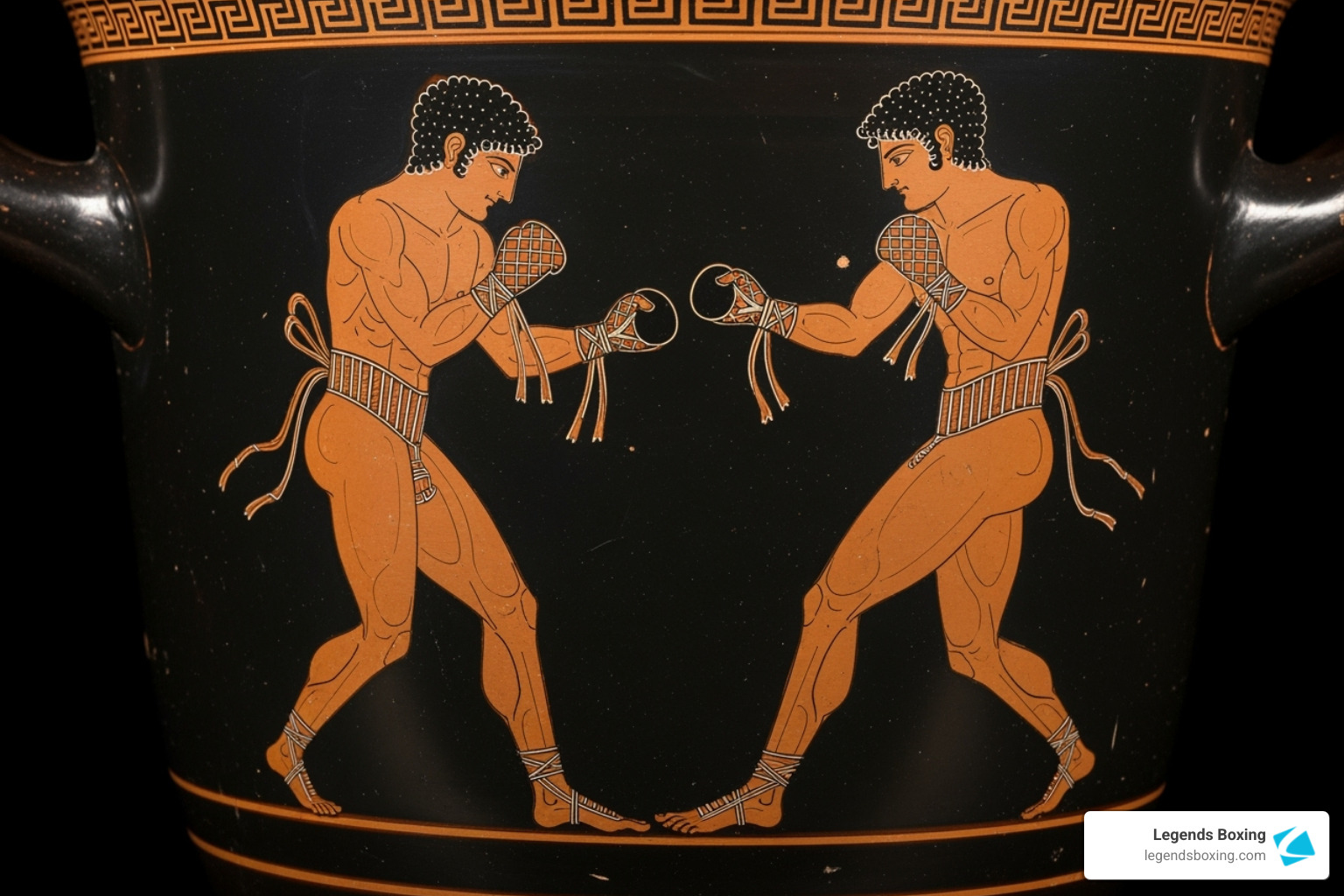
The Greeks developed specialized equipment that distinguished training from competition — a principle that remains vital in boxing today.
Soft thongs (meilichai) were often fleece-lined and used for sparring to reduce injury, functioning much like modern training gloves. They protected both the wearer and their partner during practice sessions.
Sharp thongs (imantes) were the competition version — featuring a hardened leather knuckleduster that turned the wrap into an offensive weapon. The additional rigidity created a striking surface that could split skin and cause serious lacerations, giving fighters an edge that went well beyond bare-knuckle combat.
Padded sphairai were spherical padded gloves specifically for practice, showing that even the Greeks understood the need to separate training intensity from competition brutality. This sophisticated approach to gear — different equipment for different purposes — is something modern boxing inherited directly.
The Greeks treated boxing as both a martial art and an athletic contest. Olympic boxing matches had no rounds, no point system, and no ring — fighters simply exchanged blows until one man submitted or couldn't continue. In that context, the himantes were not just protective equipment; they were tools of attrition.
The Roman Cestus: Weaponized Ancient Boxing Gloves
The Romans created the cestus (or caestus) for gladiatorial spectacle, taking brutality to an extreme that the Greeks had never intended. This battle glove featured metal studs, plates, or even spikes embedded in leather that covered the knuckles and forearm. The name comes from the Latin caedere — "to strike" — and it was, by any definition, a weapon.
Virgil's Aeneid famously describes a fighter using a cestus to kill a bull with a single punch, capturing the cultural imagination around these deadly instruments. Roman poets and historians didn't describe the cestus as sporting equipment — they described it as armor.
Unlike Greek boxing, Roman matches were often life-or-death struggles staged for public entertainment. Gladiatorial boxing with the cestus wasn't a contest of skill — it was a spectacle of violence. Fighters were often slaves or prisoners who had no choice in the matter. The cestus was designed to maim or kill, representing the absolute peak of weaponized ancient boxing gloves.
The contrast with Greek boxing is stark: Greek competitors were free men and Olympic athletes who trained for years. Roman gladiatorial boxers were entertainers in an arena where death was part of the show.
Case Study: The Vindolanda Roman Boxing Gloves
For centuries, knowledge of Roman ancient boxing gloves came only from art and text, as leather artifacts rarely survive millennia underground. This changed in 2017 with a remarkable discovery at Vindolanda, a Roman fort just south of Hadrian's Wall in northern England.
Archaeologists unearthed the only known surviving Roman-era boxing gloves, dating to approximately A.D. 117–119. Preserved in the site's unique oxygen-free, waterlogged soil — the same conditions that have preserved writing tablets, shoes, and wooden structures at Vindolanda for nearly 2,000 years — these gloves belonged to soldiers stationed in a cavalry barrack.
What the Find Reveals About Roman Army Life
The discovery confirmed what historians had long suspected: boxing was integral to Roman military life — used for combat training, physical conditioning, and entertainment. But the details of the find revealed something even more interesting.
The two gloves recovered are not a matching pair, proving they had different purposes:
- The smaller glove is a padded sparring glove, designed to protect both the wearer and their training partner — essentially the Roman equivalent of modern 16-oz training gloves
- The larger glove is a heavier fighting glove, filled with dense material and featuring a hardened leather strip along the knuckles capable of drawing blood — a functional, if tamer, cousin of the gladiatorial cestus
This distinction reveals a sophisticated approach to training that mirrors modern boxing: you spar safely, then compete with more serious equipment. Roman soldiers weren't barbarians blindly bludgeoning each other — they had a structured system for developing fighting skill.
The gloves were found alongside other military gear, embedding them firmly in the context of daily soldier life. Boxing wasn't a rare spectacle for these men; it was part of their routine physical training, as normal as sword drills or marching.
Cestus vs. Modern Gloves: A Brutal Contrast
The evolution from the Roman cestus to modern gloves marks one of the most dramatic shifts in sporting history — from weaponized brutality to regulated safety:
| Feature | Ancient Roman Cestus | Modern Boxing Glove |
|---|---|---|
| Material | Leather with metal studs, plates, or spikes | Leather exterior with multi-layer foam padding |
| Purpose | To inflict maximum damage | To protect both fighters |
| Padding | Minimal to none — designed to injure | Multiple layers to absorb and distribute impact |
| Weight | Varied; metal added significant mass | Standardized (8–16 oz by competition rules) |
| Safety | Designed as a weapon; often lethal | Designed to reduce injury; heavily regulated |
| Regulation | None — used until fighter submitted or died | Governed by bodies like WBC, IBF, WBA, and WBO |
The contrast is clear: ancient combat sports prioritized spectacle and damage, while modern boxing prioritizes skill, strategy, and athlete safety. The 1867 Marquess of Queensberry Rules — which mandated padded gloves, timed rounds, and a prohibition on wrestling — mark the formal turning point between ancient brutality and modern sport.
The Legacy of Ancient Boxing Gloves
What's remarkable about this history is not how violent the ancient world was, but how recognizable its instincts are. Greek athletes trained with padded gloves to protect their sparring partners. Roman soldiers used lighter gloves for practice and heavier ones for serious competition. Vindolanda's archaeological record shows soldiers who boxed regularly as part of a structured fitness routine.
The specific equipment has changed beyond recognition — from metal-studded leather to precision-engineered foam — but the underlying logic hasn't. You train safely so you can compete at your best. You protect your sparring partners because you need them to keep training with you. You develop technique before you develop power.
Those ideas are as old as organized boxing itself.
At Legends Boxing, we've inherited thousands of years of that accumulated wisdom — stripped of the brutality, but keeping everything that actually made fighters better. If the dedication of those Roman soldiers inspires you, find a Legends Boxing location near you and experience boxing the way it was always meant to be: disciplined, purposeful, and built to make you stronger.
Book a free workout and start your own training story — no cestus required.