
Bag It Up! Good Boxing Workouts You Can Do at Home
An at-home boxing workout with bag is a time-efficient, full-body routine that combines cardio and strength training while torching 300–500 calories in 30 minutes. This guide covers the science-backed benefits, how to choose and set up your home bag station, essential safety tips, a complete beginner 5-round workout, advanced combinations, progress tracking, and a proper cool-down and recovery protocol.
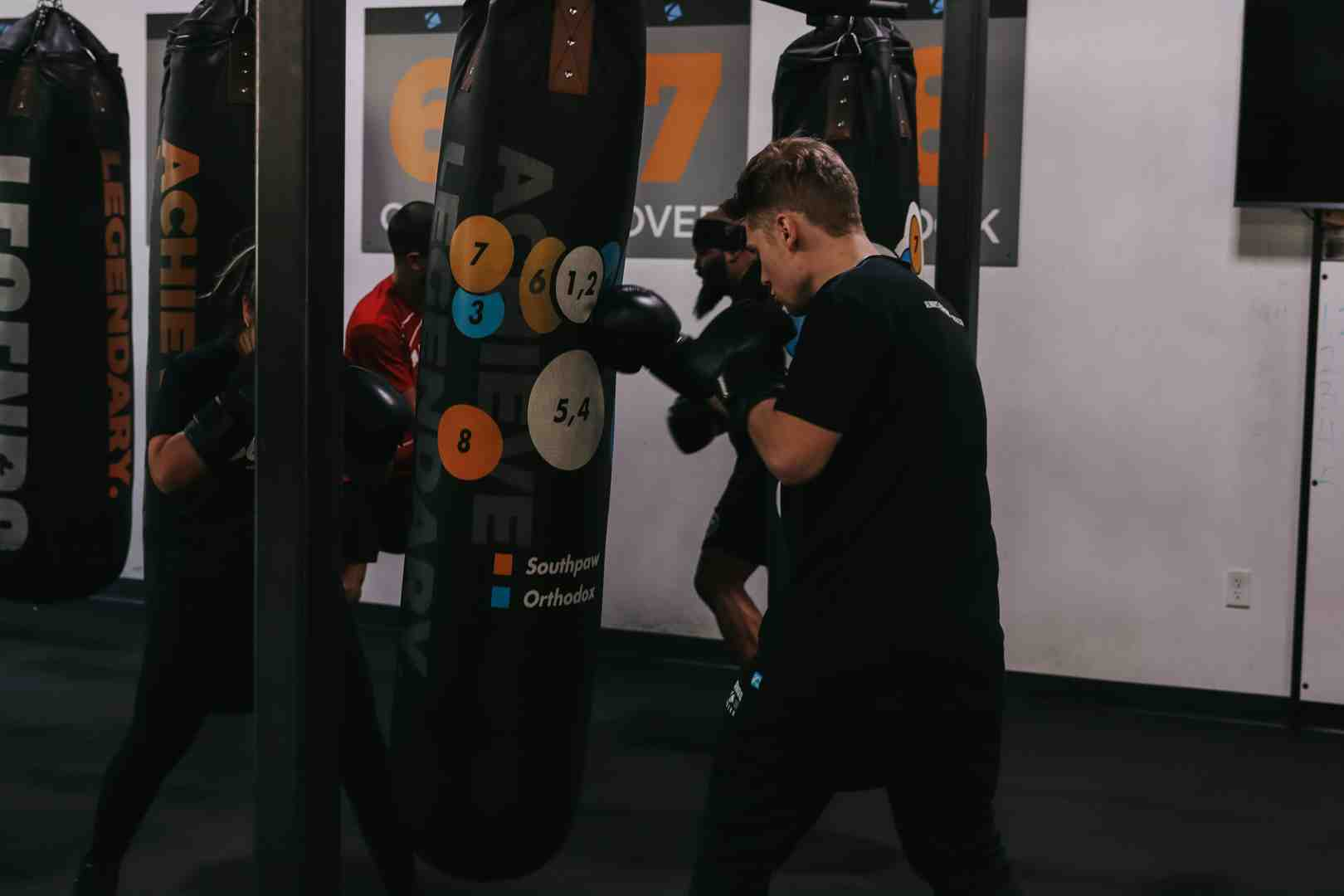
The Ultimate Heavy Bag Workout for Home Fitness
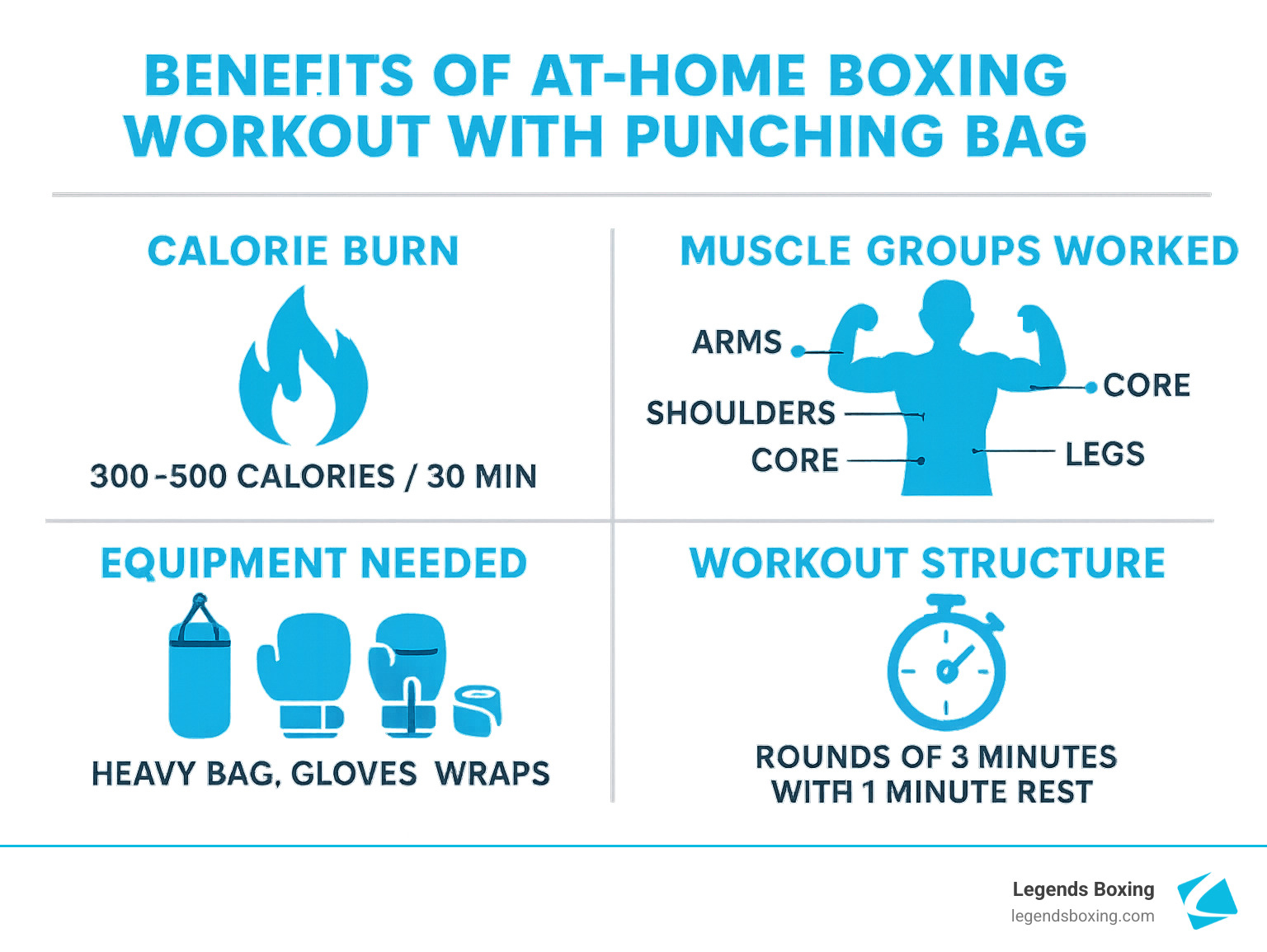
An at-home boxing workout with bag is a time-efficient, full-body exercise routine that combines cardio and strength training while relieving stress. Here's what makes it effective:
- Calorie Burn: 300–500 calories in just 30 minutes
- Full-Body Engagement: works arms, core, legs, and shoulders simultaneously
- Stress Relief: physical outlet for tension and frustration
- Convenience: train anytime without a gym membership
- Bone Density: impact training strengthens bones
A punching bag workout at home offers the perfect balance of intensity and accessibility for busy people looking to break through fitness plateaus. Whether you're a complete beginner or have some boxing experience, the heavy bag provides scalable resistance and immediate feedback.
I'm Robby Welch, National Head Coach for Legends Boxing, with experience developing at-home boxing workout with bag programs that have helped thousands transform their fitness routines from boring to exhilarating. My expertise comes from designing curriculum used nationwide and competing personally, giving me unique insights into making bag workouts both effective and engaging.
Why Punch the Bag? 8 Science-Backed Benefits
The heavy bag isn't just a piece of equipment — it's your all-in-one fitness companion with serious scientific backing. When I first started coaching clients through at-home boxing workout with bag routines, I noticed changes that went far beyond just physical improvements. Here's why science supports making the heavy bag a centerpiece of your home workout space:
1. The Afterburn Effect. Your body experiences a true metabolic awakening with bag work. That satisfying thud of glove against bag triggers what exercise physiologists call the "afterburn effect" — your metabolism stays elevated for hours after you've showered and moved on with your day.
2. Neural Rewiring. The rhythmic dance of throwing combinations doesn't just feel good — it rewires your brain. Your hand-eye coordination improves as neural pathways strengthen with each jab-cross combo you throw.
3. Balance and Stabilizer Strength. The constant weight shifting between punches builds often-neglected stabilizing muscles, dramatically improving balance and proprioception.
4. Fast-Twitch Power Development. Power development happens naturally as you push against the bag's resistance. Unlike air punching, the feedback from hitting something solid builds fast-twitch muscle fibers that make everyday movements more explosive and athletic.
5. Mental Health Benefits. There's something uniquely therapeutic about physically releasing tension through controlled punching, combined with the natural endorphin flood that follows. Members tell me their anxiety noticeably decreases after just one solid bag session.
6. Bone Density. Research published in the Canadian Journal of Applied Physiology found female boxers display impressively high bone mineral density despite low body fat — strong evidence that impact training like bag work builds stronger bones.
7. Fat-Burning Efficiency. The high-intensity nature of bag work creates ideal conditions for fat oxidation, especially when structured as intervals.
8. Time Efficiency. You simply can't beat a complete full-body workout in under 30 minutes.
"Heavy bag workouts are one of the most efficient forms of exercise," explains Coach Mike from our Legends Boxing Sandy location. "In just 20–30 minutes, you're getting what might take an hour with traditional cardio and strength training separated."
Calorie-Torching Cardio & Strength In One
The magic of an at-home boxing workout with bag is how it seamlessly blends cardiovascular conditioning with resistance training. This dual nature creates the perfect calorie-burning storm.
A typical half-hour session torches between 300–500 calories, depending on your intensity and body weight. The natural HIIT structure quickly lifts your heart rate and keeps it dancing in that optimal fat-burning zone.
Unlike mindlessly pedaling on a stationary bike, bag work demands full-body engagement. Each punch activates your shoulders, chest, and arms, while proper technique recruits your core, hips, and legs to generate power. That multi-muscle recruitment significantly increases energy expenditure.
"What makes bag work unique is that you're constantly engaging your core as you rotate and transfer power from your lower body through your midsection and into your punches," says our head trainer at Legends Boxing Riverton. "It's like doing planks and rotational exercises while also getting your heart rate up."
Stress & Confidence Booster
There's something uniquely satisfying about hitting a heavy bag that traditional workouts simply can't match. The physical act of punching releases tension that accumulates in your body throughout the day. With each impact, your brain releases endorphins — those feel-good chemicals that create a natural mood elevation.
Beyond the immediate stress relief, there's a profound confidence boost that comes from mastering boxing techniques. The progress is measurable and visible — you can literally feel yourself getting stronger, faster, and more coordinated with each session.
As one member from our Lehi location shared: "After a tough day at work, 20 minutes on the heavy bag does more for my mental health than an hour of therapy."
There's also an empowering aspect to developing self-defense skills, even if you never intend to use them outside your home gym. Simply knowing you could protect yourself creates a subtle but powerful shift in how you carry yourself in the world.
Gear Up: Choosing & Setting Up Your Home Bag Station
Setting up your home boxing station doesn't need to be complicated or expensive, but making smart choices will improve your experience and results.
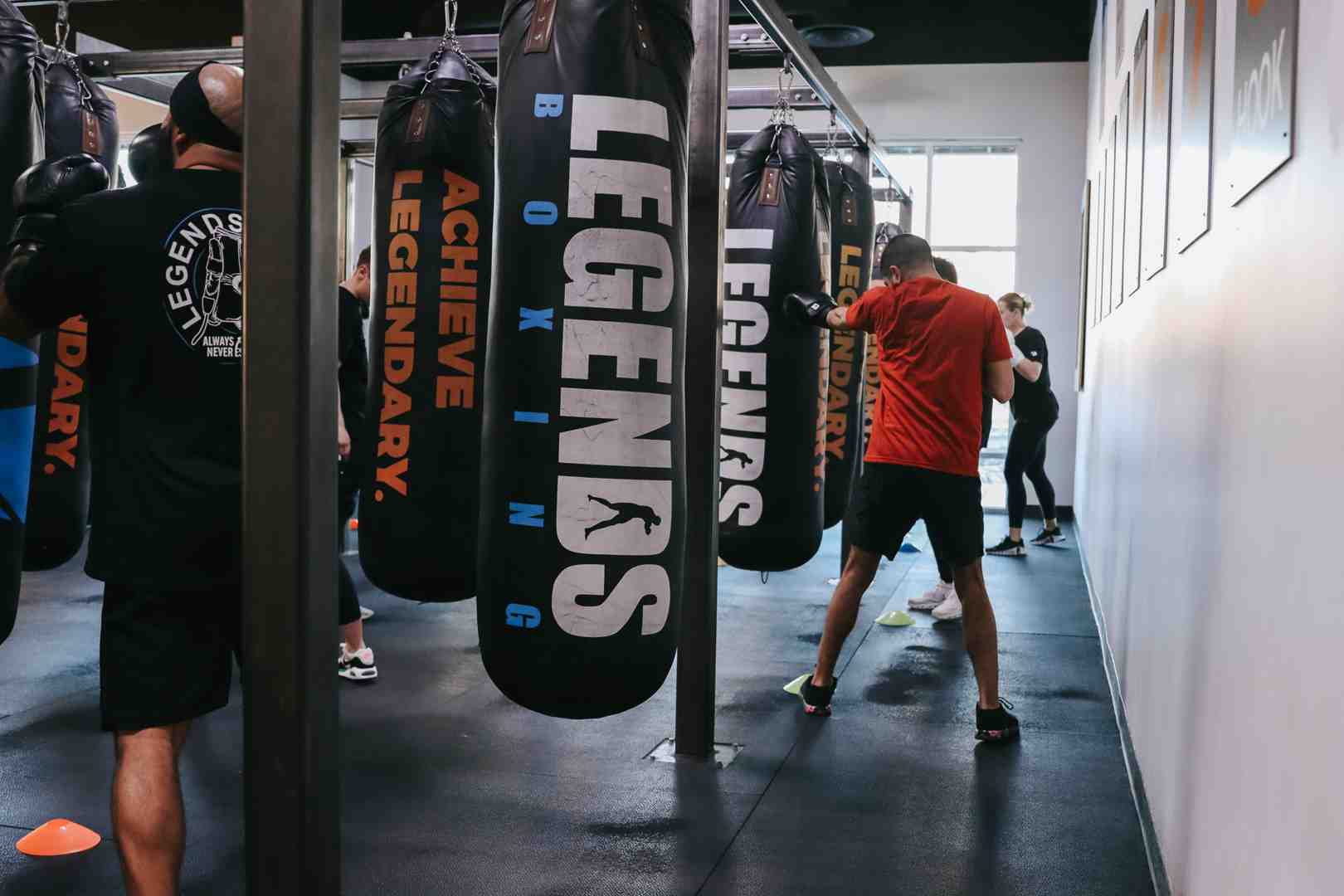
Picking the Right Punching Bag
The foundation of any at-home boxing workout with bag is, of course, the bag itself.
Bag types:
- Heavy Bags — traditional cylindrical bags (70–150 lbs) for all-purpose training
- Speed Bags — small, air-filled bags for improving hand speed and coordination
- Double-End Bags — attached to floor and ceiling; they move when struck to simulate an opponent
- Freestanding Bags — stand on their own base without ceiling mounting
Weight considerations: as a general rule, your heavy bag should weigh approximately half your body weight:
- 130–150 lb person → 70–80 lb bag
- 160–180 lb person → 80–100 lb bag
- 180+ lb person → 100–150 lb bag
| Feature | Hanging Bag | Freestanding Bag |
|---|---|---|
| Installation | Requires ceiling mount or stand | Simple setup, no mounting needed |
| Movement | Natural swing simulates opponent | Less movement, stays in place |
| Space Required | More clearance needed | Compact footprint |
| Stability | Very stable when properly mounted | Can tip with powerful strikes |
| Cost | $80–$300 | $150–$400 |
Fill material:
- Water-filled bases — good stability for freestanding bags and can be emptied for relocation
- Sand-filled bags — more resistance and realistic feel
- Foam core bags — more forgiving for beginners, easier on joints
"For home users just starting out, I typically recommend a freestanding bag with a water-filled base," explains our equipment specialist at Legends Boxing Salt Lake City. "They're easier to set up, can be moved when needed, and still provide an excellent workout platform."
Essential Accessories Checklist
- Hand Wraps ($5–$15) — absolutely essential for protecting your wrists and knuckles; learn to wrap properly before your first session
- Boxing Gloves ($40–$100) — for beginners, 14 oz or 16 oz gloves provide good protection; look for quality leather or synthetic with proper wrist support
- Timer App — a boxing-specific interval timer helps structure your rounds and rest periods
- Jump Rope ($10–$30) — perfect for warming up and improving footwork between bag rounds
- Workout Mat ($20–$50) — provides cushioning for floor exercises and protects flooring from sweat
- Towel — keep one handy to wipe down equipment and yourself
- Bluetooth Speaker — music helps maintain energy and rhythm throughout
Minimum space requirements:
- 6' × 6' clear area
- 8' ceiling height for hanging bags
- Non-slippery, stable flooring (mats recommended)
Safety First & Smart Warm-Up
The excitement of throwing your first punch can be hard to resist, but taking a few minutes to prepare properly will keep you safe and dramatically improve your workout quality.
Must-Do Injury-Prevention Tips
Thumb position: keep your thumb outside your fist, never tucked inside, to prevent serious breaks when you make contact with the bag.
Wrist alignment: maintain a straight line from your knuckles through your forearm — this structural position protects your wrist joints from buckling on impact.
Breathe: exhale sharply on impact with each punch. This rhythm not only engages your core but prevents the dangerous tendency to hold your breath during exertion.
Core engagement: always brace your abdominals before throwing combinations. This simple habit creates a protective shield for your lower back and transfers power more efficiently from your legs through your torso.
Start at 70% power: even experienced boxers start their bag sessions at about 70% power to give their body time to warm up those joints and muscles before going full force.
Hydration: many workout-related injuries happen when muscles and connective tissues are dehydrated. Keep a water bottle within arm's reach of your bag setup.
"The most common injuries we see with new boxers are wrist sprains and shoulder strains, almost always from improper technique or insufficient warm-up," notes our injury prevention specialist. "Taking five minutes to warm up properly can save you weeks of recovery time."
Dynamic Warm-Up (5–10 Minutes)
Flow naturally from one movement to the next:
- Jogging in place (1 min) — gradually increases heart rate
- Arm circles (30 sec each direction) — mobilizes the shoulder joints that will be working hard soon
- Torso twists (1 min) — activates the rotational muscles in your core that power your punches
- Jumping jacks (1 min) — engages your whole body and continues building heart rate
- Shadowboxing (2–3 min at low intensity) — rehearses your movements and mentally prepares you for the session
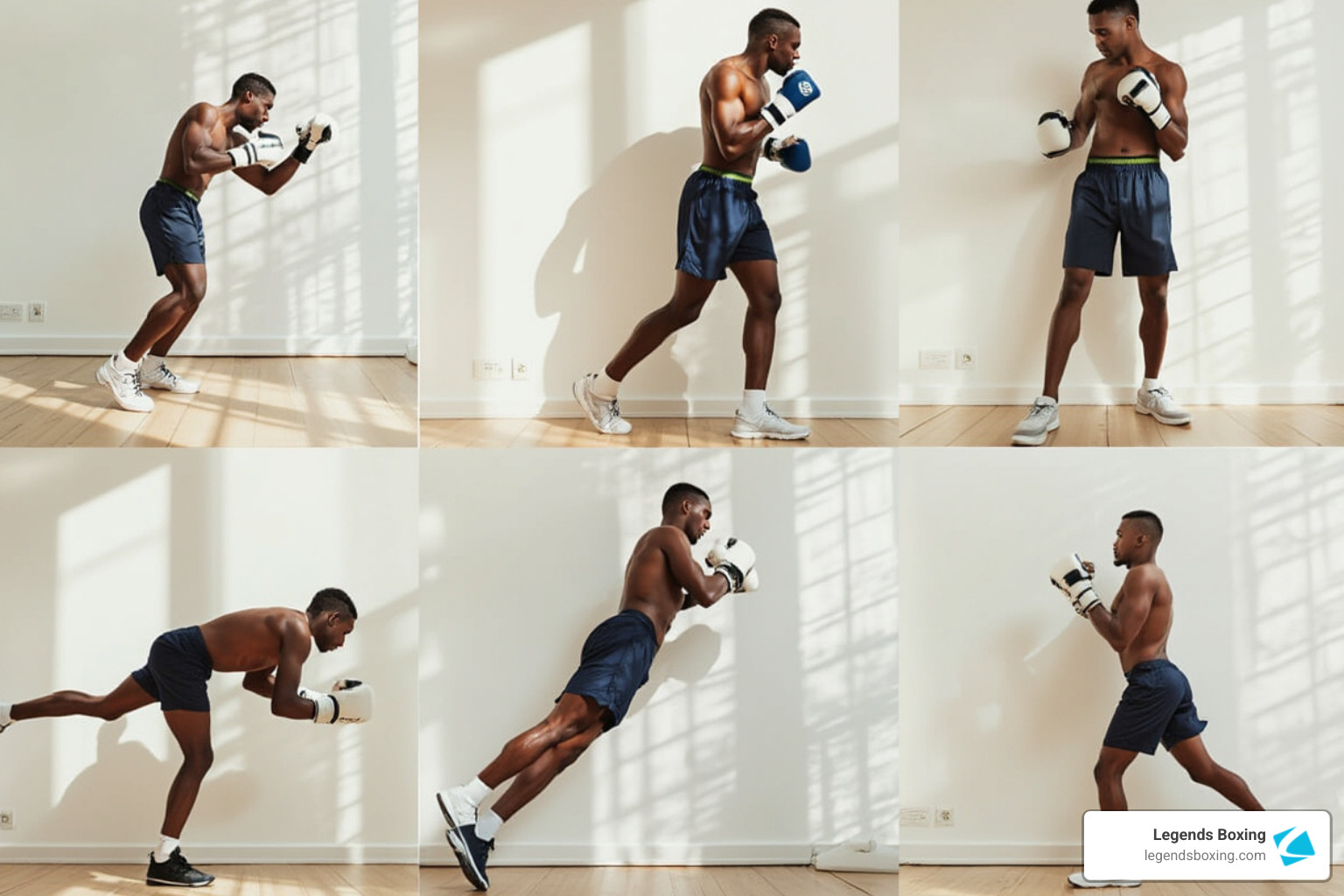
This deliberate preparation might feel like it's delaying the "real workout," but these few minutes of mindful movement create the perfect foundation for a safer, more effective at-home boxing workout with bag experience.
The Ultimate At-Home Boxing Workout With Bag
Now that you're warmed up and ready, it's time to dive into a structured workout. This framework can be adjusted for different fitness levels and time constraints.
Beginner Routine — 20 Minutes
This beginner-friendly routine follows a 3-minute round / 1-minute rest structure, mimicking a traditional boxing match pace:
Round 1: Fundamentals (3 minutes)
- Jab-Cross (1-2) combination: 45 seconds → Rest: 15 seconds
- 1-2-3 (Jab-Cross-Hook) combination: 45 seconds → Rest: 15 seconds
- 1-2-Body Shot: 45 seconds → Rest: 15 seconds
Round 2: Movement (3 minutes)
- Circle left while jabbing: 45 seconds → Rest: 15 seconds
- Circle right while throwing crosses: 45 seconds → Rest: 15 seconds
- Forward-backward movement with 1-2 combinations: 45 seconds → Rest: 15 seconds
Round 3: Power Focus (3 minutes)
- Power jabs (push through the bag): 45 seconds → Rest: 15 seconds
- Power crosses (rotate hips fully): 45 seconds → Rest: 15 seconds
- Power hooks (pivot on ball of foot): 45 seconds → Rest: 15 seconds
Round 4: Conditioning Blend (3 minutes)
- 10 seconds fast punches + 5 squats, repeat for 45 seconds → Rest: 15 seconds
- 10 seconds power punches + 5 push-ups, repeat for 45 seconds → Rest: 15 seconds
- Plank position punches (alternating arms): 45 seconds → Rest: 15 seconds
Round 5: Burnout (3 minutes)
- 30 seconds all-out punching → 30 seconds active recovery
- 30 seconds all-out punching → 30 seconds active recovery
- 30 seconds final push (maximum effort) → 30 seconds cool-down
One of our Legends Boxing members from Cache Valley shared: "When I first started this 20-minute routine, I could barely finish. Three weeks later, I was adding extra rounds and increasing intensity. The progress happens quickly!"
Structuring Rounds for Max Cardio & Strength
Work-to-Rest Ratios:
- Beginner: 30 seconds work / 30 seconds rest (1:1 ratio)
- Intermediate: 45 seconds work / 15 seconds rest (3:1 ratio)
- Advanced: 60 seconds work / 15 seconds rest (4:1 ratio)
Heart Rate Zone Training:
- Zone 2 (60–70% max HR): focus on technique, longer rounds, shorter rest
- Zone 3 (70–80% max HR): standard training, balanced work/rest
- Zone 4 (80–90% max HR): HIIT style, shorter intense work, longer recovery
Punch Count Goals:
- Beginner: 100–150 punches per 3-minute round
- Intermediate: 150–200 punches per 3-minute round
- Advanced: 200+ punches per 3-minute round
"I tell my students to think of rounds like intervals," explains our coach at Legends Boxing Saratoga Springs. "Each round should have a specific focus — speed, power, technique, or endurance — rather than just random punching."
Essential Techniques to Nail on the Bag
The Guard Position:
- Hands up protecting your face
- Elbows tucked to protect ribs
- Chin slightly tucked
- Knees slightly bent
The Six Basic Punches:
- Jab (1): lead hand straight punch, quick and snappy
- Cross (2): rear hand straight punch with hip rotation
- Lead Hook (3): lead hand horizontal punch with elbow at 90°
- Rear Hook (4): rear hand horizontal punch with full hip rotation
- Lead Uppercut (5): lead hand vertical punch starting low
- Rear Uppercut (6): rear hand vertical punch with knee dip
Power Generation Keys:
- Weight Transfer: shift weight between feet as you punch
- Hip Rotation: turn hips into punches, especially crosses and hooks
- Ground Force: push through the floor to generate power upward
- Relaxed Delivery: stay loose until the moment of impact
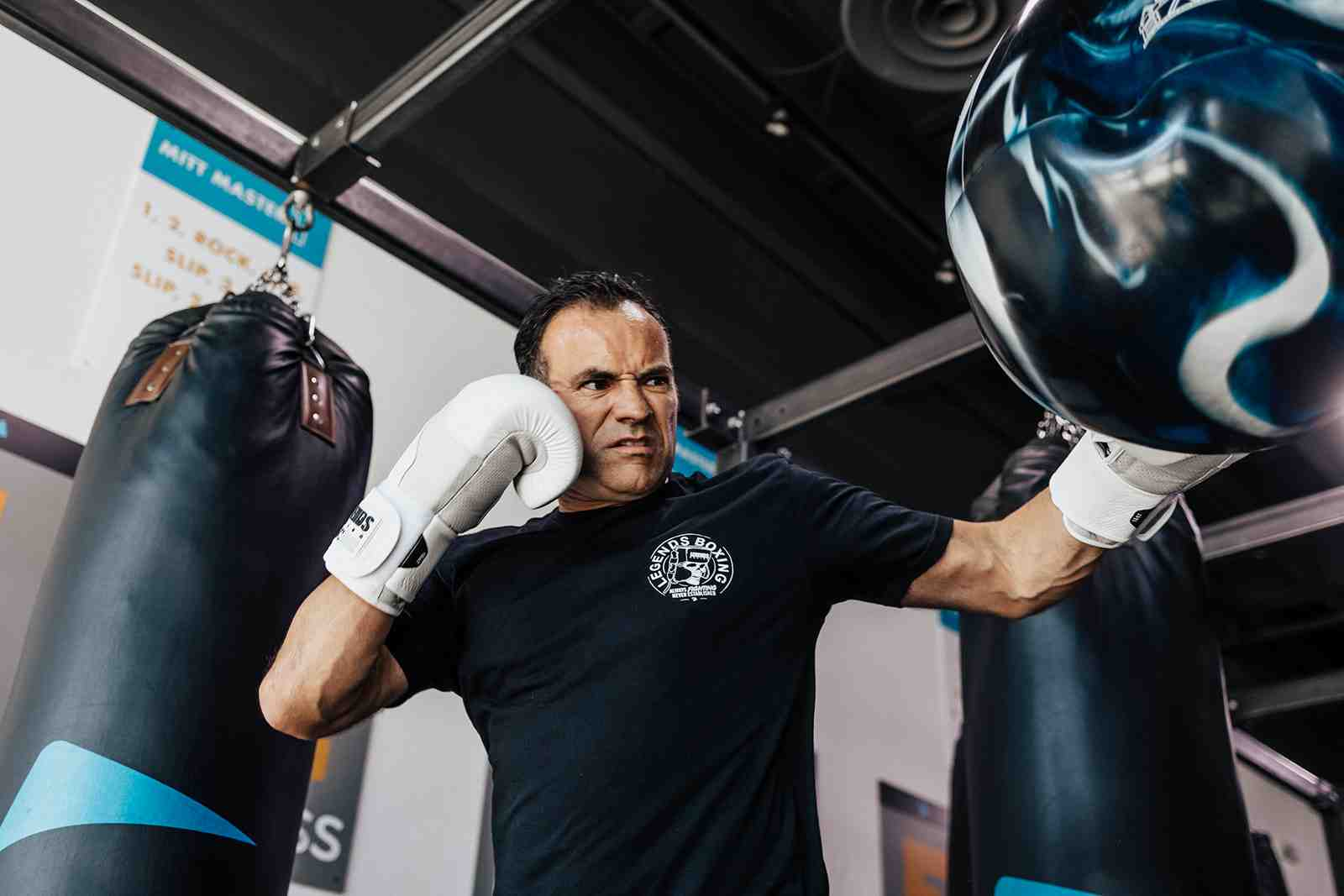
"The biggest mistake I see in home workouts is 'arm punching' — throwing punches using only arm strength," says our technique specialist at Legends Boxing Jordan Landing. "Real power comes from the legs and hips, with the arms as the delivery system."
Level Up: Advanced Combinations, Drills & Progress Tracking
Once you've mastered the basics of your at-home boxing workout with bag, it's time to kick things up a notch. These advanced methods will prevent plateaus and keep your progress moving forward.
Advanced Bag Combinations for Explosive Power
The Triple Threat (1-2-3-2): jab-cross-lead hook-cross. Add a slight duck after the hook to simulate avoiding an opponent's counter, then focus on explosively returning to position. Engages your core and legs fully.
Level Change Combo (1-2-3body-2): jab-cross to the head, drop down for a lead hook to the body, then finish with a cross to the head. Bend your knees for the body shot and quickly recover to standing — your quads will feel this one.
The Blitz (1-1-2-3-2): double jab-cross-hook-cross. Focus on making those initial jabs lightning quick to set up maximum power on your following punches.
Slip Counter Drill: imagine an opponent's punch, slip left, then counter with cross-hook (slip-2-3). Repeat on the right with hook-cross (slip-3-2). This mental visualization improves reaction time even when training solo.
Pivot Power Combo (1-2-pivot-3-2): jab-cross, pivot 45° left, hook-cross. The pivoting motion mimics ring movement while maintaining balance throughout.
"These advanced combinations aren't just about complexity," explains our head coach at Legends Boxing St. George. "They're about creating realistic fighting scenarios that engage your brain along with your body, which increases both calorie burn and skill development."
Track Progress & Stay Motivated
Tracking your progress doesn't need to be complicated:
- Punch trackers — wearable sensors that count punches and measure speed/power
- Round timer apps — boxing-specific interval timers with workout logging features
- Training journal — record your combinations, round counts, and how you felt
- Video recording — set up your phone once every few weeks to compare footage; you'll be amazed at subtle improvements you might have missed
- Heart rate monitoring — an objective way to track cardiovascular improvements over time
One Legends Boxing member from Meyerland created what he calls the "Century Club Challenge": "I started with a goal of 100 punches per minute. Each week, I try to add five more. It's simple but incredibly effective for pushing myself."
Setting performance records gives your workouts purpose. Challenge yourself to beat previous punch counts or complete more rounds than last time. Create milestone rewards — maybe new gloves after 20 consistent workouts or premium hand wraps when you master a difficult combination.
Common Mistakes to Avoid
Arm punching — relying solely on arm strength rather than engaging your entire body. Your power should come from the ground up, transferring through rotating hips into your punches.
Flat feet — standing static with weight evenly distributed. Instead, stay light on the balls of your feet, ready to move in any direction. This keeps your workout dynamic and burns more calories.
Dropping hands after punching — practice returning hands to guard position immediately after each punch. Make it automatic.
Holding your breath — develop a rhythm of exhaling sharply with each punch and inhaling during movement phases. This breathing pattern also helps engage your core.
Wrong distance from the bag — stand where your arms extend about 80% at impact. Too close robs power; too far causes dangerous overextending.
Wrist bending on impact — focus on proper knuckle alignment and ensure your wrists are wrapped correctly.
Overtraining — especially with power punches. Your body needs time to adapt, so follow a progressive program that builds intensity gradually.
"The heavy bag is honest — it will expose your technical flaws quickly," notes our instructor at Legends Boxing Lee Vista. "But that's also its value: immediate feedback you can use to improve."
Cool Down, Stretch & Recovery
The way you finish your at-home boxing workout with bag is just as important as how you start it. A proper cool-down isn't just a nice-to-have — it's essential for your progress and keeping injuries at bay.
Active recovery (2–3 minutes): gradually reduce your workout intensity rather than stopping abruptly. Try some light shadowboxing with decreasing speed, walk in place while taking deep breaths, or do some gentle arm swings and shoulder rolls. This helps your heart rate come down naturally and starts clearing lactic acid from your muscles.
"The most common mistake I see is people finishing their last round and immediately sitting down," says our recovery coach at Legends Boxing. "That's like slamming the brakes on a race car — not good for the engine or the driver!"
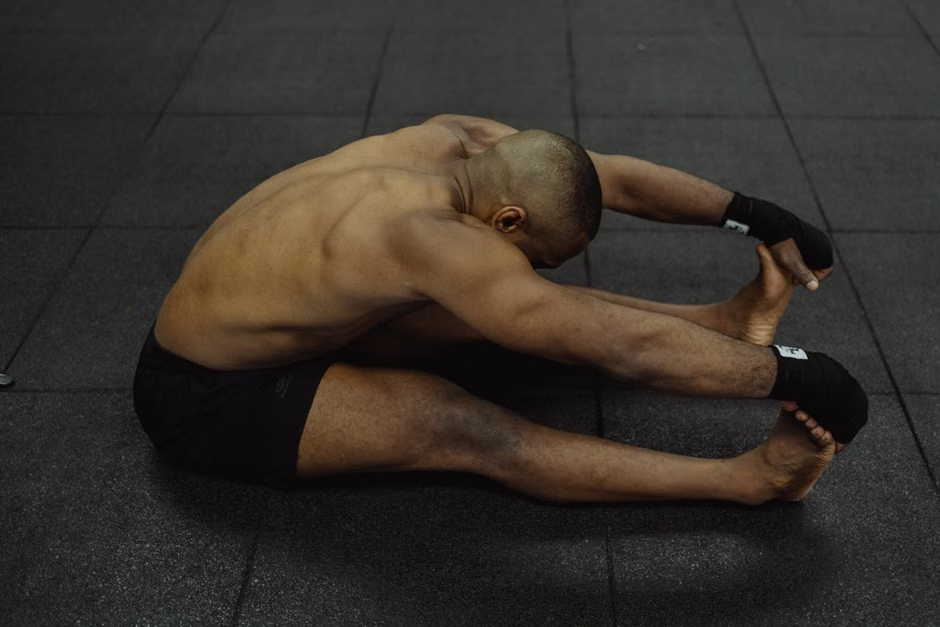
Static stretching (5–7 minutes): hold each stretch for about 30 seconds:
- Lat stretch — reach one arm overhead and gently lean to the opposite side
- Tricep stretch — place your hand behind your head and gently pull your elbow
- Chest stretch — extend your arm at shoulder height against a wall and rotate your body away
- Seated torso twist — cross one leg over the opposite knee and rotate toward that side
- Wrist flexor/extensor stretch — extend each arm and gently pull the fingers back
- Shoulder cross-body stretch — pull each arm across your chest
Beyond stretching:
- Hydration first — replace fluids lost during the session
- Post-workout nutrition — within 30 minutes, consume 20–30 grams of protein to jump-start muscle repair
- Contrast therapy — alternating hot and cold for hands and wrists can reduce inflammation
- Foam rolling — target tight spots in shoulders, back, and legs
- Sleep (7–9 hours) — this is when the real magic happens; your body repairs tissue, consolidates the neurological patterns you've been practicing, and prepares you to come back stronger
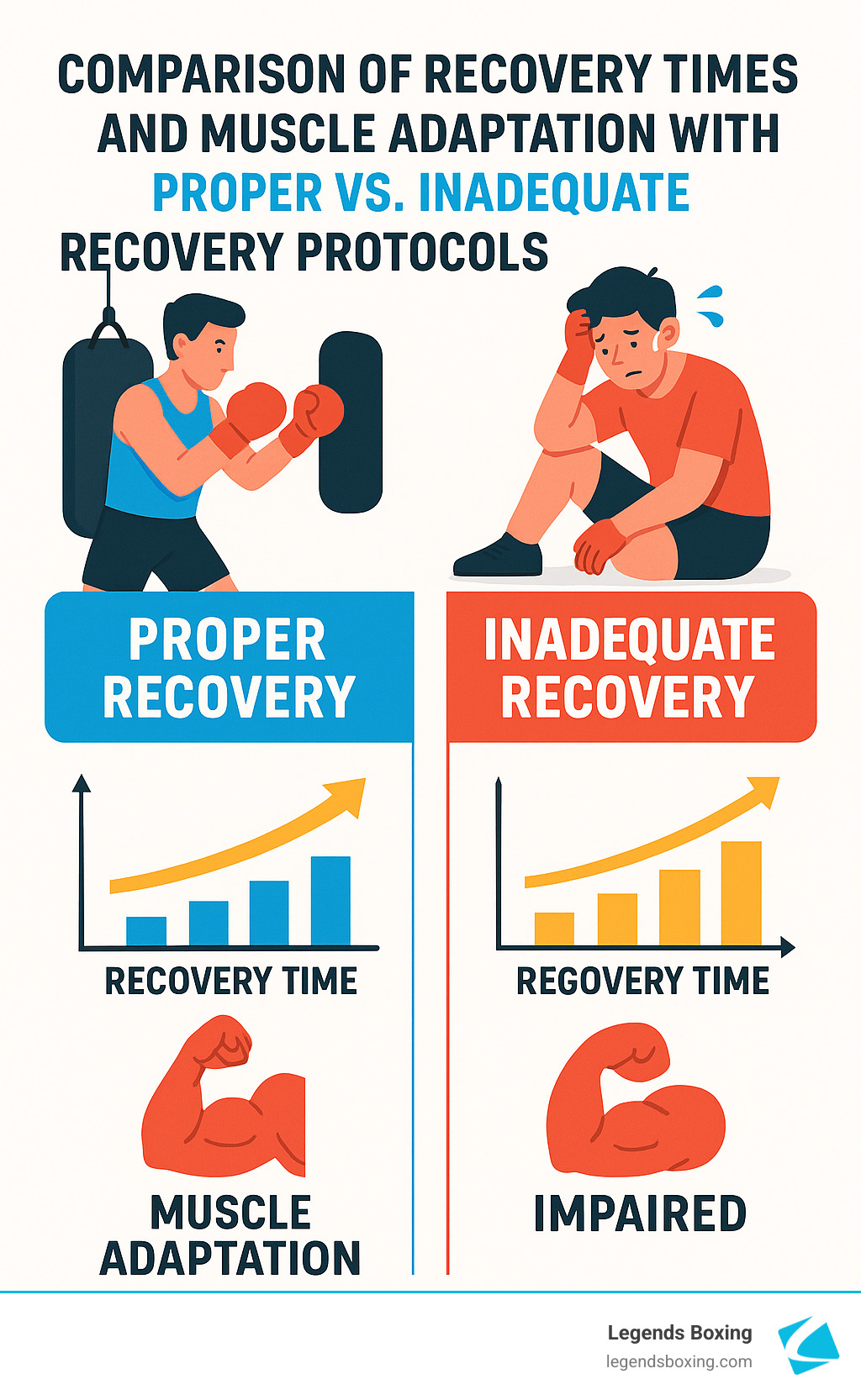
"Many people think the workout is where you get stronger, but that's actually when you're breaking down muscle," explains our head coach at Legends Boxing Orem. "It's during recovery — especially sleep — that your body rebuilds and adapts. Skip recovery, and you're only getting half the benefits of your hard work."
Consistent recovery practices won't just help you feel better tomorrow — they'll compound over time, allowing you to train more frequently and with higher intensity.
Frequently Asked Questions
What equipment do I need to start?
The bare minimum you'll need includes a punching bag (either freestanding or hanging), hand wraps to protect your wrists and knuckles, and a pair of boxing gloves (12–16 oz weight is ideal for most beginners).
As you get more comfortable with your routine, helpful additions include an interval timer, jump rope, exercise mat, and a mirror for checking your form.
"I always tell our new members that quality hand wraps and gloves should be your priority investment," shares our equipment specialist at Legends Boxing. "You can add the fancy stuff later, but protecting your hands from day one is non-negotiable if you want to make this a sustainable practice."
How often should I train on the bag each week?
Beginners: aim for 2–3 sessions per week, keeping each workout between 15–30 minutes. Give yourself at least one rest day between sessions to allow your body to adapt to these new movements and impacts.
As you progress: gradually increase to 3–5 sessions weekly, extending your workouts to 30–45 minutes each. Mix high-intensity days with technique-focused sessions to prevent overtraining.
"The number one mistake I see with enthusiastic beginners is doing too much, too soon," cautions our training director. "Bag work is more high-impact than people realize, especially on your shoulders and wrists. Listen to your body and remember that recovery isn't just important — it's when the actual improvements happen."
Can I stay motivated training alone without a partner?
One of the beautiful things about an at-home boxing workout with bag is that it's perfectly suited for solo training while still being incredibly engaging.
To keep motivation high during solo sessions:
- Follow along with online boxing workouts specifically designed for bag work
- Use interval timer apps with audio cues that tell you when to work and when to rest
- Create high-energy playlists with tempos matching your desired work rate
- Set specific punch count goals and try to beat them each session
- Join online communities where members share workouts and provide accountability
- Track your progress in endurance, technique, or body composition
"What surprises many people about boxing training is how intrinsically rewarding it becomes," notes our community manager at Legends Boxing. "Many of our most dedicated members prefer solo bag work — they describe it as their 'me time,' a space where they can focus completely on themselves, release stress, and disconnect from the constant demands of daily life."
Start Throwing — Your Bag Is Waiting
An at-home boxing workout with bag offers a unique combination of benefits that few other home workouts can match: cardiovascular conditioning, strength development, stress relief, and skill building — all in a time-efficient package.
The magic of bag work lies in progressive overload — gradually increasing duration, intensity, or technical complexity as your fitness improves. While many workout programs become stale after a few weeks, your heavy bag remains an endless source of challenge and growth. Each session can be different from the last, preventing the plateaus that derail so many fitness journeys.
At Legends Boxing, we've witnessed remarkable transformations through consistent bag work. One of our members at our Lehi location put it perfectly: "My heavy bag became my therapist, personal trainer, and stress ball all in one."
The beauty of this training method is its simplicity. You don't need complicated equipment or extensive space — just you, your bag, and the determination to push through those final rounds when your arms feel heavy. The heavy bag doesn't judge your technique, doesn't cancel on you last minute, and is always ready whenever you find those precious moments for yourself.
If you're craving the energy of group training or want expert eyes on your technique, find a Legends Boxing location near you across Utah, Florida, and Texas — our inclusive community welcomes all fitness levels, with absolutely no boxing experience required. Or book your first free class today and experience firsthand the energy that keeps our members coming back day after day.
Your boxing journey is uniquely yours. Some days you'll feel like a champion, landing every punch with perfect form and power. Other days, you'll just be proud you showed up. Both kinds of days count equally toward your progress. The heavy bag will be there through it all.