
Get Fighting Fit Fast With This Beginner Boxing Cardio Workout
A beginner boxing cardio workout combines high-intensity intervals with fun, stress-busting punches to deliver maximum results in minimal time — burning 300–500 calories in 30 minutes while building real boxing skills. This guide covers proper stance, the four fundamental punches, a complete 30-minute follow-along workout with round-by-round breakdowns, modifications for every fitness level, gear you need (spoiler: nothing to start), and a 4-week progression plan.
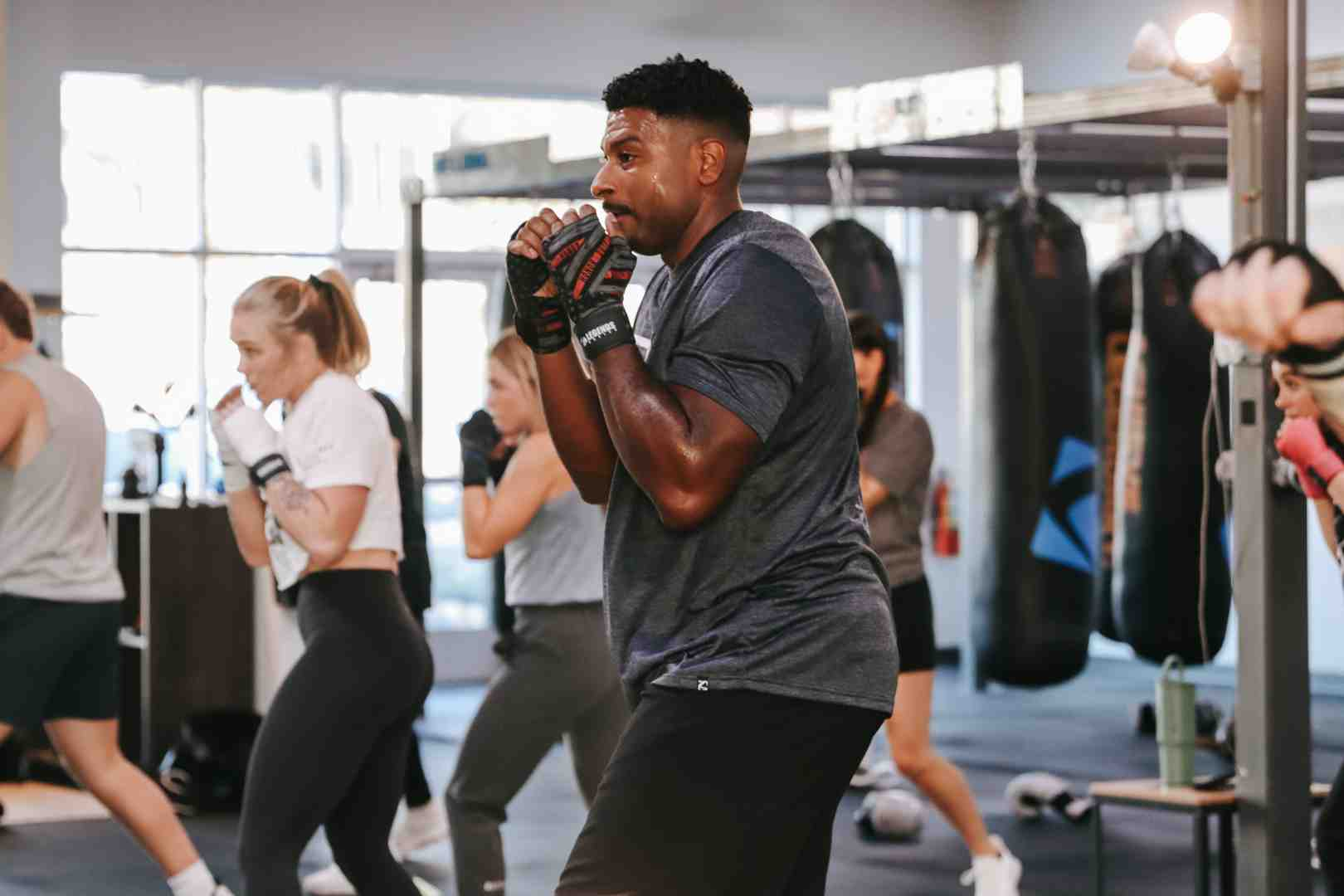
Why Boxing Cardio Is Perfect for Busy Professionals
A beginner boxing cardio workout combines high-intensity intervals with fun, stress-busting punches to deliver maximum results in minimal time. Here's what makes it ideal for newcomers:
Quick Results:
- Burns 300–500 calories in just 30 minutes
- Lifts heart rate into fat-burning zone rapidly
- Can burn up to 13 calories per minute at high intensity
Full-Body Benefits:
- Engages core, legs, and upper body simultaneously
- Improves cardiovascular endurance, speed, and coordination
- Builds muscle while torching calories
Beginner-Friendly:
- No equipment required — shadowboxing works perfectly
- Easy to modify for any fitness level
- Can be done at home in small spaces
Boxing isn't just another cardio routine — it's a total game-changer for busy professionals tired of boring treadmill sessions. Research shows that a 15-minute high-intensity boxing workout can burn the same or more calories than 30 minutes of steady jogging, making it the perfect solution when time is tight.
Unlike traditional cardio that only targets your cardiovascular system, boxing engages your entire kinetic chain. Most of your punching power actually comes from your legs and core, not your arms. This means you're building functional strength while getting an incredible cardio workout.
The stress-relief factor is huge too. There's something incredibly satisfying about throwing punches after a frustrating day at work. As one trainer puts it: "If you're frustrated and want to release pent-up aggression, there's nothing better than attacking a heavy bag."
I'm Robby Welch, National Head Coach at Legends Boxing with over two years of experience helping beginners find the transformative power of boxing cardio. I've personally guided hundreds of first-timers through their initial beginner boxing cardio workout sessions, watching them build confidence while achieving incredible fitness results.
Why Boxing Is the Ultimate Cardio for Beginners
There's something magical that happens when you throw your first punch in a beginner boxing cardio workout. Your heart rate shoots up, your whole body engages, and suddenly you're having way more fun than you ever thought possible while sweating buckets.
Boxing creates what fitness experts call the "perfect storm" of benefits. Unlike running on a treadmill where you're just moving your legs, boxing demands full-body coordination. Every punch starts from your feet, travels through your core, and explodes out through your fists. You're building strength, burning fat, and improving your reflexes all at once.
The stress-relief factor alone makes boxing worth trying. There's something deeply satisfying about channeling your frustrations into powerful punches. After a tough day at work, nothing beats the feeling of throwing combinations and watching your stress melt away with each strike.
Here's where the science gets really exciting: boxing naturally follows HIIT principles without you even thinking about it. Those traditional three-minute rounds push you into the anaerobic zone — that sweet spot where your body torches calories most efficiently. These intense bursts followed by brief rest periods maximize both your aerobic and anaerobic benefits.
What sets boxing apart from other cardio is the mental engagement. You're not mindlessly pedaling or watching the clock crawl by. Instead, you're learning combinations, improving your coordination, and building real skills. This mental focus makes workout time fly by and keeps you coming back for more.
The agility and coordination improvements happen fast too. Within just a few sessions, you'll notice better balance, quicker reflexes, and smoother movement patterns — benefits that carry over into everyday life.
Main Benefits of a Beginner Boxing Cardio Workout
Heart health — those intense rounds rapidly lift your heart rate and keep it elevated throughout the workout. This interval training pattern strengthens your cardiovascular system more effectively than steady-state cardio, giving you better endurance for everything else you do.
Weight loss happens naturally with boxing because you're burning massive calories during the workout plus getting the metabolic afterburn effect. Your body continues torching calories for hours after you finish punching. A solid 30-minute session can burn 300–500 calories, depending on how hard you push yourself.
Muscle definition from boxing is different from other cardio. Instead of just burning calories, you're actually building and toning muscle simultaneously. The resistance from punching, combined with all the bodyweight movements, creates lean muscle definition throughout your entire body — especially in your core, shoulders, and legs.
Can Boxing Help You Lose Weight & Build Muscle?
Absolutely. When you throw punches at high intensity, you're working in that anaerobic zone where your body burns stored energy and keeps burning calories long after you're done — the metabolic afterburn effect.
The muscle activation in boxing is incredible. Every single punch engages your core for stability, your legs for power generation, and your upper body for execution. You're essentially doing full-body resistance training while getting an amazing cardio workout.
Here's the calorie math that makes boxing so effective: during high-intensity boxing intervals, you can burn 13+ calories per minute. Compare that to walking at 3–4 calories per minute or even running at 8–10 calories per minute, and you can see why boxing delivers faster results in less time. That's why busy people love boxing — maximum impact in minimum time.
Gear & Space: What You Need to Start at Home
Here's some great news: you can start your beginner boxing cardio workout journey right now, even if you own absolutely nothing. Shadowboxing requires zero equipment and delivers an incredible workout. That said, a few simple items will make your training more comfortable and effective as you progress.
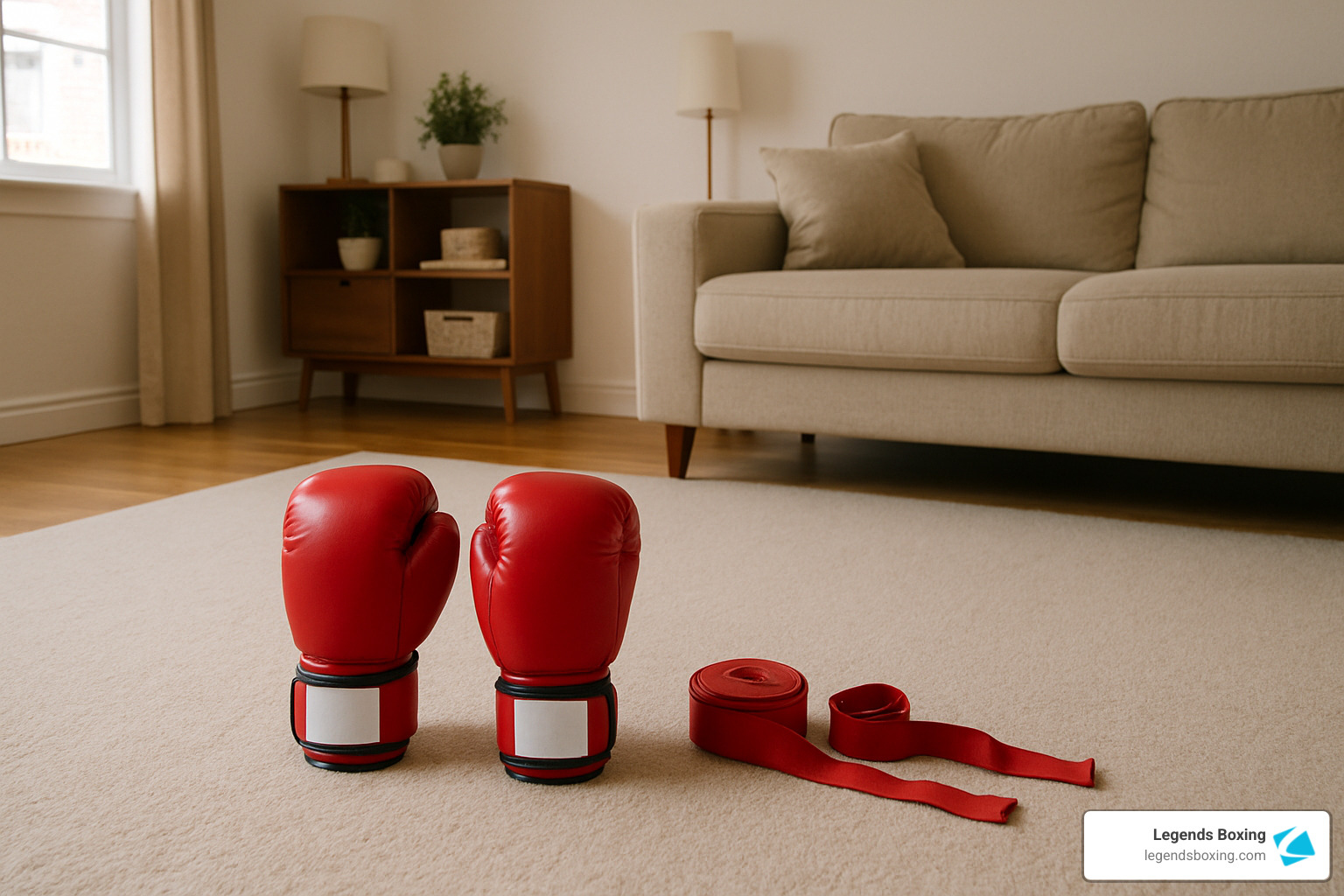
Absolute essentials to start:
- Hand wraps — protect your wrists and knuckles for under $10
- Boxing gloves (12–14 oz) — typically $20–40 for beginners
- Timer app — many are free; structures your rounds and rest periods properly
- Water bottle — boxing will have you sweating more than you expect
Nice additions once you're hooked:
- Jump rope for warming up and cardio finishers
- Yoga mat for floor exercises (~$15–25)
- Full-length mirror to check your form during shadowboxing
- Heavy bag (requires adequate ceiling height and a sturdy mounting point)
Space requirements: about 6×6 feet gives you plenty of space for shadowboxing and basic movements. If you plan to add a heavy bag later, make sure you have at least 8 feet of ceiling height and a solid mounting point.
Budget Checklist for First-Timers
- Week 1–2: $0. Start with shadowboxing and a free timer app. A small towel can protect your hands temporarily while you test the waters.
- After month 1: $30–50. Invest in proper hand wraps, lightweight training gloves, and a decent water bottle.
- Months 2–3: $50–100 total. Upgrade to quality boxing gloves, add a jump rope, and get a yoga mat.
The fanciest equipment won't make up for inconsistent training. Build the habit first, then upgrade your gear as your passion grows.
Safety First: Warming Up & Cooling Down
Boxing places unique demands on your shoulders, wrists, and core, so we need to prepare these areas properly — and skipping your warm-up isn't just risky, it's leaving results on the table.
Your 5-minute dynamic warm-up:
- Arm circles in both directions — 30 seconds each
- Hip circles
- Jumping jacks — 1 full minute
- Light shadowboxing — 2 minutes
- Gentle joint rotations for wrists, ankles, and shoulders
Cool-down (equally important for recovery):
- Deep breathing while raising and lowering your arms — 1 minute
- Chest and shoulder stretches — 2 minutes
- Hip flexor and quad stretches — 1 minute
- Gentle neck rolls and side bends
Hydration: the high intensity means you'll sweat significantly more than during steady-state cardio. Sip water during rest periods, and make sure you're well-hydrated before and after your session.
Master the Basics Before You Throw Down
Here's the truth about boxing: you can't punch your way to fitness without proper form. Too many eager beginners jump straight into throwing wild haymakers, only to end up with sore wrists, poor habits, and frustration.
Think of boxing fundamentals like learning to cook — you wouldn't attempt a soufflé before mastering how to crack an egg. The same principle applies to your beginner boxing cardio workout: nail the basics first, and everything else becomes so much easier.
Good technique isn't about looking like a pro. It's about staying injury-free while getting maximum results from every punch you throw. When you establish proper stance, guard, and punching mechanics from day one, you're setting yourself up for months of safe, effective training.
Your Boxing Stance Explained
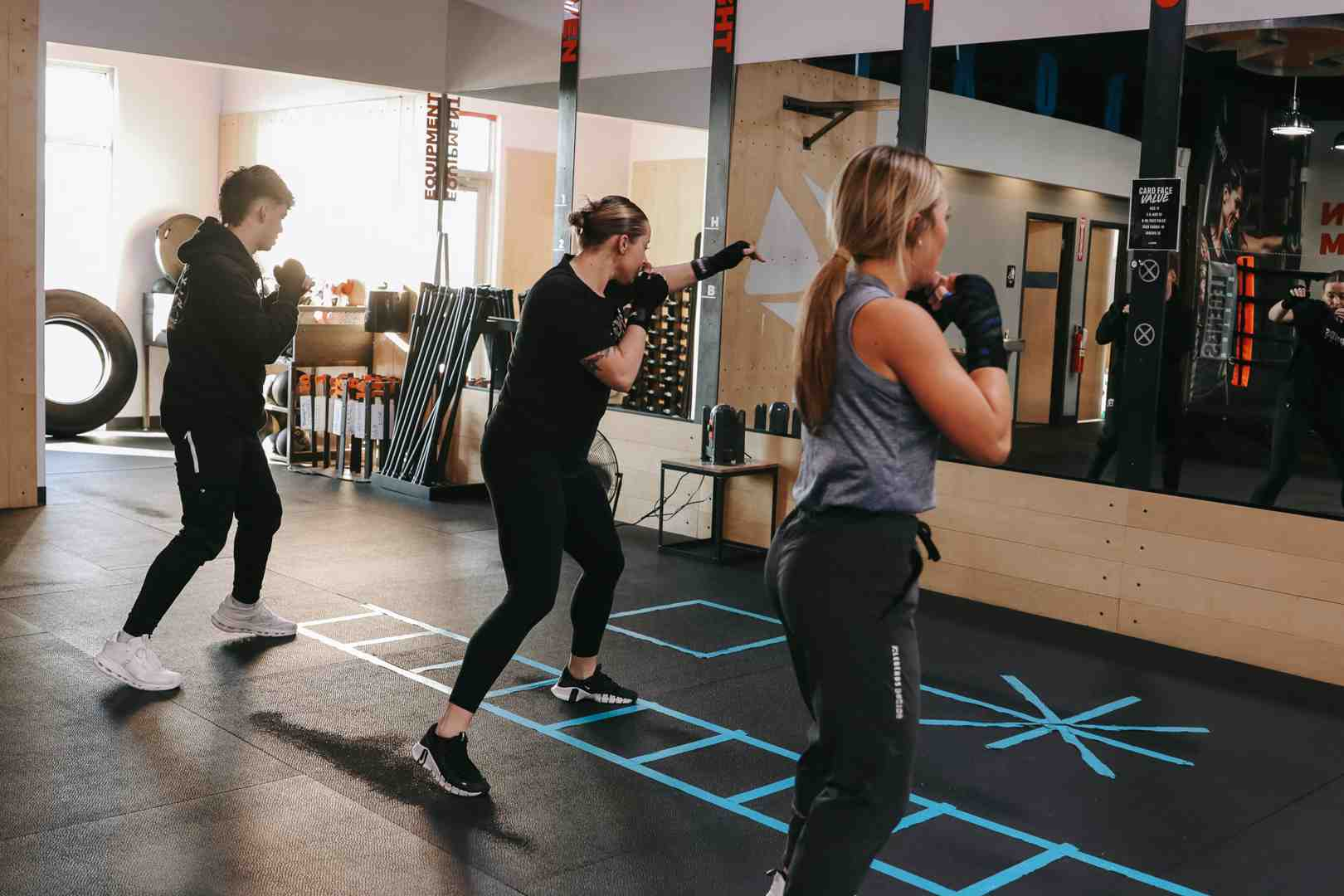
Your boxing stance is your home base — the position you'll return to after every combination:
Orthodox stance (right-handed fighters):
- Stand with feet slightly wider than shoulder-width
- Step your right foot back about 18 inches at a comfortable angle
- Left foot stays pointing forward; right foot turns out at ~45 degrees
Southpaw (left-handed): simply reverse this — right foot forward, left foot back.
Weight distribution: keep about 60% on your back foot and 40% on your front foot. This gives you stability for powerful rear-hand punches while staying mobile enough to move quickly.
Knee bend: soft and athletic, never locked straight — think of a tennis player waiting for a serve. Elbows: tucked naturally close to your ribs, creating a protective shell around your core.
The Four Fundamental Punches
Jab — extend your lead hand straight out from your guard position, rotating your fist so the palm faces down at impact. Fire it out and immediately return to guard position. Think of touching a hot stove — quick out, quicker back.
Cross — drive your rear hand straight toward your target while rotating your hips and shoulders like you're throwing a baseball. Your front foot can step slightly forward for extra reach, but the power comes from that hip rotation, not just your arm.
Hook — keep your elbow at 90 degrees and rotate your entire body like you're swinging a baseball bat. The punch travels in a circular path, and pivot on your front foot to generate that rotational power.
Uppercut — start with a slight dip at your knees. Drive upward with your fist (palm facing you), using your legs to generate that upward explosion. Keep the movement compact — a controlled upward strike, not a rocket launch.
Beginner Combinations
Once you've drilled the four punches, put them together:
- 1-1-2 (jab, jab, cross) — builds rhythm and gets your hands working together; the double jab sets up distance and timing while the cross delivers the power finish
- 1-2-3 (jab, cross, lead hook) — introduces circular punching and teaches you to change angles mid-combination
- 5-6 (lead uppercut, rear uppercut) — engages your legs heavily and builds incredible core strength; dip slightly with each uppercut
- Defensive movement between combos — practice simple slips (small head movements side to side) and ducks (bending at the knees) to keep you mobile and add extra cardio challenge
Start slowly with each combination, focusing on clean technique rather than speed or power. Ten perfect punches beat fifty sloppy ones every time.
The 30-Minute Beginner Boxing Cardio Workout (Follow-Along)
Ready to experience the beginner boxing cardio workout that transforms first-timers into boxing enthusiasts? This is the exact routine we use at Legends Boxing to introduce newcomers to the sweet science while delivering serious fitness results.
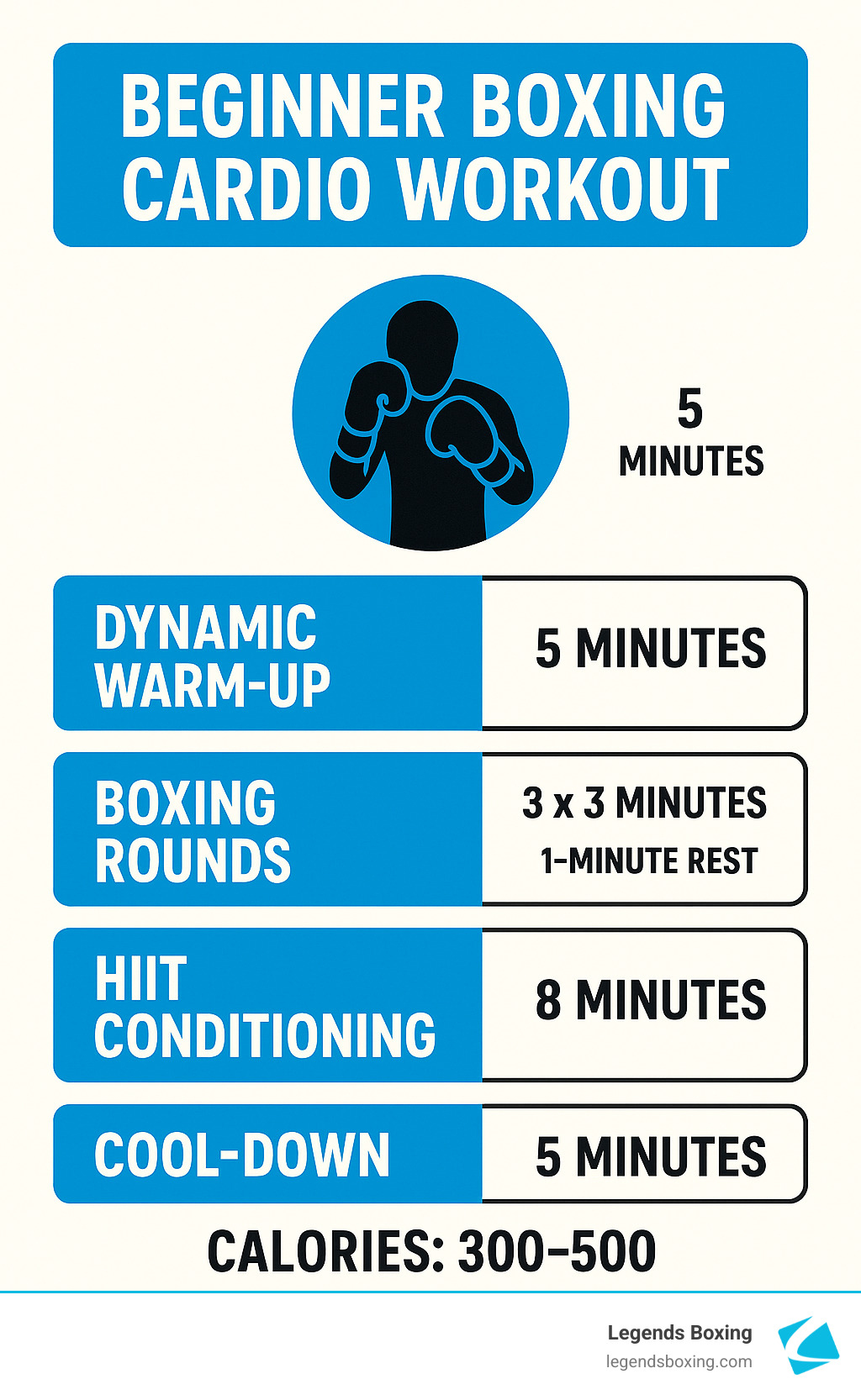
The structure follows traditional boxing training: 5-minute dynamic warm-up → three 3-minute boxing rounds with 1-minute rest periods → 8-minute HIIT conditioning block → 5-minute cool-down. This timing mirrors how professional boxers train, building both technique and cardiovascular endurance simultaneously.
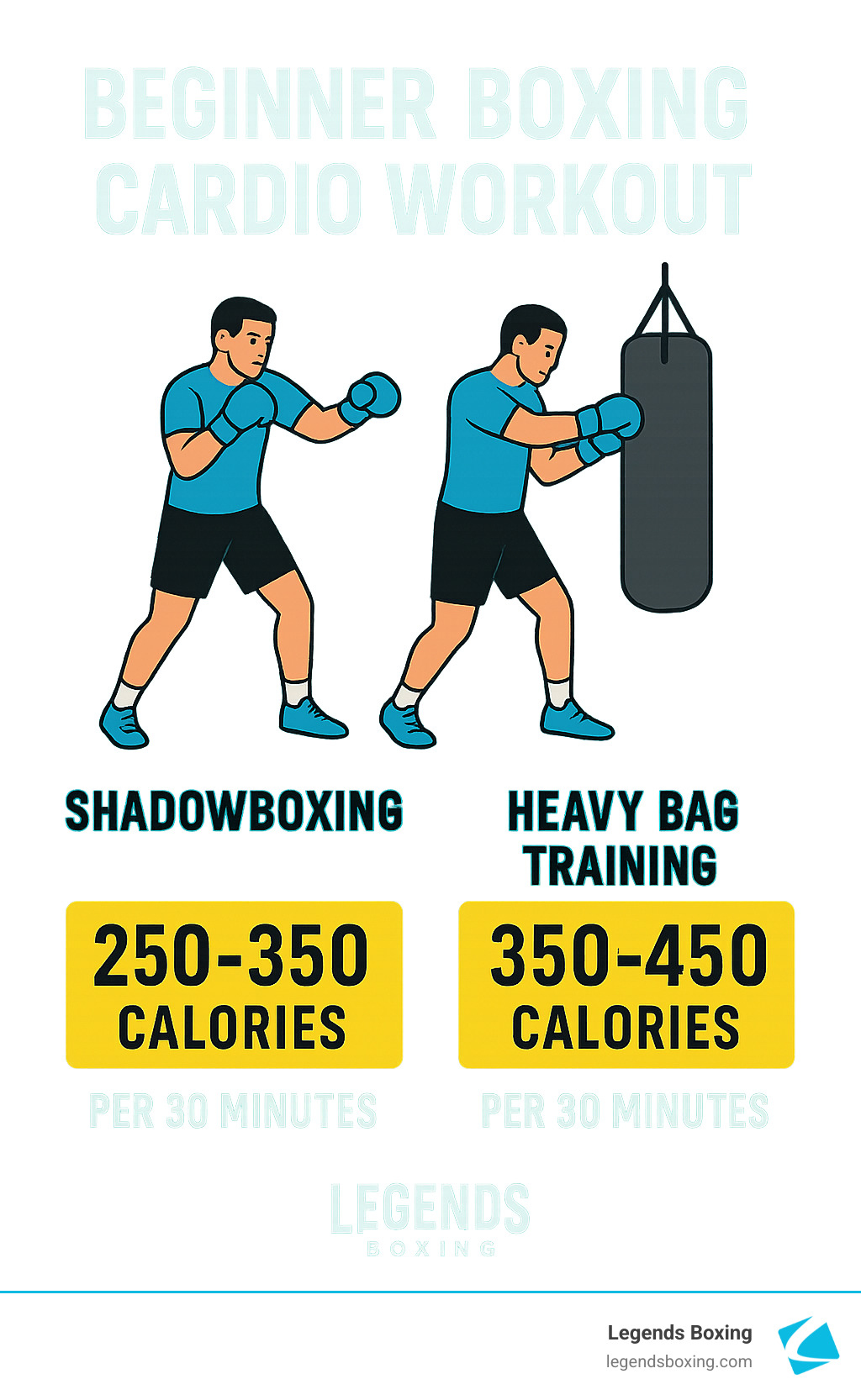
You can complete this workout through shadowboxing (no equipment needed) or progress to heavy bag work as you advance. Shadowboxing burns 250–350 calories in 30 minutes; heavy bag training cranks that up to 350–450 calories. Both options deliver incredible results.
Round-By-Round Breakdown
Round 1 — Technique Development (3 minutes)
Start with simple jabs for the first 30 seconds, concentrating on proper form and that satisfying snap back to guard position. Progress to jab-jab-cross combinations while adding forward and backward movement.
Around the 90-second mark, add squats between your jab-cross-jab-cross sequences — this builds the leg strength that generates real punching power. Finish with lead hook practice and freestyle combination work. Target: 200 punches minimum.
1-minute rest: light movement, deep breaths, or very light shadowboxing to stay warm.
Round 2 — Power Development (3 minutes)
Your muscles are warm, your technique is dialed in. Power jab-cross combinations should feel crisp and strong. Hook-cross-hook sequences teach you to flow between straight and circular punches naturally.
Mid-round: 30 seconds of plank jacks — your core needs that extra challenge. Power hooks with hip rotation are where you'll really feel the full-body engagement boxing delivers. Finish with a burn-out sequence — maximum intensity punching until the bell rings. Target: 200 punches minimum.
1-minute rest: stretch your shoulders and shake out your hands.
Round 3 — Speed & Conditioning (3 minutes)
Work in 15-second intervals of lightning-fast jab-cross combinations followed by 15 seconds of active recovery. Add mountain climbers for 30 seconds to keep your heart rate in the stratosphere.
Speed uppercuts challenge your coordination while building explosive leg power. Finish with freestyle combinations incorporating movement and footwork. Target: 220 punches minimum.
8-Minute HIIT Conditioning Block
| Exercise | Duration | Rest |
|---|---|---|
| Burpees | 1 minute | 1 minute |
| Boxer twists | 1 minute | 30 seconds |
| Squat thrusts | 1 minute | 30 seconds |
| Mountain climbers | 1 minute | 30 seconds |
Each exercise targets the specific fitness demands boxing places on your body.
Modifications for Every Fitness Level
Beginners: reduce punch goals to 150 per round, extend rest periods to 90 seconds, and focus purely on form rather than speed or power.
Low-impact options: replace jumping movements with step-touches, substitute burpees with squat-to-calf-raise movements, and reduce round duration to 2 minutes if needed.
Chair boxing: perform all upper body movements seated, focus on arm speed and coordination, and add resistance bands for strength development — same timing and intensity as standing participants.
Advanced progressions: add light dumbbells (2.5–5 pounds) during shadowboxing, increase punch goals by 50%, reduce rest periods to 30 seconds, and incorporate resistance bands.
Complementary Cardio & Strength Moves
Your beginner boxing cardio workout becomes even more effective when supported by:
- Running — builds the aerobic base that supports boxing endurance
- Jump rope — improves footwork, timing, and hand-eye coordination
- Sprint intervals — develop the explosive power needed for devastating punches
- Battle ropes — mimic the specific arm endurance demands boxing places on your body
- Core circuits (Russian twists, planks, dead bugs) — strengthen the powerhouse that connects your upper and lower body
- Bodyweight squats — build the leg power that drives every punch
- Push-ups — develop punching muscles and shoulder stability
- Pull-ups — balance all that pushing and improve the posture that keeps you confident in and out of the gym
The beauty of boxing cardio is how it integrates seamlessly with other fitness activities, creating a complete training program that keeps you engaged and progressing week after week.
Progress Tracking, Motivation & Common Mistakes
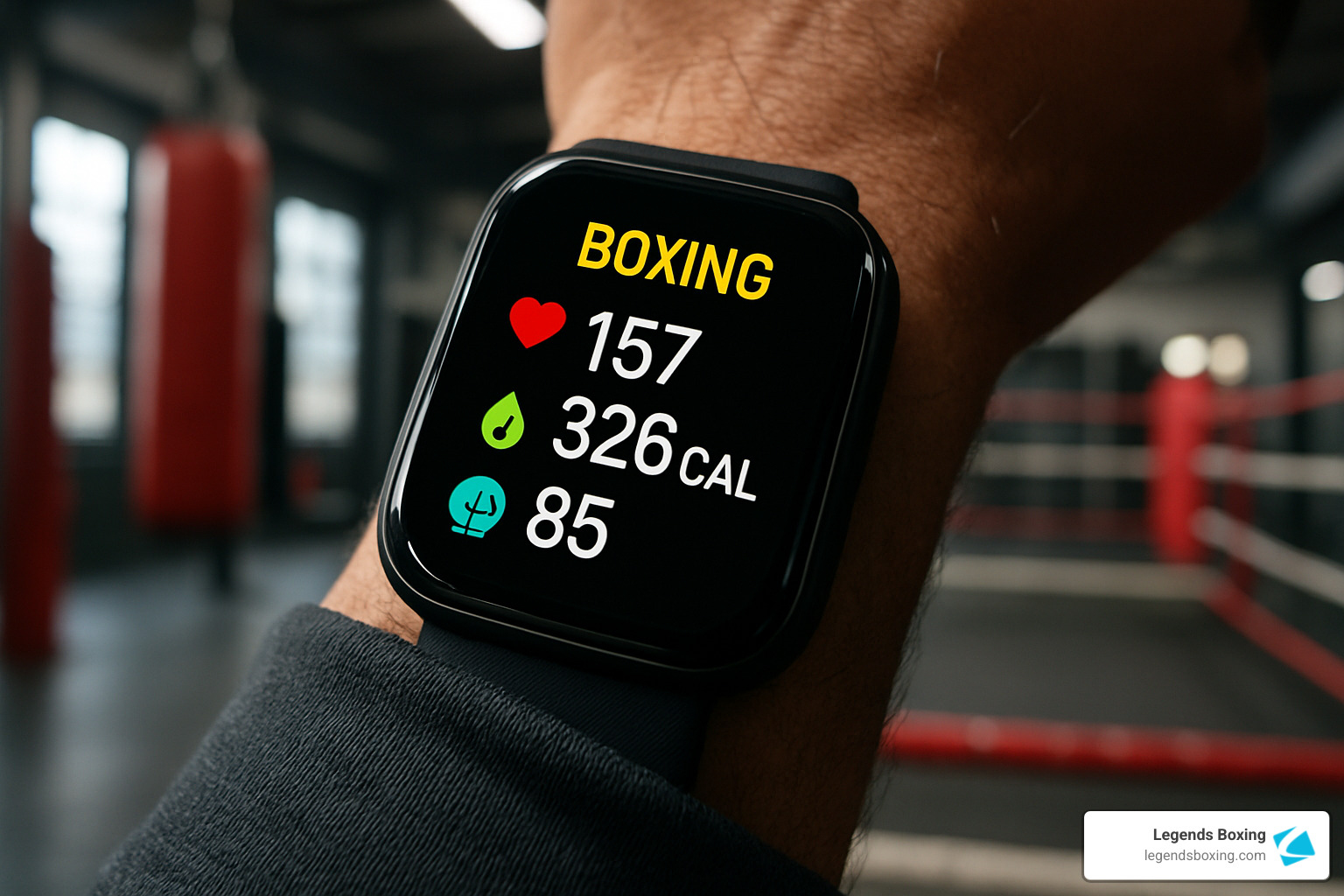
Starting your beginner boxing cardio workout journey is exciting, but tracking your progress keeps that momentum going strong.
What to track:
- Punch count per round — start at 150–200 punches per 3-minute round; within weeks most people hit 250+
- Heart rate recovery — notice how much faster you catch your breath between rounds as your fitness improves
- RPE scale — rate each workout 1–10; what felt like a crushing 9 in week one might feel like a manageable 7 by week three
Punch tracking apps make monitoring easier, though a simple workout journal works perfectly. Some people love seeing stats on fitness trackers; others prefer progress photos to track body composition changes over time.
Common Mistakes to Avoid
- Over-punching — the biggest beginner trap. 100 perfect punches beat 200 sloppy ones every time
- Dropping your guard — keep those hands up even during shadowboxing; you're building muscle memory
- Rounded shoulders — keep your chest open and shoulders back; it's the computer posture creeping into your boxing
- Bent wrists — wrist alignment matters enormously, especially on heavy bag work; bent wrists are injured wrists waiting to happen
- Inadequate rest days — boxing cardio is intense; your body needs time to rebuild stronger. More isn't always better
How Often Should You Do a Beginner Boxing Cardio Workout?
Start with 2–3 sessions per week. Your body needs time to adapt to these new movement patterns.
| Phase | Sessions/Week | Intensity (RPE) | Focus |
|---|---|---|---|
| Weeks 1–2 | 2–3 | 6–7 / 10 | Foundation building, mastering basics |
| Weeks 3–4 | 3 | 7–8 / 10 | Increasing intensity, feeling the rhythm |
| Month 2+ | 3–4 | 7–9 / 10 | Endurance, advanced combos, body composition |
Key rule: maintain a 24–48 hour recovery window between boxing sessions. Use off days for gentle walks or light stretching.
Staying Motivated Week After Week
- Set weekly punch count goals that challenge you without overwhelming — maybe 200 punches per round this week, 220 next week
- Create music playlists with strong beats that help you maintain timing during combinations
- Find an accountability partner or join a class — there's something powerful about having someone ask "how was your workout today?"
- Try mini-challenges: a "perfect form day" where you focus entirely on technique, or a "punch-a-thon" goal for higher output
- Track and celebrate small wins — the people who stick with boxing long-term aren't necessarily the most athletic; they're the ones who celebrate every improvement, no matter how small
Frequently Asked Questions
Is boxing hard on the joints?
This is the #1 concern from newcomers, and the good news is boxing cardio is actually gentler on your joints than you might think. When you're starting with a beginner boxing cardio workout, you're beginning with shadowboxing — which means zero impact on your joints. You're moving through space, throwing punches at air, completely different from running on concrete.
The key is proper progression: start with shadowboxing, then gradually introduce light bag work with proper hand wraps and gloves. Your wrists, elbows, and shoulders actually get stronger over time as they adapt. That said, technique matters enormously — poor punching form can stress your joints. Always warm up thoroughly, keep your wrists straight when punching, and listen to your body.
Can I get results without a bag or partner?
Absolutely. Some of the most successful beginners started with nothing but an empty room and determination.
Shadowboxing is incredibly effective for cardio conditioning. You're still throwing hundreds of punches, moving your feet, engaging your core, and working up a serious sweat. The calorie difference is real but not dramatic — 250–350 calories versus 350–450 calories in 30 minutes.
Here's what makes shadowboxing so powerful: you can focus completely on technique. Without the distraction of hitting a target, you can perfect your form, work on combinations, and really dial in your movement patterns. Many professional boxers spend significant portions of their training shadowboxing for exactly this reason. Plus, it's incredibly convenient — no equipment to set up, no noise concerns for neighbors.
How long before I see improvements in fitness and weight loss?
Most beginners report feeling different within their first week and seeing visible changes by week three.
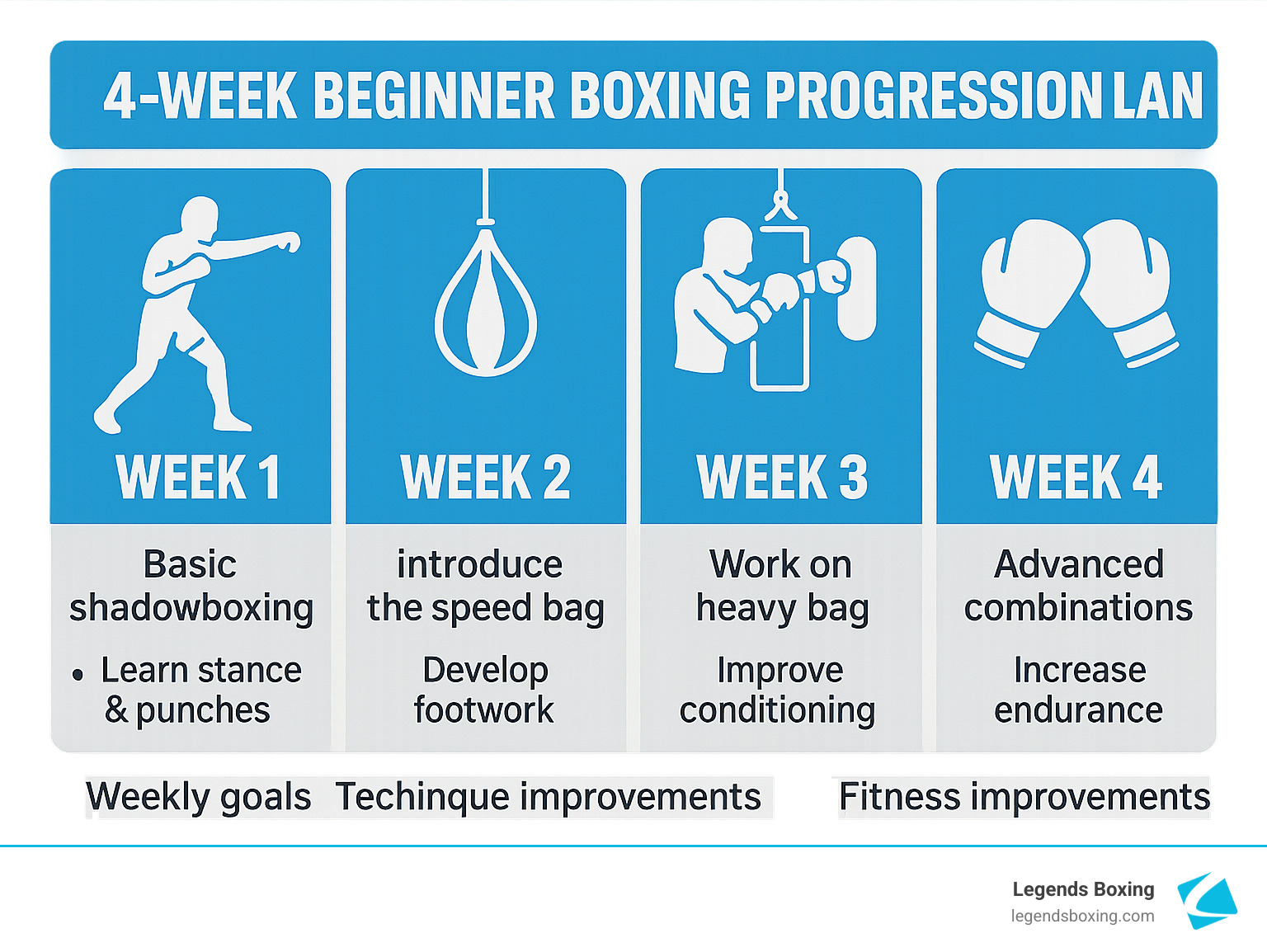
- Weeks 1–2 ("energy revolution"): better sleep, more energy, less stress, improved coordination
- Weeks 3–4: rounds you were gasping through become manageable; initial body composition changes
- Month 2: endurance takes a major leap, muscle definition appears in arms and shoulders, weight loss becomes very noticeable with good nutrition
- Month 3+: significant strength gains, advanced combination mastery, major body composition changes — this is when friends and family start giving compliments
The secret: consistency beats intensity every time. Three moderate boxing workouts per week will deliver far better results than one brutal session followed by a week on the couch.
Start Your Boxing Journey Today
Your beginner boxing cardio workout journey starts with that first jab you throw in your living room. Right now, you have everything you need to begin: proper stance, basic punches, a complete 30-minute workout, and realistic expectations about what comes next.
Boxing cardio isn't just another fitness trend — it's a complete game-changer that delivers serious results while actually being fun. When you're throwing combinations, those 30 minutes fly by faster than any treadmill session ever could. The numbers don't lie: 300–500 calories burned in half an hour, plus metabolic afterburn that keeps working hours later.
Your first beginner boxing cardio workout might feel awkward. Your punches might look more like gentle waves than powerful strikes. That's perfectly normal — every professional boxer started exactly where you are right now, throwing clumsy jabs and trying to remember which foot goes where.
Consistency over perfection: show up, throw punches, and trust the process. Your technique will improve, your endurance will build, and your confidence will soar. Boxing teaches you something gyms can't — how to fight through discomfort and come out stronger. That mental toughness transfers to everything else in your life.
Find your nearest Legends Boxing location across Utah, Florida, and Texas — or book your first free class today. Our coaches specialize in taking complete beginners and turning them into confident fighters. We'll guide you through every punch, cheer your progress, and help you find the champion inside.
Remember: champions aren't built overnight, but they're built every single day. Your boxing story starts with that first punch. Throw it today.