
Bagging the Basics — Beginner Boxing Workout at Home With a Bag
A beginner boxing workout at home with a bag delivers everything busy professionals need — stress relief, full-body conditioning, and serious calorie burn without a crowded gym. This guide covers choosing and setting up the right bag, mastering the six core punches, a complete four-round workout with warm-up and cool-down, safety and progression tips, and what to do if you don't own a bag yet.
Why Punching a Bag is the Ultimate Home Workout
A beginner boxing workout at home with bag delivers everything busy professionals need: stress relief, full-body conditioning, and serious calorie burn without stepping foot in a crowded gym.
Quick Start Guide:
| Equipment needed | 50–150 lb heavy bag, 12–16 oz gloves, hand wraps |
| Workout duration | 15–30 minutes for beginners |
| Training frequency | 2–3 times per week |
| Basic structure | 2–3 minute rounds with 30–60 second rest |
| Power level | Start at 50–75% intensity |
| Essential combos | Jab-Cross (1-2), Double Jab-Hook, body shots |
Boxing workouts torch up to 700 calories per hour while building bone density — something you can't get from running or cycling. The mental focus required to execute combinations means you'll never zone out like you do on a treadmill.
Robby Welch, National Head Coach at Legends Boxing, has helped thousands of beginners find the power of boxing fitness through nationwide coaching programs.
Why Punching a Bag Beats Boring Cardio
Let's be honest — most cardio workouts are mind-numbingly boring. But when you step up to a heavy bag, something magical happens. You're not just moving your body; you're engaging every muscle from your toes to your fingertips in one explosive, satisfying movement.
Think boxing only works your arms? That's the biggest myth in fitness. When you throw a proper cross, you're pushing off your back foot, rotating your hips, engaging your core, and driving through your shoulder. It's a full-body workout disguised as stress relief.
Heavy bag training naturally mimics HIIT without the torture of burpees or mountain climbers. You throw explosive combinations for 2–3 minutes, rest for 30–60 seconds, then repeat. This interval structure keeps your metabolism elevated for hours after you finish. A 20-minute session can torch the same calories as 45 minutes on a treadmill — and it's actually fun.
Bone density is a benefit your spin class can't offer. Scientific research shows that female boxers maintain high bone mineral density despite low body fat and high energy expenditure. The impact of striking builds stronger bones — something you'll never get from swimming or cycling.
The mental health benefits might be even better than the physical ones. There's something deeply therapeutic about channeling your frustration into controlled, powerful strikes. Bad day at work? Take it out on the bag. You'll walk away feeling refreshed and mentally clear.
Key Benefits for New Boxers
Confidence builds faster through bag work than any other training method. When you land your first solid jab-cross combination, you feel the power you're capable of generating — and that confidence carries into every area of your life.
Core strength is inevitable when you box correctly. Every punch requires core engagement to transfer power from your legs through your torso. After just a few sessions, you'll notice better posture and less back pain from sitting at a desk all day.
Fat loss accelerates because boxing combines strength training with cardiovascular conditioning. You're building lean muscle while burning calories at an elevated rate — changes in body composition come faster than with traditional cardio alone.
Setting Up a Safe & Effective Home Boxing Space
Your equipment choices and setup directly impact both safety and results. Let's start with the star of the show — your heavy bag.
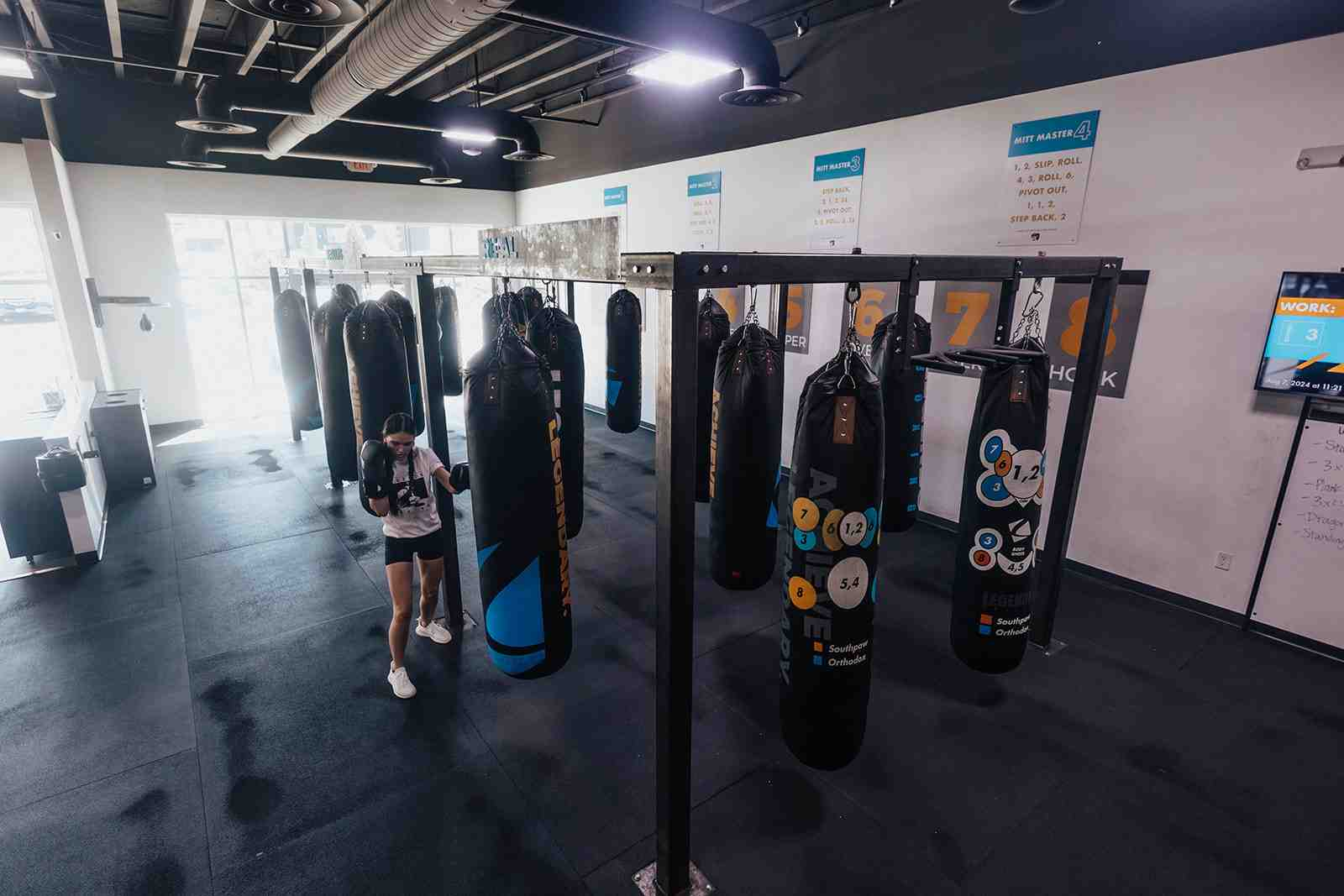
Bag sizing rule: most home boxing bags weigh between 50 and 150 pounds. Choose a bag that's roughly half your body weight. If you weigh 160 pounds, an 80-pound bag gives you the perfect resistance for powerful combinations without being too heavy to move properly.
Hanging vs. freestanding:
| Feature | Hanging Bag | Freestanding Bag |
|---|---|---|
| Installation | Requires ceiling mount | No installation needed |
| Movement | Natural swing/rebound | Minimal movement |
| Space needed | Less floor space | More floor space |
| Authenticity | Most realistic feel | Good for beginners |
| Portability | Fixed location | Easy to move |
| Cost | Lower ongoing | Higher initial |
Ceiling-mounted bags give you the authentic boxing gym feel with natural swing and rebound that makes your combinations flow beautifully — but they need solid structural support. Freestanding bags are perfect if you're renting or don't have suitable ceiling joists.
Non-negotiable gear:
- Hand wraps — never hit the bag without them; they prevent wrist injuries and knuckle damage
- 12–16 oz boxing gloves — heavier gloves protect your hands better and add resistance
- Rubber floor mats — protect your flooring, reduce noise, and give you better traction during footwork
- Timer app — keeps your rounds structured; look for boxing-specific timers with work/rest intervals
- Water bottle and towel — boxing generates serious sweat
Budget tip: Start with basic hand wraps and gloves for under $50. You'll be throwing proper punches in no time.
Mastering the Fundamentals Before You Swing
Your boxing stance is everything — your home base, the place you always return to between combinations. Stand with feet shoulder-width apart, non-dominant foot slightly forward, both feet at roughly 45-degree angles to create a stable platform.
Guard position: hands up at cheekbone level with elbows tucked close to your ribs. This protects your face and body while keeping your hands ready to strike. Relax your shoulders — tense shoulders are slow shoulders.
Hip rotation is your secret weapon. Every effective punch starts from the ground up — your feet, legs, and hips generate the power, while your arms simply deliver it. Beginners who understand this throw harder punches than those who try to muscle everything with their arms.
Breathwork is a game-changer: inhale as you set up to throw a punch, then exhale sharply on impact. This breathing pattern maximizes your power while preventing you from holding your breath during intense combinations.
The Six Punches — Your Boxing Vocabulary
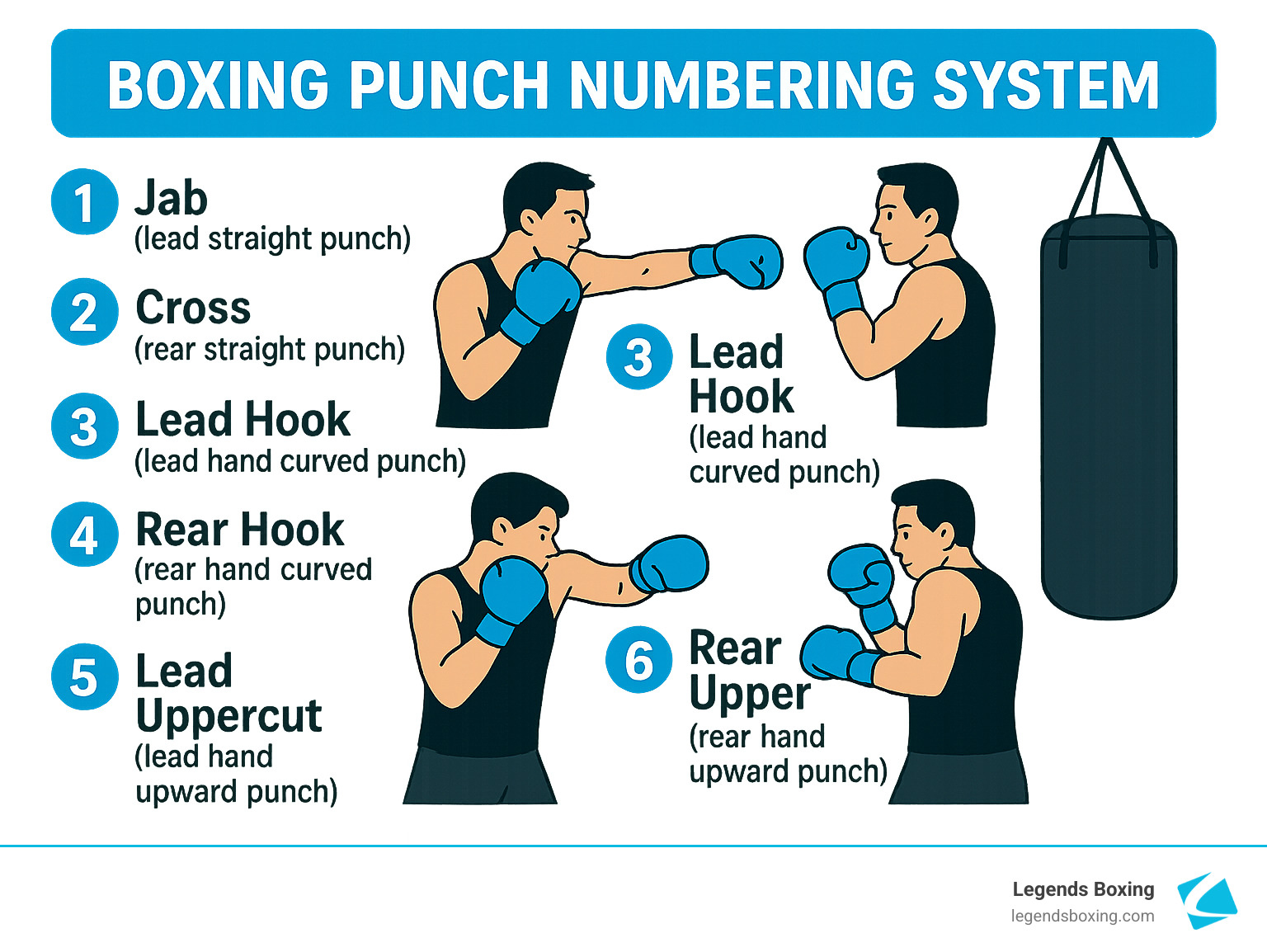
The Jab (1) is your best friend — fast, straight, and sets up everything else. Drive off your back foot, rotate your lead shoulder forward, and snap that fist straight out. Then snap it back to guard immediately. The jab isn't about power; it's about speed and accuracy.
The Cross (2) is where knockout power lives. Push hard off your back foot, rotate your hips and shoulders, and drive your rear hand straight through the target. Your shoulder should actually touch your chin at the end of the punch — it's your whole body working together.
Hooks (3 and 4) are curved punches that attack from the side. Keep your elbow parallel to the ground and rotate your entire body like you're swinging a baseball bat. The power comes from torque and hip rotation, not from muscling it with your arm.
Uppercuts (5 and 6) are upward strikes targeting the chin or body. Bend your knees slightly and drive upward with your legs while rotating your torso — think of scooping ice cream rather than just lifting your arm straight up.
Key rule for all punches: snap, don't push. Fast, explosive movements followed by immediate retraction are far more effective than slow, heavy pushes. Your legs initiate, your core transfers, your arms deliver.
The Beginner Boxing Workout at Home With Bag
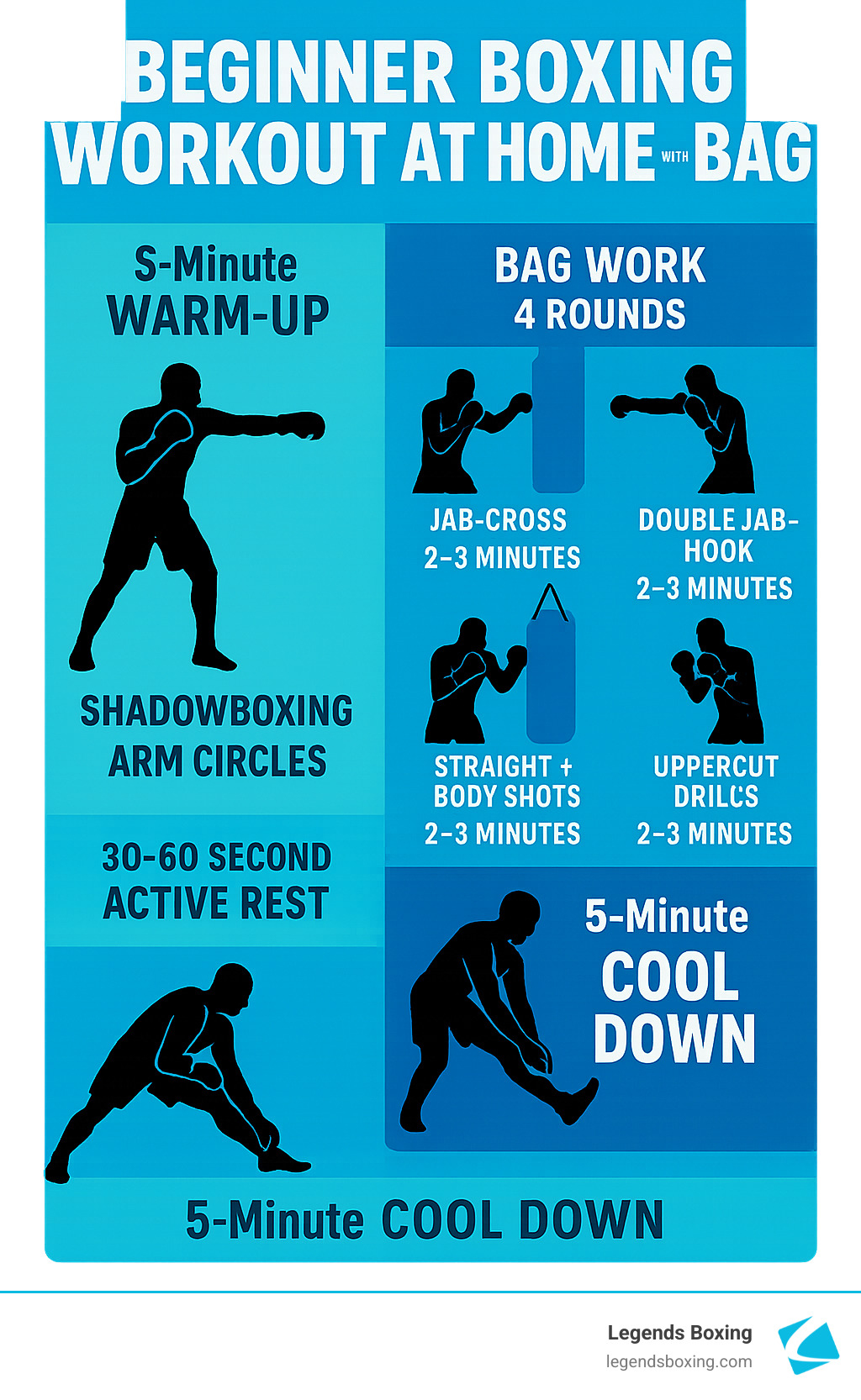
This workout follows the same round structure professional boxers use, scaled perfectly for beginners. Four rounds, each lasting 2–3 minutes with 30–60 second rest periods — total workout time: 15–30 minutes.
Start at 50–75% power. This isn't about knocking the bag across the room. It's about building proper form, conditioning your hands and wrists, and developing that satisfying rhythm that makes boxing addictive. Even at moderate intensity, you'll be surprised how quickly your heart rate climbs.
Warm-Up (5 Minutes)
Never skip your warm-up — five minutes of preparation saves weeks of recovery time.
- 2 minutes shadowboxing — basic jab-cross combinations with smooth, controlled movements
- 2–3 minutes jump rope (or simulate the bouncing motion in place) — builds the light, rhythmic footwork that separates boxers from people who just swing their arms
- 30 seconds arm circles forward + 30 seconds backward — crucial for shoulder health; gradually increase circle size
- 30 seconds high knees + 30 seconds butt kicks — fully activate your legs before throwing punches
Round 1: Jab-Cross-Body Shot Foundation (3 minutes)
This round builds your foundation with the jab-cross (1-2). Start with head-level punches, then drop down for body shots. Make real level changes by bending your knees, not just dropping your arms.
Work for 45 seconds, then perform mountain climbers for 15 seconds as active rest. This keeps your heart pumping while giving your arms a quick breather. Repeat throughout the round.
Round 2: Double Jab-Bob and Weave-Lead Hook (3 minutes)
Now we're adding defensive movement. Throw two quick jabs, perform a subtle bob-and-weave (ducking slightly right then left), then come up throwing a lead hook. This combination teaches you to blend offense and defense seamlessly.
The bob-and-weave should be subtle upper-body movement — not dramatic ducking that throws you off balance. Keep your hands up and let your shoulders do most of the work.
Round 3: Straight Punches with Power Body Shots (3 minutes)
Time to increase power output while maintaining control. Focus on straight punches thrown with more authority, followed by deliberate body shots aimed at the solar plexus area of the bag.
Your body shots should feel different from head shots — heavier and more deliberate. Drive them with full hip rotation and a slightly downward angle. Use push-ups as your active rest between 45-second work intervals.
Round 4: Uppercut Burnout Finish (3 minutes)
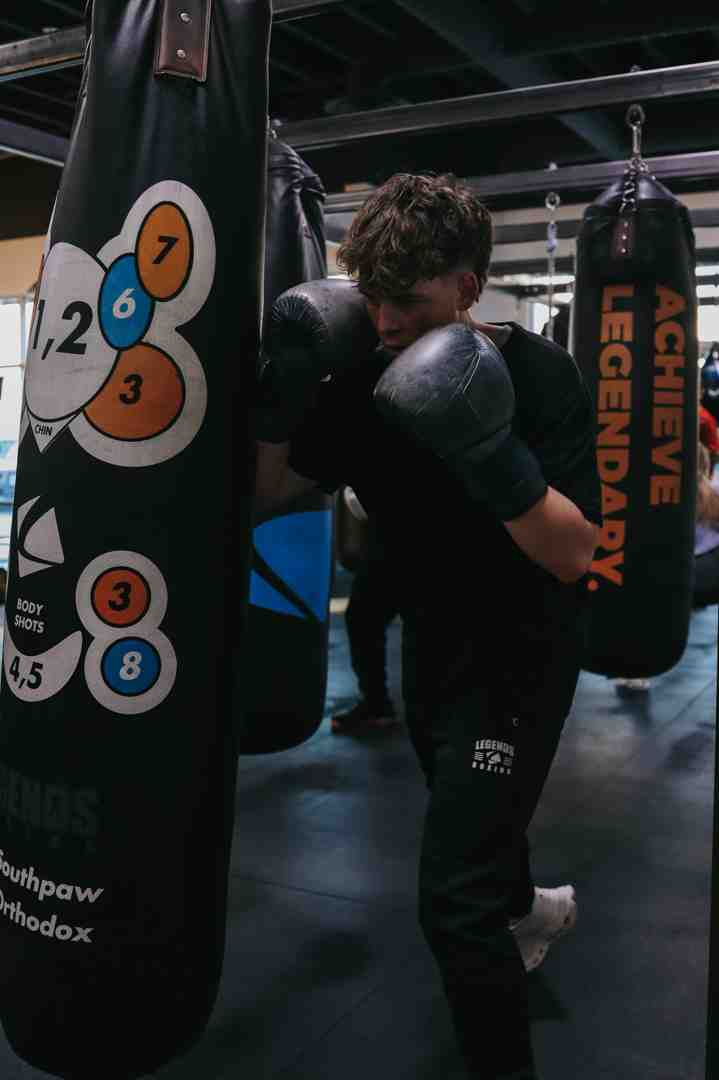
This is your burnout round — time to empty the tank. Focus on uppercuts thrown with maximum power, alternating between lead and rear hands. Really drive upward with your legs and core, like you're scooping under an opponent's chin.
Give everything you have left. End with 30 seconds of straight punches at maximum speed to completely exhaust your arms and shoulders.
Between each round, rest for 60 seconds or perform light shadowboxing. Hydrate, catch your breath, and mentally prepare for what's coming next.
Cool-Down & Stretch (5 Minutes)
Your muscles just worked harder than they have in a long time — show them some appreciation.
- Child's pose (1 minute): kneel, sit back on heels, fold forward with arms extended — targets shoulders, back, and hips
- Shoulder pulls (30 seconds each arm): bring one arm across your chest and gently pull it closer with your opposite hand
- Hip flexor stretches (30 seconds each leg): step into a lunge position and gently push your hips forward — boxing stance keeps your hips shortened throughout the workout
- Deep breathing (2–3 minutes): inhale through nose for 4 counts, hold for 4, exhale through mouth for 6
Progress, Safety & Staying Motivated
Hand care is critical. Always use hand wraps — they're not optional equipment, they're essential protection. Inspect your wraps regularly for signs of wear; when they lose elasticity or start fraying, replace them immediately.
Gradually increase power output over several weeks rather than trying to knock the bag off its mount on day one. Start at 50% power for your first few sessions while you master form. Once technique becomes second nature, bump up to 60–70% power. This prevents overuse injuries and allows your joints, tendons, and muscles to adapt.
Your weekly schedule: 2–3 boxing sessions with at least one full day of rest between intense training days. Your muscles get stronger during rest, not during the workout itself. Three focused, well-executed sessions per week will deliver better results than daily training with poor form and declining energy.
Common mistakes to avoid:
- Holding your breath during combinations — limits your power and exhausts you quickly
- Dropping your hands after punching — breaks the flow and leaves you exposed
- Standing too close or too far from the bag — compromises technique and power
- Punching with just your arms instead of engaging your whole body
- Training at maximum intensity too frequently — leads to burnout and overuse injuries
- Skipping warm-up and cool-down — increases injury risk and slows recovery
Level-Up Tips
Once you've mastered the basic four-round structure consistently:
- Extend your rounds from 3 minutes to 4 or 5 minutes to build championship-level endurance
- Add kicks for a kickboxing hybrid — start with basic front kicks and roundhouse kicks to the lower bag; focus on balance over power initially
- Weighted shadowboxing during rest periods — hold 1–2 pound hand weights between bag rounds to build shoulder endurance; your hands will feel lightning-fast when you return to the bag without weights
- Heart rate targets — aim to reach 70–85% of your maximum heart rate during work intervals, recovering to 60–70% during rest
Frequently Asked Questions
How long should a beginner session last?
Your first sessions should last just 15–20 minutes — and that's perfectly fine. A typical beginner session breaks down into: 5 minutes warm-up, 10–15 minutes of bag work (3–4 rounds), and 5 minutes cool-down. This might seem short, but 15 minutes of focused boxing will leave you feeling like you've been hit by a truck — in the best possible way.
As your conditioning improves over 4–6 weeks, gradually extend your sessions to 30 minutes. Quality beats quantity every single time. A focused 15-minute session with proper form delivers better results than a sloppy 45-minute session where you're just going through the motions.
How often can I train without overtraining?
Train 2–3 times per week with at least one full day of rest between sessions. Your muscles don't get stronger during your workout — they get stronger during recovery. When you punch a heavy bag, you're creating tiny tears in your muscle fibers. During rest days, your body repairs and builds them back stronger.
More experienced boxers can train daily because they've built up their work capacity over months or years. As a beginner, pushing for daily sessions leads to injury, burnout, or both. Listen to your body: if you're consistently sore, your punches feel weak, or you're dreading your next session — add more rest days.
What if I don't own a heavy bag yet?
Don't let the lack of equipment stop you from starting. Shadowboxing is how most professional boxers begin every training session. You can learn proper punch mechanics, footwork, and combinations without any equipment at all.
Practice the same combinations from the main workout — just throw them at the air instead of a bag. Focus on perfect form rather than power. Shadowboxing in front of a mirror helps you spot and correct technique issues before they become bad habits.
Many of the movement patterns you learn through shadowboxing translate directly to bag work once you get your setup ready. Think of it as learning the choreography before the actual performance. And if you want to train with bags and expert coaching while you plan your home setup, our classes have everything you need from day one.
Your Heavy Bag Is Waiting
You now have everything you need to transform your space into a personal boxing gym that delivers real results — stress relief that actually works, calorie burn that beats any treadmill session, and strength building that makes you feel genuinely powerful.
The best part? You're never stuck doing the same boring routine twice. Boxing naturally evolves as you get stronger and more skilled. Those combinations that felt awkward during your first session will become second nature, and you'll find yourself creating new punch sequences that challenge both your body and mind.
Every professional boxer started exactly where you are now — throwing their first tentative punches and wondering if they were doing it right. What makes boxing special is how quickly you'll see changes. Not just in your fitness level, but in how you carry yourself through daily life.
Find your nearest Legends Boxing location to experience boxing with the energy of a group class and expert coaching — or book your first free class today and see the same techniques you've learned here combined with the motivation that comes from training alongside others.
Your heavy bag is waiting, and so is the stronger, more confident version of yourself.