
Master the Bag: Top Boxing Bag Training Drills for Beginners to Pros
Boxing bag training drills are the core of any effective heavy bag workout. This guide covers essential technique, common mistakes to avoid, a full drill library for power, speed, and footwork, a complete 30-minute sample workout, and the full-body benefits that make heavy bag training one of the most efficient workouts available.
Why Boxing Bag Training Drills Transform Your Fitness Journey
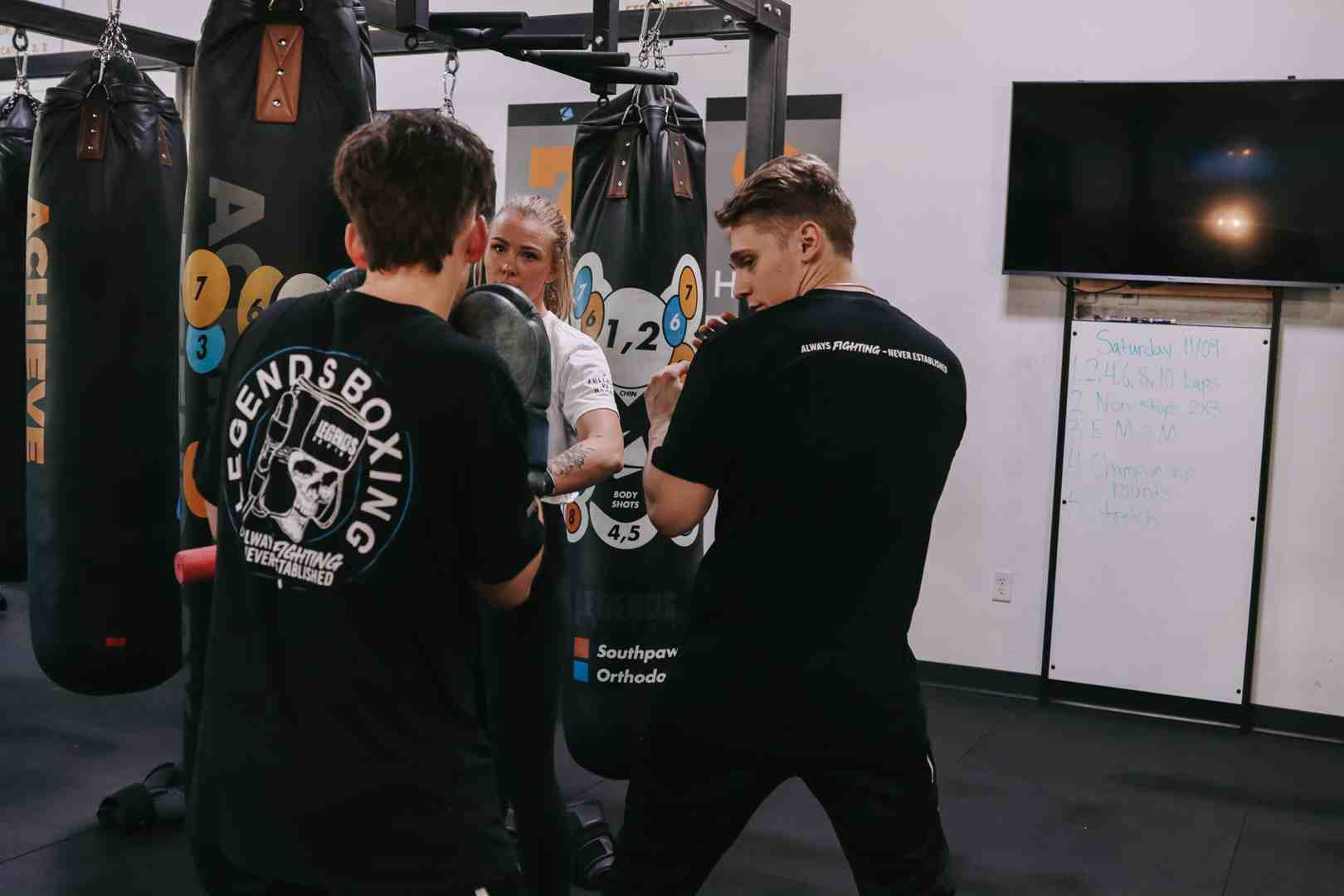
Boxing bag training drills are the core of effective heavy bag workouts. They provide structured exercises to build power, speed, and technique while delivering a fantastic full-body workout. The right drills can transform a simple punching session into a complete fitness game-changer.
Essential Boxing Bag Training Drills at a Glance:
- Basic Combinations — Jab-Cross (1-2) sequences for beginners
- Power Drills — Heavy punches focusing on hip rotation and form
- Speed Drills — Rapid-fire combinations to boost hand speed
- Footwork Drills — Movement patterns combined with punching
- Defensive Drills — Slip, roll, and counter-punch sequences
- Conditioning Drills — High-intensity intervals for endurance
Heavy bag workouts efficiently burn calories and engage your entire body. Just 10 minutes of boxing bag training offers significant cardiovascular benefits, improves hand-eye coordination, and serves as an effective stress reliever. The versatility of boxing bag training allows for workouts structured in traditional 3-minute rounds or custom HIIT sessions tailored to your fitness goals.
I'm Robby Welch, National Head Coach at Legends Boxing. I've seen how proper boxing bag training drills transform our members' fitness and confidence. My experience developing our nationwide curriculum shows that the right progression of drills is key to achieving results while staying injury-free.
Why Train with a Punching Bag? The Full-Body Benefits
Training with a punching bag is a multi-faceted workout. At Legends Boxing, we see members find unexpected benefits from boxing bag training drills every day.
Cardiovascular Health
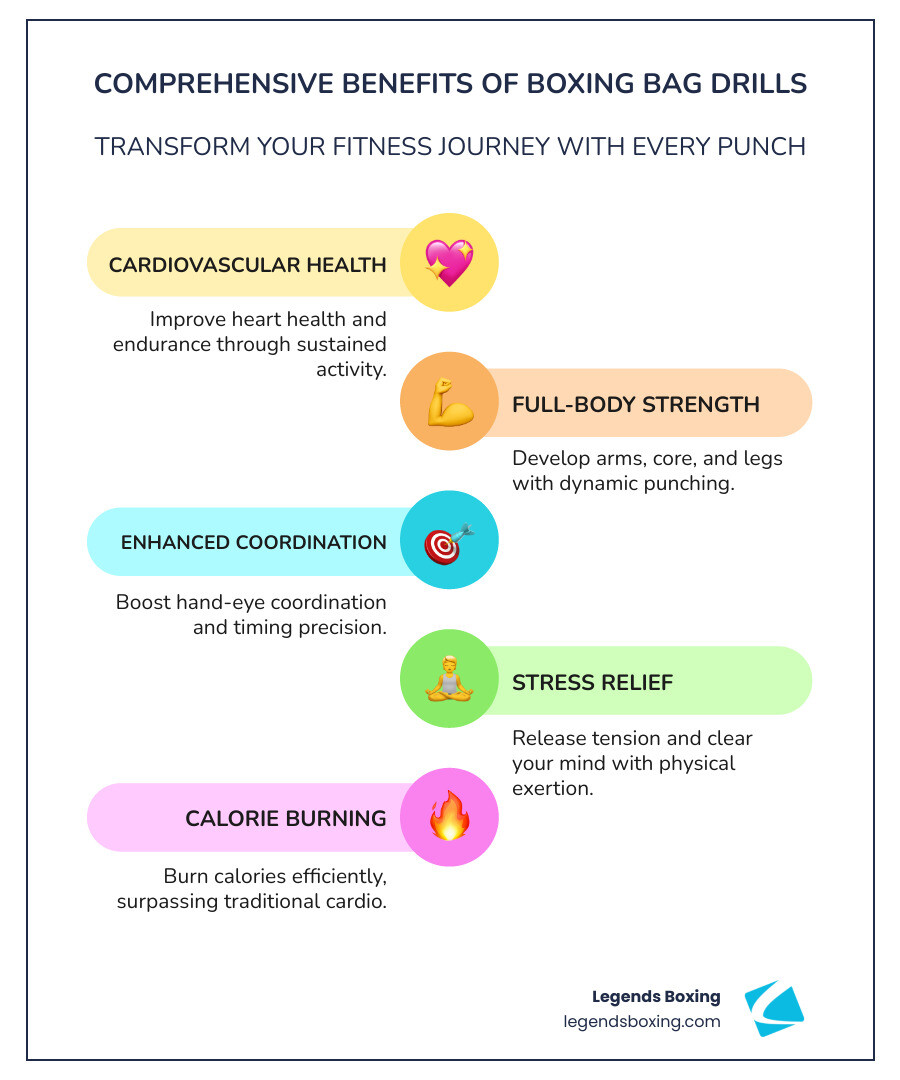
Working through boxing bag training drills lifts your heart rate, providing an incredible cardio workout that's far from monotonous. Just 10 minutes of boxing bag training can be as effective as longer traditional cardio sessions, strengthening your heart and improving stamina.
Strength Training and Muscle Toning
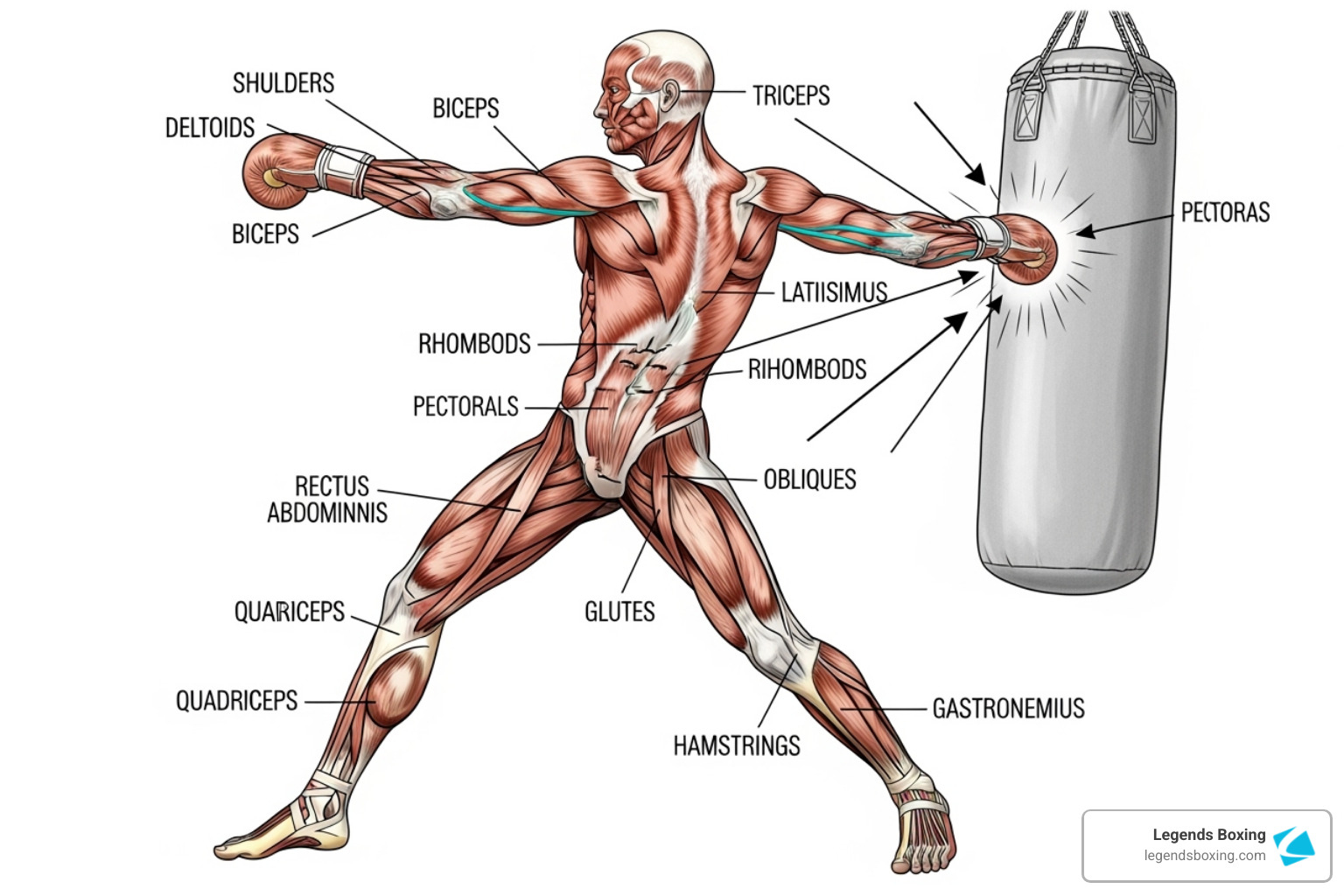
Every punch is a full-body movement, starting from your feet and traveling through your legs, core, shoulders, and arms. Heavy bag training serves as strength training, engaging your core for stability, your legs for power, and your upper body for building lean muscle.
Improved Hand-Eye Coordination
Practicing punching combinations on the bag forces your brain and body to work together. Targeting specific areas sharpens your reflexes and precision, improving coordination that benefits you both in and out of the gym.
Improved Balance and Stability
Moving around a heavy bag while throwing punches constantly challenges your balance. This dynamic movement makes you more agile and grounded as your body learns to stay stable while in motion.
Stress Relief
A punching bag is a perfect outlet for stress. The physical exertion combined with rhythmic punching offers a therapeutic release, clearing your mind and leaving you feeling refreshed and focused.
Efficient Calorie Burning
Combining boxing bag training drills with HIIT principles creates a calorie-burning powerhouse, maximizing results in minimal time. It's an efficient, multitasking workout that builds strength, coordination, and relieves stress simultaneously.
Fundamentals First: Technique and Common Mistakes
Just like learning to drive, mastering boxing bag training drills starts with a solid foundation. Proper technique is crucial for effectiveness and injury prevention.
Essential Techniques for Beginners
The heavy bag is the perfect, patient teacher. At Legends Boxing, we focus on these fundamentals to build confident boxers:
- Your boxing stance is everything. Stand with feet shoulder-width apart, non-dominant foot forward. Keep knees slightly bent, weight even, and your rear hand guarding your chin while the lead hand is slightly extended.
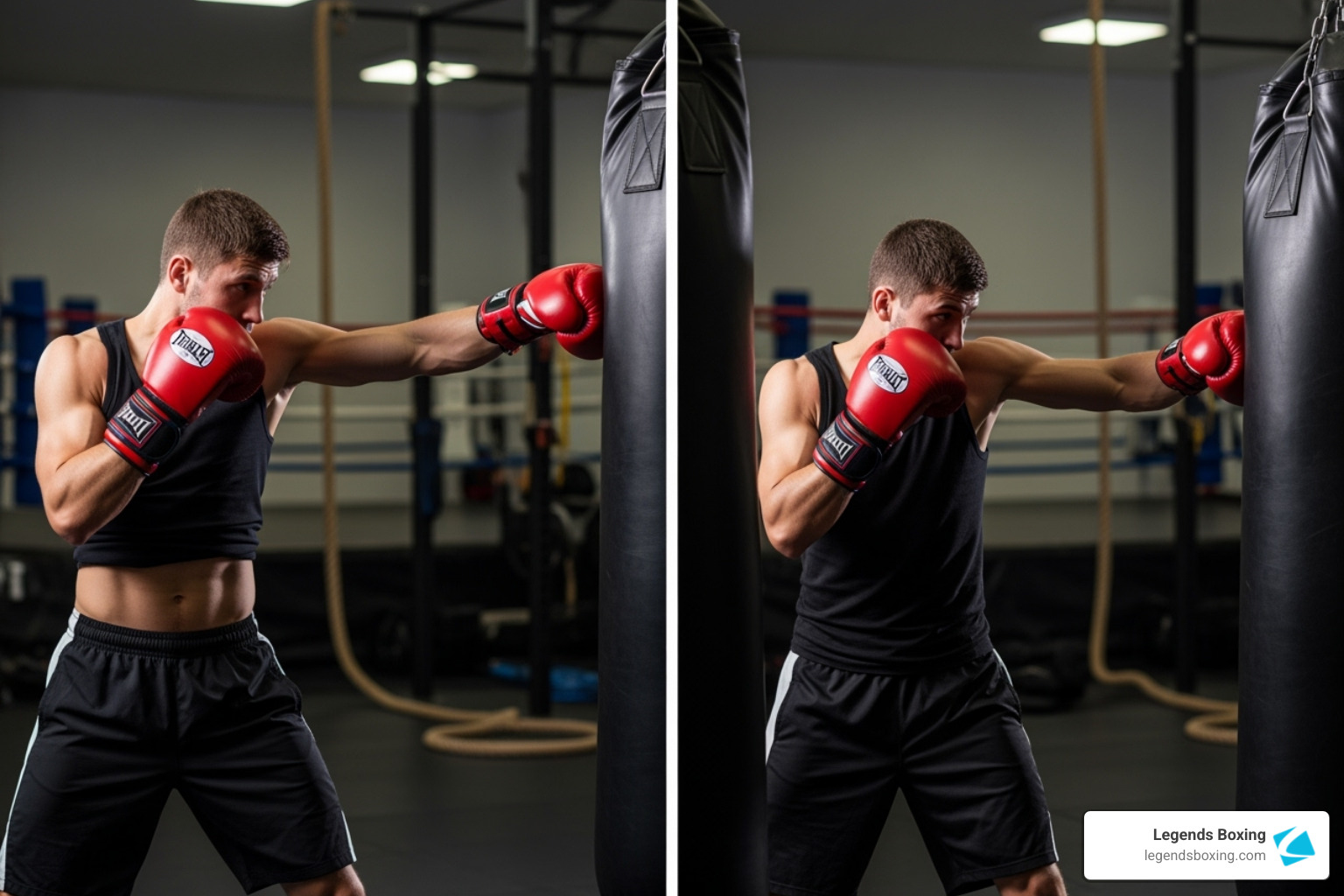
- The four basic punches are the core of all boxing bag training drills. The jab is a quick, straight punch from your lead hand — extend, rotate your fist palm-down on impact, and snap it back. The cross is your power punch from the rear hand — pivot your back foot and rotate your hips to generate force. Hooks and uppercuts add variety: the hook is a curving punch with a bent elbow, while the uppercut drives upward from below.
- Hip rotation for power is key. True power originates from the ground up, traveling through your legs and core before exploding from your fist.
- Breathing technique is your endurance superpower. Exhale sharply with each punch to keep your core engaged and avoid holding your breath.
- Keep those hands up! Always return your hands to a defensive position by your face after every punch to build crucial muscle memory.
Common Mistakes to Avoid
Catching these common errors early will prevent bad habits from forming:
| Mistake | The Fix |
|---|---|
| Dropping your guard | Snap your hands back to your face after every punch |
| Pushing instead of snapping | Focus on explosive extension and immediate retraction — like cracking a whip |
| Standing still | Stay light on your feet; circle the bag and change angles constantly |
| Bending your wrist on impact | Keep your wrist straight and strong to prevent injury |
| Holding your breath | Exhale sharply with every punch to stay relaxed and powerful |
| Throwing "arm punches" | Engage your legs, core, and hips — your arms are just the delivery system |
Your Ultimate Library of Boxing Bag Training Drills
Here is a collection of boxing bag training drills to progressively build your skills from beginner to advanced.
Beginner-Friendly Boxing Bag Training Drills
These foundational drills emphasize form over power to build solid technique and muscle memory.
- Basic Combinations (1-2): The jab-cross drill is your starting point. Throw a crisp jab followed immediately by a powerful cross, focusing on smooth transitions and hip rotation.
- Head and Body Jab-Crosses: Vary your targets by mixing combinations to the head and body. This teaches you to adjust angles and engage different muscle groups.
- Freestyle Rounds: Dedicate rounds to moving and flowing around the bag. Throw natural combinations, incorporate footwork, and be creative. This builds rhythm and relieves stress.
Perfect technique is the foundation for future speed and power.
Drills for Punching Speed and Power
Once your form is solid, use these advanced boxing bag training drills to increase intensity.
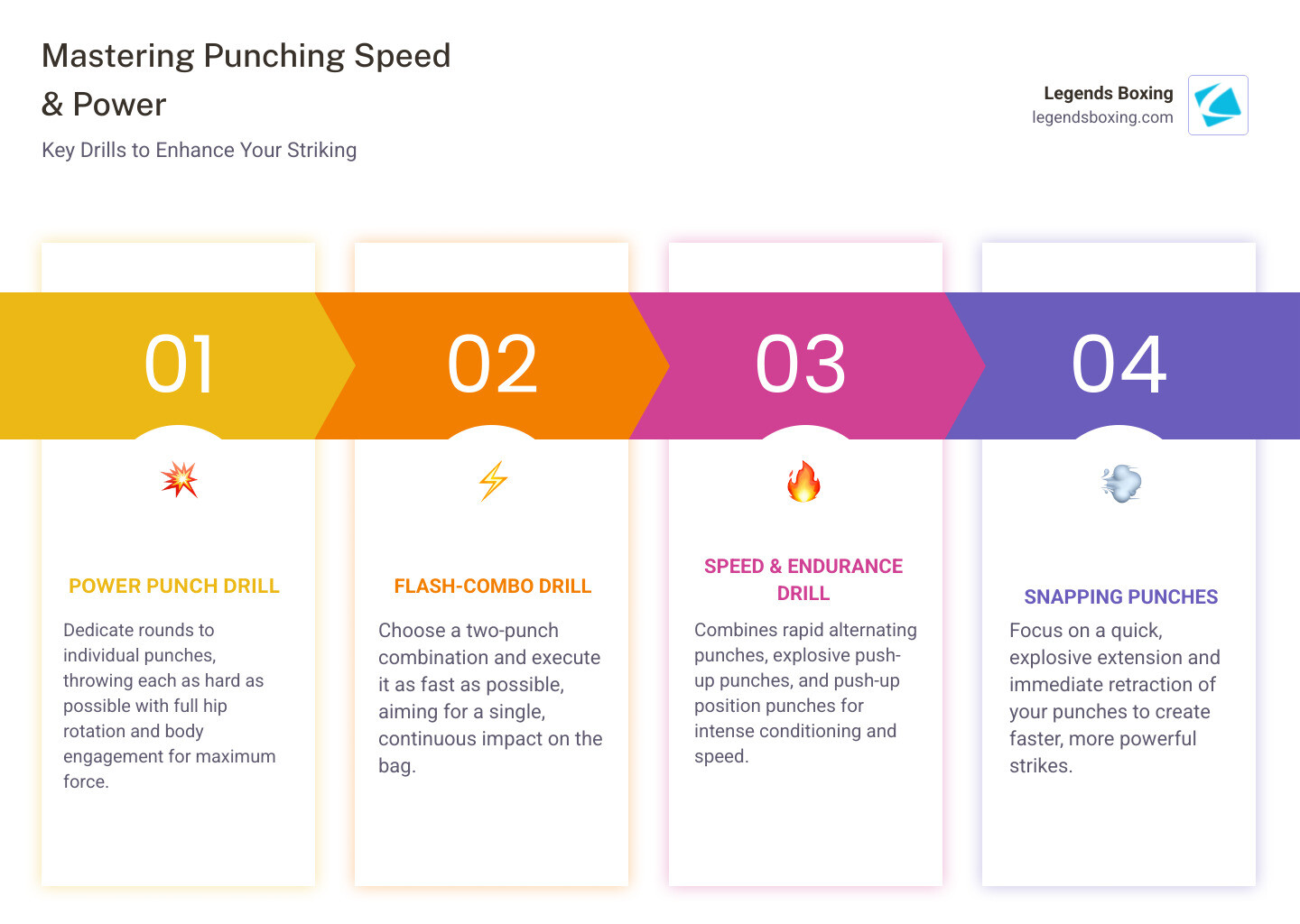
- Power Punch Drill: Dedicate rounds to single punches — one round of only crosses, one of only hooks. Focus on maximum force with full-body engagement.
- Flash-Combo Drill: Choose a two-punch combo and throw it as fast as possible, aiming for a single, continuous impact sound. This drill dramatically improves hand speed.
- Speed and Endurance Drill: This intense drill combines conditioning and technique. Cycle through 30 seconds of alternating speed punches, 30 seconds of explosive push-up punches, and 30 seconds of holding a push-up position while punching.
Always practice snapping punches — explosive extension and immediate retraction — for faster, more powerful strikes that conserve energy.
Drills for Footwork and Defensive Movements
Good boxing involves becoming a moving target. These boxing bag training drills will make you a more elusive, dangerous boxer.
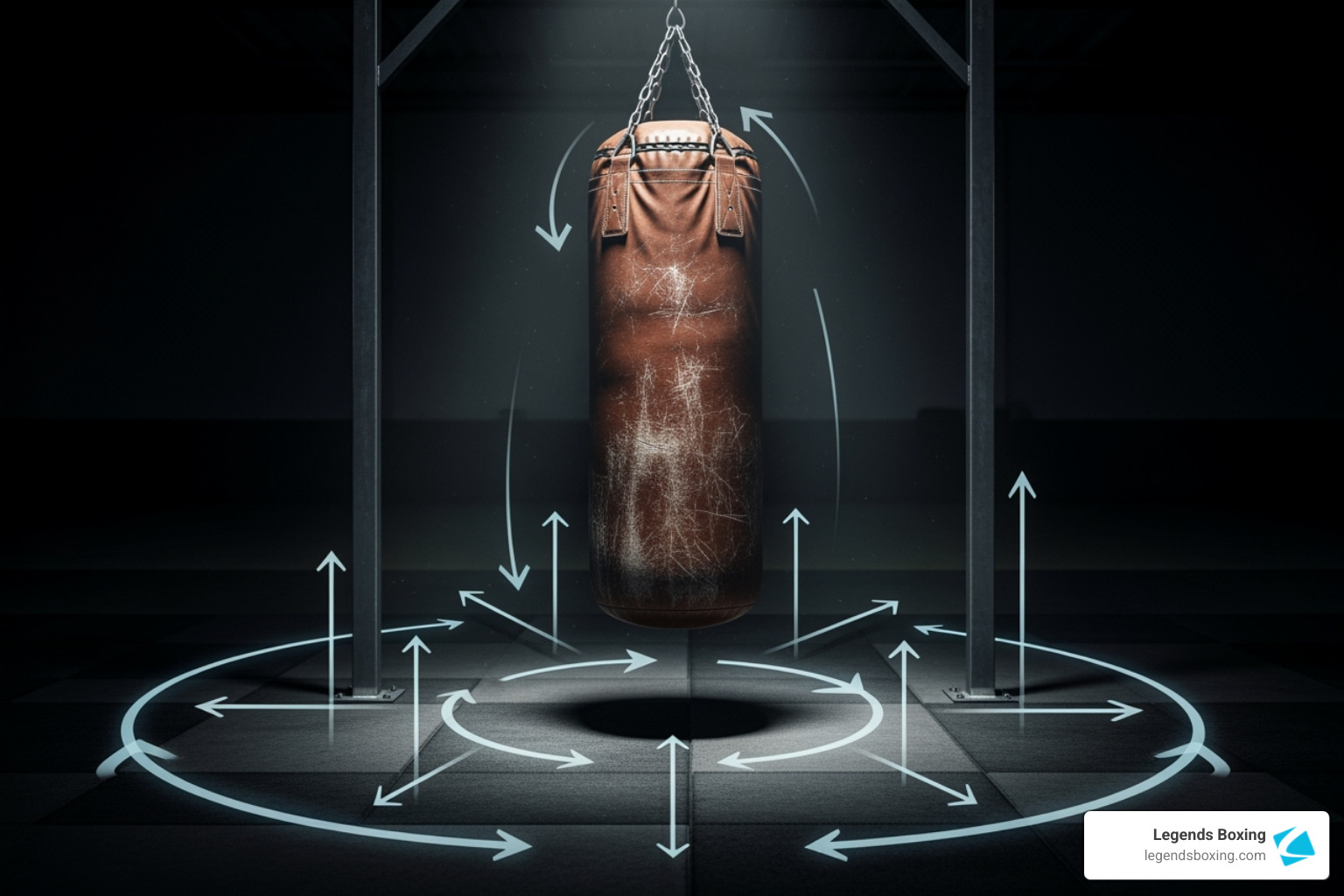
- Movement Drill (Punch and Move): Break the habit of standing still. Circle the bag, throwing punches from different angles to improve footwork and power generation from various positions.
- Counter-Puncher Drill (Slip/Roll then punch): Treat the bag like an opponent. Practice a defensive move (slip or roll) and immediately counter with a combination.
- Bob and Weave Drill: Combine vertical and lateral movements to avoid imaginary punches while maintaining your offense. This improves coordination and concentration.
- In-and-Out Drill (Pendulum Step): Master distance control by stepping into range for an attack and quickly stepping back out with pendulum footwork.
How to Structure Your Punching Bag Workout
An effective punching bag workout requires a proper warm-up, a structured routine, and a thorough cool-down. At Legends Boxing, we use this approach for maximum results and safety.
The Perfect Warm-Up
Never skip your warm-up — it prepares your body for peak performance and helps prevent injury.
- Jumping rope (2–3 minutes): Lifts your heart rate and sharpens coordination.
- Shadow boxing (2–3 minutes): Move and throw light punches with perfect form, focusing on fluidity over power.
- Dynamic stretches (1–2 minutes): Arm circles, torso twists, and leg swings to prepare your joints for their full range of motion.
A Sample 30-Minute Workout
Boxing bag training drills are often structured in 3-minute rounds with 1-minute rest periods to build skill and endurance. For beginners, training 2–3 times per week is ideal, allowing for recovery.
| Round | Focus | Duration | Key Goal |
|---|---|---|---|
| Warm-up | Jump rope + shadowboxing + dynamic stretches | 5 min | Prepare joints and heart rate |
| Round 1 | Jab and Movement | 3 min | Sharp jabs while circling the bag for angles |
| Round 2 | Basic Combinations | 3 min | 1-2 and 1-2-3 sequences with hip rotation |
| Round 3 | Power Punches | 3 min | Single crosses and hooks — quality over quantity |
| Round 4 | Body Shots | 3 min | Hooks and uppercuts to the midsection |
| Round 5 | Speed and Endurance | 3 min | 2 min non-stop jabs/crosses + 1 min max-effort power |
| Round 6 | Freestyle with Defense | 3 min | Combine movement, combinations, slips and rolls |
| Cool-down | Light shadowboxing + static stretches | 5 min | Lower heart rate and stretch major muscle groups |
The Essential Cool-Down
A cool-down is crucial for recovery and adaptation:
- Light shadowboxing (2 minutes): Slow your movements down, focusing on fluid form.
- Static stretching (3–5 minutes): Hold stretches for your major muscle groups — shoulders, arms, chest, back, legs, and core.
- Hydration and recovery: Drink plenty of water and consider a protein-rich snack to help your muscles repair and grow stronger.
Frequently Asked Questions about Punching Bag Training
What's the difference between a heavy bag and a speed bag?
| Bag Type | Best For |
|---|---|
| Heavy Bag | Power, endurance, combinations, strength building |
| Speed Bag | Hand-eye coordination, timing, reflexes, arm speed, focus |
The heavy bag is for building raw power, strength, and endurance — perfect for practicing combinations and getting a full-body workout. The speed bag is for finesse, sharpening hand-eye coordination and reflexes. At Legends Boxing, we focus on heavy bag work because it delivers the most comprehensive workout, combining strength, cardio, and stress relief.
How often should I incorporate boxing bag training drills into my routine?
Consistency is more important than intensity:
- Beginners: Aim for 2–3 times per week. This allows your body to adapt and build muscle memory while focusing on proper form.
- Intermediate/Advanced: 3–5 times per week is effective.
Recovery days are not optional — they are essential for muscle growth and skill development, helping you avoid burnout and injury. Always listen to your body.
What gear do I absolutely need to start?
You don't need much, but the following items are non-negotiable for safety:
- Hand wraps: Essential for protecting the small bones in your hands and wrists by distributing impact force.
- Boxing gloves (12–16 oz): Heavier gloves (14–16 oz) offer more padding, making them ideal for beginners and heavy bag work. Lighter gloves are for speed work once your foundation is solid.
- Proper athletic shoes: Boxing shoes are ideal, but any athletic shoe with good lateral support will work.
- Comfortable, breathable clothing: Choose moisture-wicking fabrics that allow for free movement.
Investing in quality gear is an investment in your safety and longevity in the sport.
Release Your Potential with the Right Drills
Boxing bag training drills boost cardio, build strength, improve coordination, and relieve stress. You've learned essential techniques, common mistakes to avoid, a full drill library for power, speed, and footwork, and how to structure a complete 30-minute workout.
The punching bag is an ideal training partner — always available and never judgmental. Consistency is the secret sauce. The magic happens when you show up regularly, prioritize clean technique over raw power, and listen to your body. The physical changes will come, but the confidence and mental toughness you'll gain are the real prize.
At Legends Boxing, we incorporate these principles into high-energy, fun classes. Our expert coaches help you perfect your technique, push past plateaus, and celebrate your progress. No boxing experience required — just the desire to become a stronger, fitter version of yourself.
Ready to experience these boxing bag training drills in person? Book a free class at Legends Boxing and let our coaches guide you through your first session. Find a location near you across Utah, Texas, and Florida — and discover why so many people are trading their traditional gym memberships for the excitement, community, and results of boxing fitness.