
The Championship Belt Chronicles: Boxing's Rich History Explained
Boxing belts history stretches from 1810 — when King George III awarded Tom Cribb a lion-skin belt with real claws — to today's four major organizations (WBA, WBC, IBF, WBO) awarding championship belts across 17 weight divisions. This guide covers every era: the Lonsdale Belt, the Queensberry Rules revolution, how each sanctioning body was born, the difference between lineal/unified/undisputed champions, the artistry behind modern belts, and boxing's biggest belt controversies.
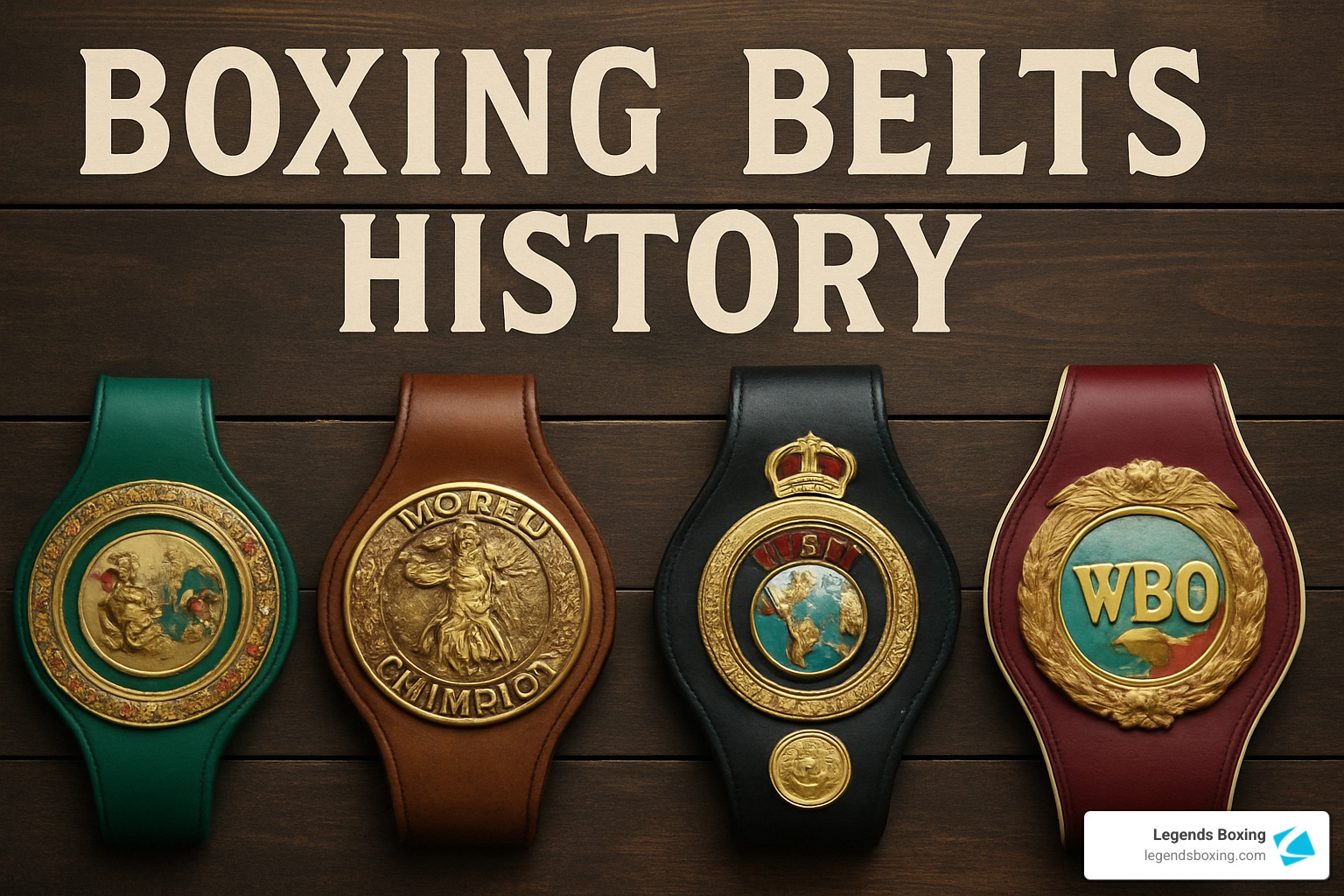
The Golden Legacy: How Boxing Belts Became the Ultimate Prize
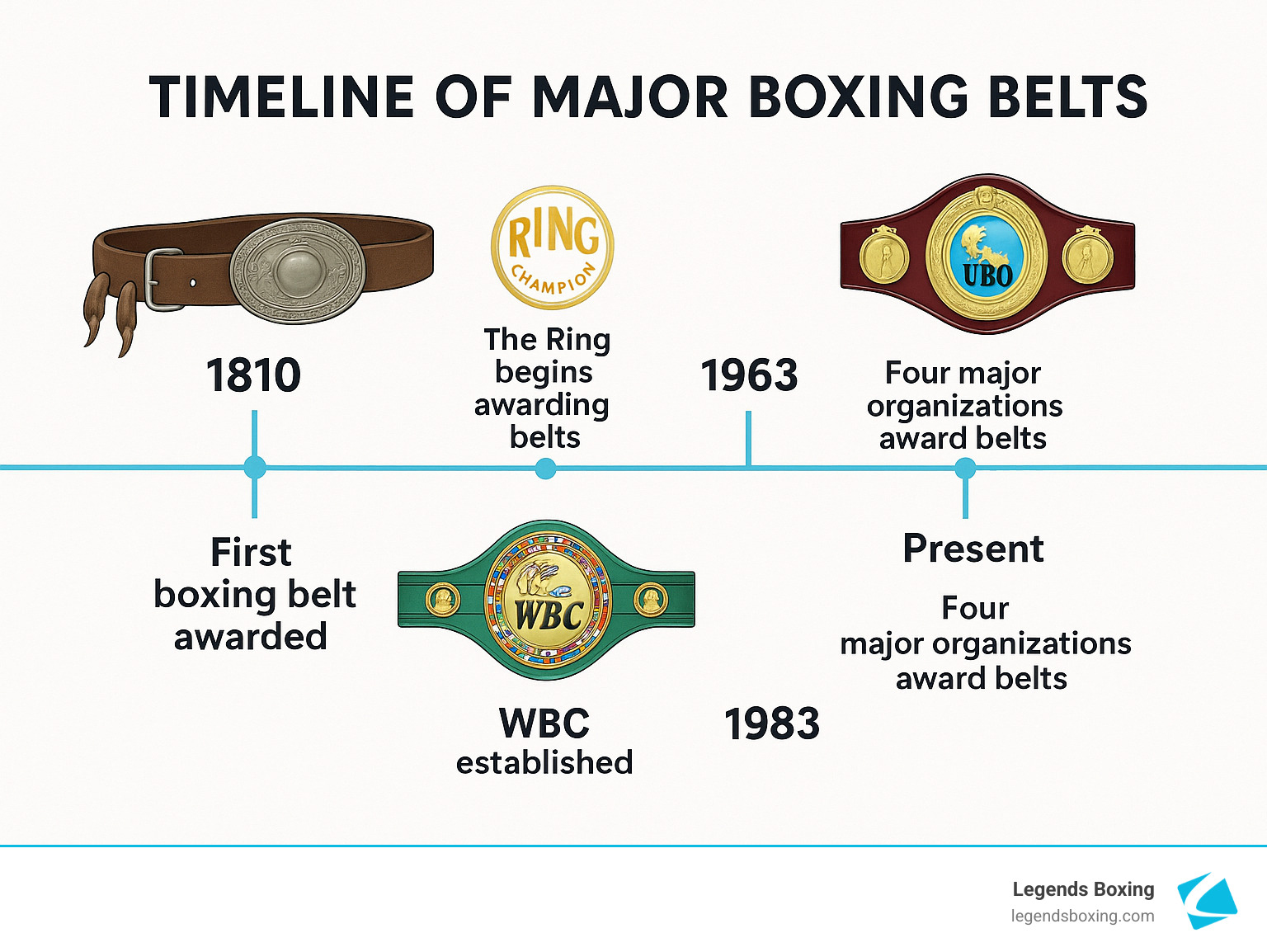
Boxing belts history can be traced back to 1810 when King George III awarded the first championship belt to British boxer Tom Cribb after his victory over Tom Molineaux. Here is a quick timeline of how boxing belts evolved:
- 1810 — First boxing belt awarded (lion skin with silver buckle and real claws)
- 1909 — Lord Lonsdale Challenge Belt introduced by the National Sporting Club
- 1922 — The Ring magazine begins awarding championship belts
- 1921–1962 — WBA formed (originally as the National Boxing Association)
- 1963 — WBC established in Mexico City
- 1867 — Marquess of Queensberry Rules transform the sport
- 1983 — IBF recognized as a major sanctioning body
- 1988 — WBO founded in Puerto Rico
- Present — Four major organizations (WBA, WBC, IBF, WBO) award belts across 17 weight divisions
When you watch a championship boxing match today, the gleaming belt raised high above the winner's head represents more than just victory — it embodies centuries of tradition, prestige, and the pinnacle of athletic achievement. What began as a simple leather strap has evolved into elaborate gold-plated masterpieces adorned with precious stones and intricate designs, each telling the story of boxing's rich heritage.
I'm Robby Welch, National Head Coach at Legends Boxing with extensive experience studying boxing belts history to develop a training curriculum that honors the sport's traditions while making them accessible to modern fitness enthusiasts.
From Crowns to Straps: The 19th-Century Birth of Prize Belts
Picture early 19th-century boxing rings filled with sweat, blood, and roaring crowds watching fighters battle with bare knuckles. No gloves. No time limits. Just raw determination and fights that could stretch to dozens of grueling rounds. Being a champion meant fame and prize money, but there was no shiny belt to hold up after victory. Fighters like James Figg and Jack Broughton were celebrated champions who walked away with only cash and bragging rights.
The Police Gazette stepped in as an unlikely hero in boxing's formalization. They began keeping official records of champions and challengers, helping transform street fighting into a legitimate sport with recognized titleholders.
Then came December 10, 1810 — a date that would forever change boxing belts history. In a historic 35-round bare-knuckle battle at Shenington Hollow, England, Tom Cribb defeated American challenger Tom Molineaux — a former slave competing in deeply prejudiced times, making the contest as socially significant as it was physically brutal. The match caught the attention of King George III himself, who presented Cribb with what historians recognize as the first true championship belt in boxing: made from actual lion skin (symbolizing British imperial power), featuring a magnificent silver buckle, and adorned with real lion claws.
This was not just a prize — it was a royal statement about boxing's importance. The belt transformed from mere accessory to the ultimate prize, and helped legitimize an entire sport, shifting boxing from its association with gambling dens toward something more structured and respectable.
A Belting Good Idea: The Lord Lonsdale Challenge Belt (1909)
Fast forward to 1909, when boxing belts history took another leap forward with the introduction of the Lord Lonsdale Challenge Belt. This was the vision of Hugh Cecil Lowther, the 5th Earl of Lonsdale and president of London's National Sporting Club (NSC). Boxing faced potential prohibition due to its dangerous nature and lack of consistent rules — Lonsdale recognized that creating a prestigious prize with clear regulations could help save the sport he loved. The belt was not just a prize; it was a rescue mission.
The original Lonsdale Belts were crafted from 9-carat gold, featuring the champion's portrait alongside the Earl of Lonsdale's image. Many boxing historians have called it "the most beautiful of all sporting trophies." What made it truly special were its ownership rules: a boxer could win it outright by successfully defending it three times or remaining undisputed champion for three years — and winners also received a pension of £1 per week after turning 50, a meaningful benefit when many fighters ended their careers broke and broken.
The first Lonsdale Belt contest took place on November 8, 1909, with Freddie Welsh defeating Johnny Summers at lightweight. This beautiful tradition continues today through the British Boxing Board of Control (BBBoC), connecting today's champions with the sport's golden age through a physical symbol of excellence over a century in the making.
Gloves On, Belts Out: Evolution Through Rules & Technology (1850s–1940s)
The most pivotal moment in boxing belts history came with the introduction of the Marquess of Queensberry Rules in 1867 — drafted by John Graham Chambers and endorsed by John Sholto Douglas, the 9th Marquess of Queensberry. Before these rules, boxing operated under a patchwork of regulations that allowed fights lasting dozens of rounds. The Queensberry Rules changed everything: mandated padded gloves, timed three-minute rounds with one-minute rest periods, and the 24-foot squared ring that remains standard today.
As boxing gained respectability, weight classes emerged, creating multiple championship categories where before there had only been vague distinctions between fighters of different sizes. Each new division meant another belt — another symbol of excellence to be coveted and defended.
Boxing Belts History: Designs Before World War II
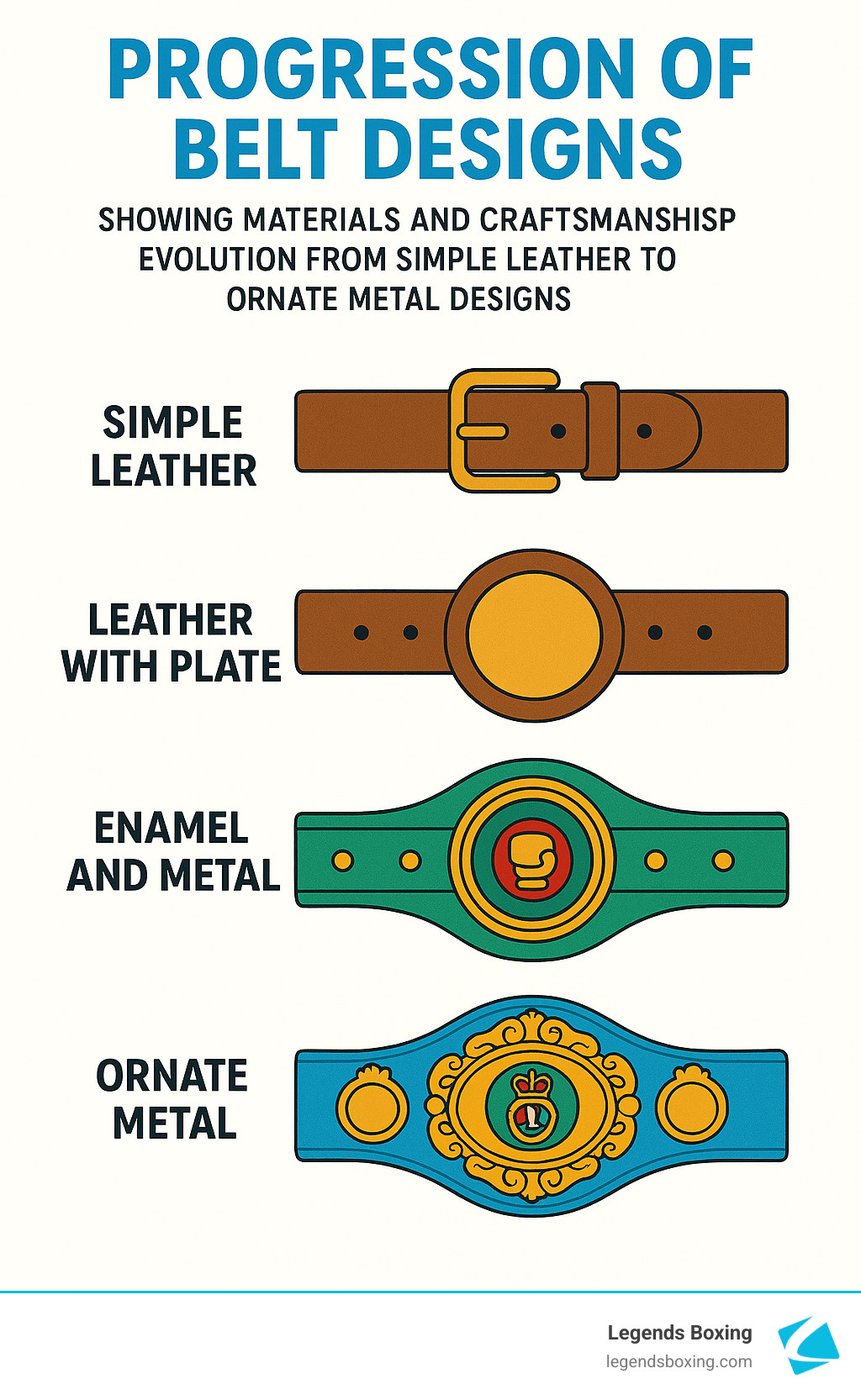
Victorian-era belts featured ornate scrollwork and classical flourishes requiring weeks of meticulous craftsmanship. Some of the earliest championship recognition came not as belts at all, but as silk sashes draped over the champion's shoulder — gradually replaced by more substantial leather belts with metal plates.
The 1920s and '30s brought the unmistakable influence of Art Deco: bold geometric patterns, clean lines, and stylized figures. Mythological connections ran deep — images of classical athletes, laurel wreaths, and figures from Greek mythology adorned many belts, creating a visual link between modern boxing champions and ancient Olympic victors.
"Every curve, every detail had to be perfect," one 1930s belt maker described. "These belts were going to immortalize champions — they deserved nothing less than our best work."
As boxing promoters gained influence, they recognized the belt's power as a marketing tool. The belt had become more than a prize — it was now a powerful symbol that could sell tickets and create legacies.
The Four-Belt Era: Boxing Belts History and Modern Sanctioning Bodies
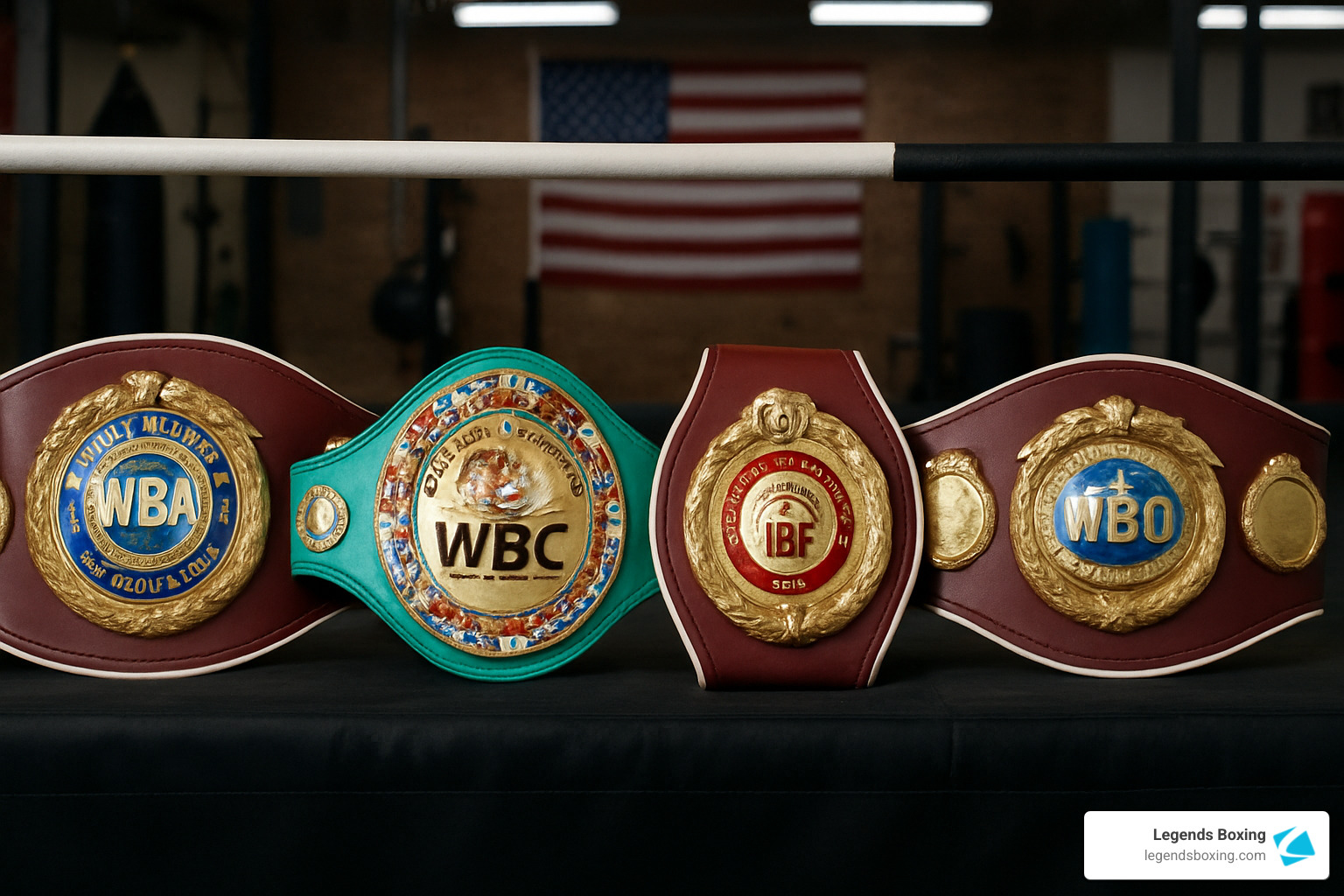
When you hear about a boxing "world champion" today, the question immediately follows: "Which belt?" The modern landscape features four major organizations, each with their own championship belts across 17 weight divisions.
The World Boxing Association (WBA) stands as boxing's elder statesman, originally founded as the National Boxing Association in 1921. This pioneering organization sanctioned the first world title fight under its banner — Jack Dempsey vs. Georges Carpentier. Today's WBA belt features a distinctive red and black design accented with gold elements.
The World Boxing Council (WBC) emerged in Mexico City in 1963 with a commitment to fighter safety. The WBC introduced several crucial reforms, including reducing championship fights from 15 rounds to today's 12-round standard and implementing the standing eight count to protect vulnerable fighters. Many consider the WBC belt — with its stunning green and gold design featuring 161 national flags around its perimeter — to be boxing's most visually impressive and prestigious prize.
The International Boxing Federation (IBF) joined the championship landscape in 1983, its roots stretching back to the United States Boxing Association (USBA). The IBF belt proudly displays a red, white, and blue color scheme reflecting its American origins, despite now operating as a global organization.
The World Boxing Organization (WBO), founded in 1988 in Puerto Rico, was initially viewed with skepticism and did not receive universal recognition as a major world title until 2004. Its distinctive red and gold belt design has now earned its place alongside the other three major championships.
Beyond these four, The Ring magazine has awarded its own championship belt since 1922 — often called the "true championship" by boxing purists, recognizing the lineal champion regardless of which sanctioning body belts they hold.
Birth of Each Organization
The WBA's journey began in 1921 when thirteen state athletic commissions formed the National Boxing Association as a counterweight to the powerful New York State Athletic Commission. By 1962, recognizing boxing's global nature, they rebranded as the World Boxing Association.
The WBC was born from a 1963 gathering in Mexico City, where representatives from 11 countries met — with backing from Mexican President Adolfo Lopez Mateos himself. The organization gained tremendous respect for its safety innovations, particularly after the tragic death of fighter Kim Duk-Koo in 1982 prompted the reduction of championship fights from 15 to 12 rounds.
The IBF's story reveals boxing's political nature. In 1977, Bob Lee — a former WBA executive who had lost an election for the WBA presidency — created his own organization. What began as the United States Boxing Association formally established itself as the IBF in 1983.
The WBO emerged in 1988 in Puerto Rico, founded by a group including former WBA Vice President Ramon Pina Acevedo. Initially dismissed (some called it the "Woo Boo"), it slowly built credibility throughout the 1990s before achieving full recognition in 2004.
Belt Tiers & Titles
The WBA takes complexity furthest, recognizing up to four champions in a single weight division: Super Champion (a WBA champion who also holds a belt from another major organization), Regular Champion (primary WBA titleholder when a Super Champion exists), Interim Champion (when a champion cannot defend due to injury), and the newer Gold Champion designation.
The WBC has developed its own special categories: the Diamond Belt (prestigious award for exceptional fights), the Emerald Belt (for truly historic bouts), the Silver Belt (interim championship), and the Eternal Champion designation (for undefeated champions who retire).
The IBF maintains a more straightforward approach — primarily regular champions with occasional interim championships — and has earned a reputation for strictly enforcing mandatory defenses, stripping champions who fail to comply regardless of their commercial drawing power.
The WBO similarly focuses on regular championships, with a Super Champion designation that grants special privileges to long-reigning champions who have made multiple successful defenses.
Reading the Hierarchy: Lineal, Unified, Undisputed & More
The lineal champion carries boxing's most romantic notion — "the man who beat the man," tracing an unbroken line of succession through direct defeats. This tradition dates back to John L. Sullivan in the late 19th century. The beauty of lineal championship is its simplicity: it cuts through the politics of sanctioning bodies and focuses purely on who defeated the previous champion.
A unified champion has collected championship belts from two or more major organizations simultaneously — a statement that they are not just any champion, but one recognized across organizational boundaries.
The undisputed champion stands at boxing's summit — holding all four major world titles (WBA, WBC, IBF, and WBO) simultaneously. Since the four-belt era began in 2004, undisputed champions have been as rare as perfect diamonds. Lennox Lewis made history as the last undisputed heavyweight champion in November 1999 (before the WBO was fully recognized). More recently, Oleksandr Usyk achieved this remarkable feat in the heavyweight division in May 2024, cementing his place in boxing belts history.
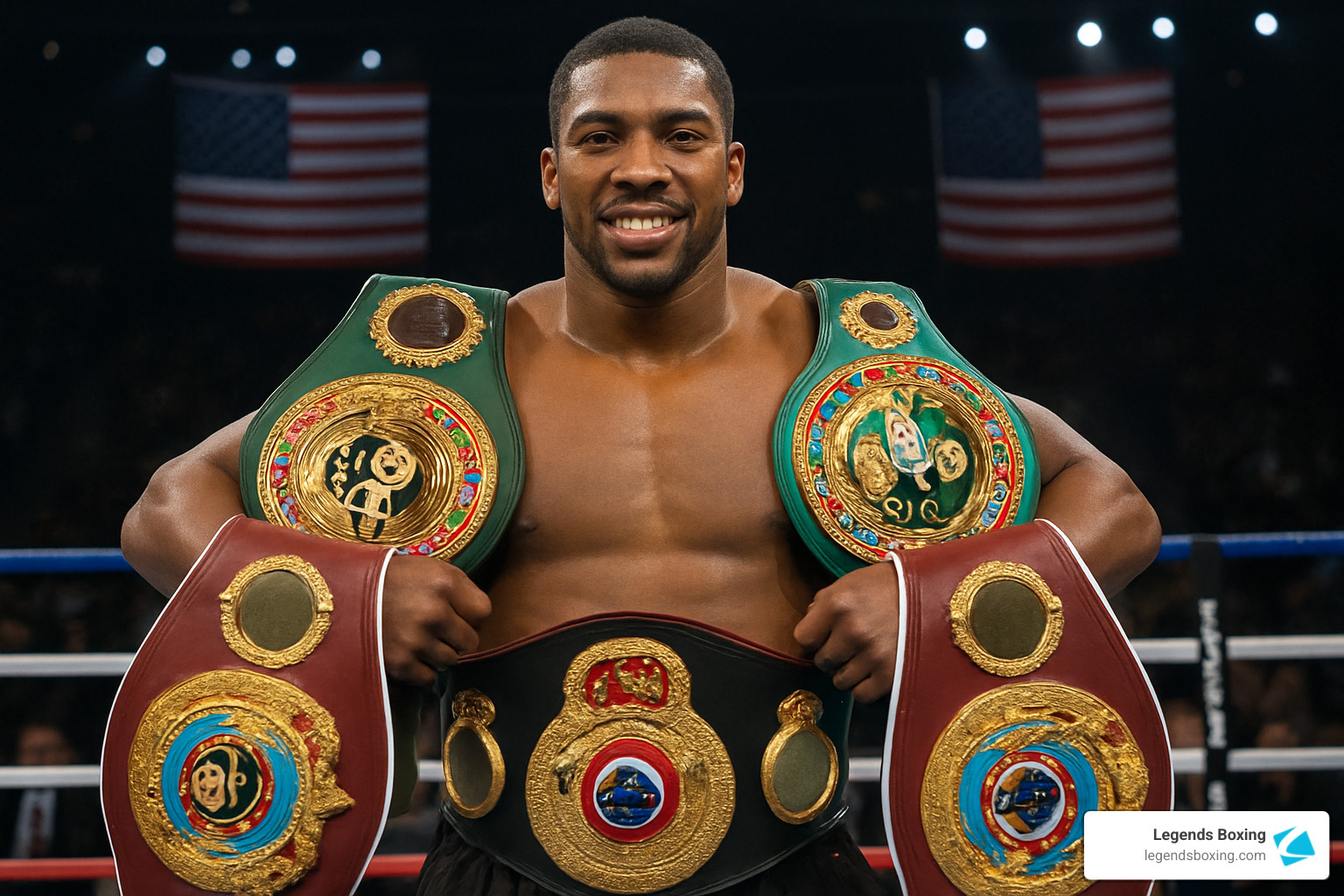
Interim champions hold titles temporarily when a champion is injured or unable to defend — the interim champion must eventually face the returning champion in a unification bout or may be promoted to full champion if the original titleholder vacates.
Mandatory defenses are obligations champions must fulfill to keep their belts — each sanctioning body requires champions to face their designated mandatory challenger within a specific timeframe, usually once per year. Champions sometimes pay "step-aside fees" to mandatory challengers, compensating them to temporarily waive their right to a title shot while the champion pursues a more lucrative bout.
How Boxers Win & Keep Belts
The journey to winning a championship belt is not just about being the best fighter — it is about navigating a complex landscape of rankings, politics, and business decisions.
Every major sanctioning body maintains its own ranking system, evaluating fighters based on their records, quality of opponents, and recent performances. When negotiations break down, sanctioning bodies may order a "purse bid" — a fascinating process where promoters submit sealed bids for the right to stage the fight, with proceeds split between champion and challenger according to predetermined percentages.
Keeping the belt can be even harder than winning it. The WBC and WBO are particularly strict about mandatory defense requirements. When a champion faces serious obstacles like injury, they might receive a "Champion in Recess" designation rather than being stripped outright — allowing them to challenge for the title immediately upon return.
The financial impact of becoming champion cannot be overstated. Title holders command higher purses, better television exposure, and more lucrative endorsement deals. Championship belts are not just sporting achievements — they are business assets that can transform a fighter's career and financial future entirely.
Beyond Boxing: Belts in MMA, Wrestling & Motorsports
The championship belt has proven such a powerful symbol that it has spread far beyond the boxing ring.
Mixed Martial Arts accepted the championship belt tradition wholeheartedly. Unlike boxing's varied designs across organizations, the UFC maintains a consistent belt design across all weight divisions, distinguished only by weight class markings — current versions featuring gold plating, leather straps, and personalized side plates displaying each champion's name.
Professional wrestling took the championship belt concept and turned it into an art form. WWE and other wrestling promotions create elaborately designed belts for different championships, often with designs that reflect the character or legacy of the title. The legendary "Big Gold Belt," which originated in the NWA before moving through WCW and eventually WWE, stands as perhaps the most recognizable wrestling championship in history.
Even motorsports have adopted championship belts as trophies — the Las Vegas Motor Speedway awards special belts to race winners instead of traditional trophies. And golf's Open Championship originally awarded a "Challenge Belt" from 1860 until 1870, when Young Tom Morris won it outright by claiming three consecutive championships.
Artistry & Iconic Straps: Materials, Makers, Memorabilia
Modern championship belts start with a foundation of premium cowhide leather that comfortably wraps around a fighter's waist while standing up to years of display. The centerplates and sideplates have evolved from simple metal buckles to elaborate works of art showcasing each sanctioning body's unique identity.
The WBC belt is perhaps the most recognizable in all of sports. Its vibrant green leather strap provides the perfect backdrop for gold-plated components that gleam under arena lights. What makes this belt truly special: each of the 161 national flags encircling the centerpiece is individually hand-enameled by skilled artisans — a painstaking process that can take weeks to complete.

For truly historic occasions, belt makers have pushed the boundaries of luxury. When Floyd Mayweather and Manny Pacquiao met in their long-awaited 2015 showdown, the WBC created the "Emerald Belt," featuring over 3,000 precious emeralds. The "Money Belt" created for Mayweather vs. McGregor in 2017 took opulence further still: 3,360 diamonds, 600 sapphires, and 300 emeralds all set in 1.5 kilograms of solid gold.
Creating these masterpieces requires a unique blend of traditional craftsmanship and modern techniques — leatherworkers who cut and stitch the base, metalworkers who form the plates, jewelers who set precious stones, and enamel artists who add vibrant colors. A single championship belt often represents hundreds of hours of meticulous labor.
Beyond their symbolic value, championship belts have become coveted collectibles. Muhammad Ali's championship belt from the 1974 "Rumble in the Jungle" sold for $358,500 in 2016. Rocky Marciano's belt from his historic 1952 victory over Jersey Joe Walcott commanded $250,000 in 2022.
Controversies & Curious Cases
The story of boxing belts history is not all glitter and gold — it is also filled with scandals, lawsuits, and power struggles.
Perhaps the darkest chapter came in the 1990s when the IBF's reputation was shattered by corruption. Founder Robert W. Lee Sr. and three other officials faced federal indictments on racketeering and bribery charges — investigators uncovered a scheme where rankings were essentially for sale. Lee was ultimately convicted of money laundering and tax evasion, leaving a permanent stain on the organization's credibility.
The WBC found itself in a different kind of fight when German boxer Graciano Rocchigiani took them to court in 1998 after the WBC stripped him and reinstated Roy Jones Jr. as champion. Rocchigiani won a staggering $31 million judgment in 2003 — a decision that nearly bankrupted the WBC before they reached a settlement.
The WBA's practice of recognizing multiple champions in the same weight class — "Super," "Regular," and "Interim" titleholders — has been widely criticized for diluting what it means to be a world champion. While the WBA defends this approach as creating more opportunities for fighters, many fans find it commercially motivated rather than merit-based.
Then there is Riddick Bowe, who provided one of the most dramatic moments in boxing belts history when, during a 1992 press conference, he dumped his WBC heavyweight belt into a trash can rather than face mandatory challenger Lennox Lewis — choosing to keep only his WBA and IBF titles instead. A visual symbol of the tension between fighter autonomy and organizational control.
Frequently Asked Questions
What's the difference between lineal, unified, and undisputed champions?
A lineal champion carries boxing's most romantic notion — "the man who beat the man." This tradition traces back to John L. Sullivan in the late 1800s, creating an unbroken line of succession independent of any sanctioning body. Even without holding an official belt, many purists consider the lineal champion the division's true king or queen.
A unified champion has managed to collect championship belts from two or more major organizations (WBA, WBC, IBF, WBO) simultaneously — a statement recognized across organizational boundaries.
The undisputed champion stands at boxing's summit — holding all four major world titles simultaneously. These rare achievements create unforgettable moments in boxing belts history. We have recently witnessed this with Oleksandr Usyk in heavyweight and Terence Crawford in welterweight. When a fighter becomes undisputed, there is simply no debate about who rules the division.
Why are there so many versions of the WBA title?
The WBA recognizes up to four champions in a single weight class: the Super Champion (created in 2001 for WBA champions who also hold other major belts, with greater scheduling flexibility and fewer mandatory defenses), the Regular Champion (primary titleholder when a Super Champion exists), an Interim Champion (appointed when a champion cannot defend due to injury), and the newer Gold Champion designation. Most serious boxing observers consider only the WBA Super Champion as the organization's legitimate titleholder.
Do fighters keep their belts after losing?
Yes — champions typically keep their physical belts even after losing the title. When a new boxing champion is crowned, the sanctioning body creates a brand new belt for them. This means a multiple-time champion can accumulate several identical belts throughout their career.
Special commemorative belts created for specific fights (like the WBC Money Belt or Emerald Belt) may have different ownership arrangements. And in earlier eras of boxing belts history, before major sanctioning bodies were established, some belts were indeed passed from champion to champion. Muhammad Ali's championship belt from the "Rumble in the Jungle" later sold for over $350,000 at auction — a testament to what these belts mean as permanent symbols of historical achievement.
The Legacy That Keeps Boxing Moving Forward
The journey through boxing belts history reveals much more than the evolution of shiny trophies. These championship belts tell the story of boxing's transformation from rough-and-tumble unregulated contests to the sophisticated global sport we know today. From Tom Cribb's exotic lion-skin strap with actual claws to the dazzling gold-plated masterpieces raised in victory in arenas worldwide, each belt captures a moment in boxing's rich cultural heritage.
The true value of these belts extends far beyond their material worth. When a fighter wraps that prestigious strap around their waist, they are joining an exclusive fraternity of champions stretching back over two centuries — validation of a lifetime dedicated to the craft.
At Legends Boxing, we draw daily inspiration from this rich heritage as we help our members connect with boxing's traditions through our fitness programs. Whether you are training at our locations in Bountiful, Salt Lake City, Sandy, or any of our other facilities across Utah, Florida, and Texas, you are participating in a sport with a prestigious legacy that continues to inspire.
Find your nearest Legends Boxing location and connect with boxing's championship tradition in person — or book your first free class today and experience the training methods that have produced champions for generations. No boxing experience required.