
All About the History and Origins of Boxing
Boxing history spans thousands of years, from ancient Sumerian carvings to Muhammad Ali standing over Sonny Liston. This deep dive covers the sport's origins in Greece and Rome, England's bare-knuckle era, the rule changes that created the sweet science, the champions who defined each era, and how those traditions live on in every class at Legends Boxing today.
Why Boxing History Matters: Understanding the Sweet Science
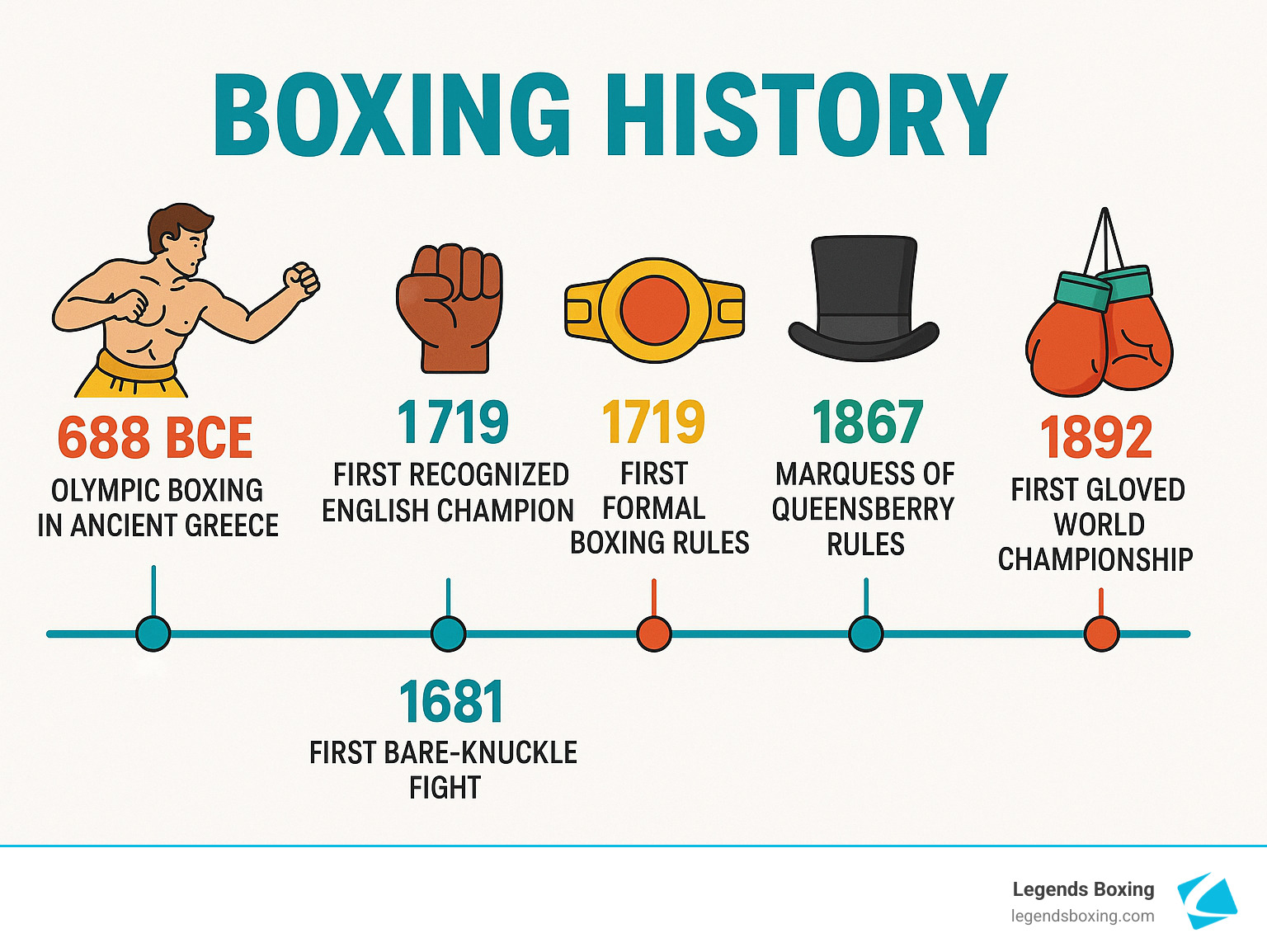
Boxing history spans thousands of years, evolving from ancient combat rituals to the modern sport we know today. Here are the key milestones:
- 688 BCE — Boxing becomes an Olympic sport in ancient Greece
- 1681 — First documented bare-knuckle fight in England
- 1719 — James Figg becomes first recognized English champion
- 1743 — Jack Broughton introduces first formal boxing rules
- 1867 — Marquess of Queensberry Rules establish modern boxing
- 1892 — James J. Corbett becomes first world champion under gloved rules
The journey from ancient bare-knuckle brawls to today's regulated sport shows how boxing transformed from brutal spectacle to strategic competition. What started as survival training for soldiers became the "sweet science" — a test of skill, endurance, and mental toughness.
Ancient civilizations like Egypt, Greece, and Rome used boxing for military training and entertainment. The sport nearly disappeared after the fall of Rome, only to be revived in 18th-century England as prizefighting. The evolution of rules changed everything: early boxing had no rounds, no gloves, and fights often ended in serious injury or death. The introduction of padded gloves, timed rounds, and safety regulations transformed boxing into a sport that emphasized technique over brutality.
Robby Welch, National Head Coach at Legends Boxing, has spent over two years developing training programs that honor boxing history while making the sport accessible to everyone. His passion for boxing history drives the curriculum development at Legends Boxing, ensuring every member understands the rich heritage behind every punch they throw.
The Ancient Origins of Fist-Fighting
Imagine finding that people were throwing punches in organized fights over 5,000 years ago. That's exactly what archaeologists discovered when they uncovered Sumerian relief carvings from the 3rd millennium BCE — ancient stone pictures showing fighters squared off, proving that boxing history goes back much further than most people realize.
The ancient Egyptians took boxing seriously too. Around 1350 BCE, artists in Thebes carved detailed scenes showing not just boxers in action, but crowds of spectators cheering them on. People were gathering to watch boxing matches when the pyramids were still relatively new.
Over in Minoan Crete, around 1500 BCE, craftsmen created something remarkable — a carved vase showing fighters wearing what look like the very first boxing gloves. Not the padded gloves we know today, but definitely the ancestors of modern protective gear.
But it was ancient Greece where boxing truly found its home. The Greeks called their version "pygmachia" and treated it as high art. In 688 BCE, boxing earned its place in the Olympic Games during the 23rd Olympiad, making it one of the oldest Olympic sports still practiced today.
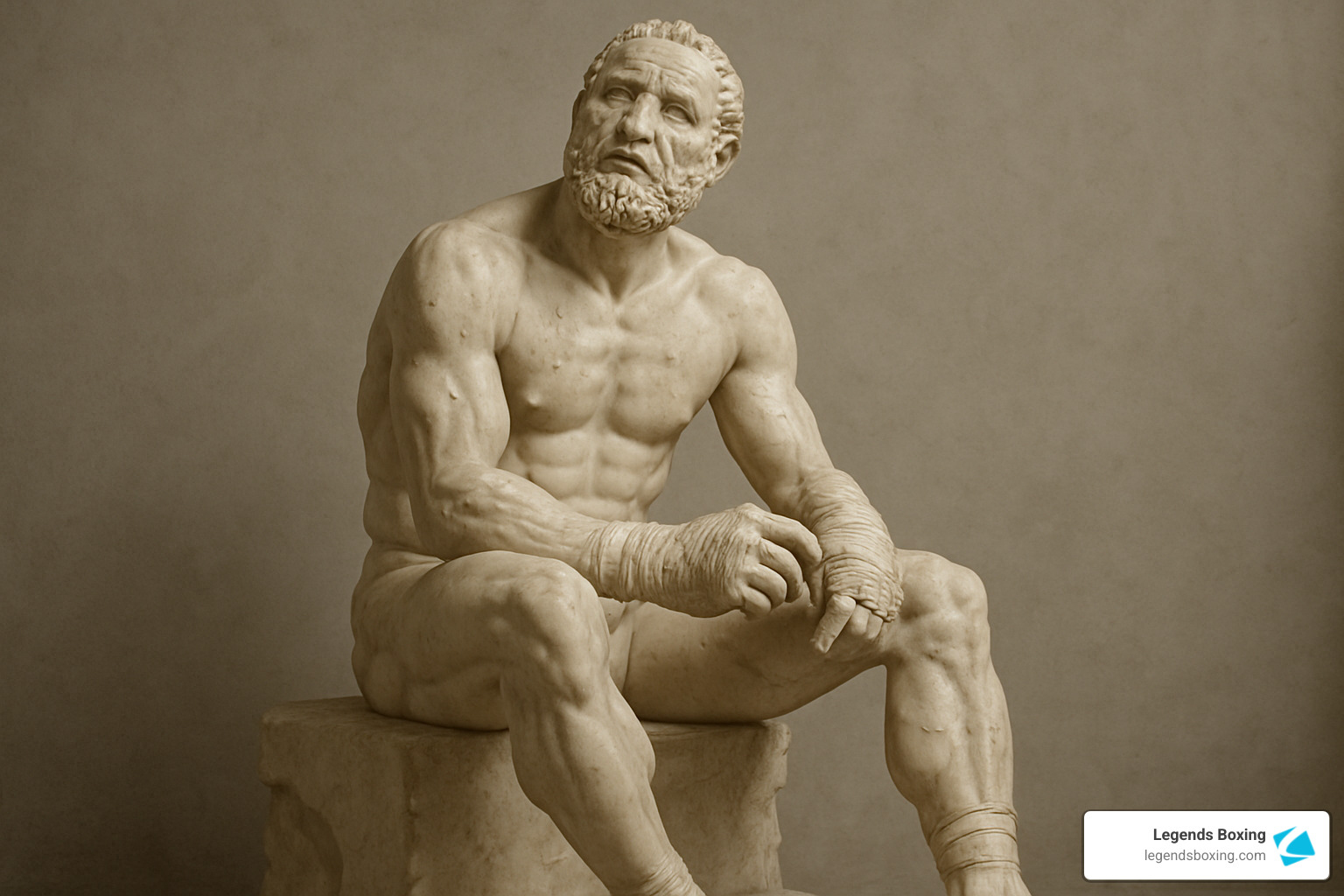
The Romans inherited boxing from the Greeks but turned it into something far more dangerous. They created the "cestus" — essentially a glove embedded with metal studs and spikes. These weapons transformed boxing matches into life-or-death gladiatorial contests that were more about survival than skill. Roman soldiers used boxing as training for hand-to-hand combat, which made practical sense for building an empire. However, the sport's association with brutal gladiatorial spectacles eventually sealed its fate. When Christianity became dominant, boxing was abolished around 393 CE due to its excessive violence.
From Sport to Spectacle in Greece and Rome
Greek boxing was a completely different animal from what we see today. There were no rounds, no weight classes, and no time limits. Fighters kept going until one man either gave up or couldn't continue. Clinching was forbidden, which meant boxers had to rely purely on striking skills and footwork.
Greek fighters wrapped their hands in soft leather strips called "himantes" for protection. By the 4th century BCE, these evolved into "sharp thongs" — thick leather wrappings that covered the knuckles and could do serious damage. Protection and weapon rolled into one.
The Romans took this concept and ran with it in the worst possible way. Their gladiatorial spectacles turned boxing into a blood sport where the cestus often meant fights ended in death. What started as athletic competition became entertainment focused on brutality rather than skill.
When the Roman Empire fell, boxing disappeared with it. The sport that had thrived for thousands of years went underground, waiting for the right moment to make its comeback — in the coffeehouses and back alleys of 18th-century England.
The Rebirth of Boxing: England's Bare-Knuckle Era
After vanishing for over a thousand years, boxing came roaring back to life in 16th-century England. The sport emerged from the shadows as "prizefighting" — raw, unregulated contests where men fought with bare fists for money, honor, and the roar of the crowd.
The spark that reignited boxing history appeared in the London Protestant Mercury on January 6, 1681. This historic bout pitted a butler against a butcher, arranged by Christopher Monck, the Duke of Albemarle. The fight captured public attention and marked the beginning of organized boxing in England after centuries of silence.
By the early 18th century, boxing had woven itself into the fabric of London life. James Figg emerged as the sport's first great champion in 1719, holding the title until 1730. But Figg was more than just a fighter — he was a showman who opened the first boxing school and helped transform boxing from street brawls into legitimate entertainment.
The bare-knuckle era was defined by its brutality and complete lack of rules. Fights had no time limits, no weight classes, and virtually no restrictions. Contests often stretched for hours, with fighters battling until one could no longer stand. These weren't just fights — they were spectacles that drew crowds from every corner of society.
Key figures of the prizefighting world:
- James Figg — father of modern boxing; his promotional genius and boxing school attracted students from all walks of life, including members of the nobility
- Jack Broughton — "Father of English Boxing"; after witnessing the death of opponent George Stevenson in 1741, he created the first set of boxing rules to make the sport safer
- Daniel Mendoza — revolutionized technique in the late 18th century; known as "Mendoza the Jew," he was the first fighter to emphasize footwork, defensive skills, and scientific boxing over brute strength
- Tom Cribb — became a national hero when he defeated American challenger Tom Molineaux in 1811; their rematch drew enormous crowds and helped establish boxing as a spectator sport
The Rules That Shaped the Sweet Science
Imagine watching a boxing match where fighters could wrestle, hit below the belt, and pound on opponents who were already down. That's exactly what boxing history looked like before rules transformed it from brutal chaos into the strategic sport we know today.
The change wasn't sudden. It took centuries of gradual reform, driven by tragic deaths and the growing belief that boxing should test skill rather than just survival instincts. Each set of rules marked a crucial turning point.
Broughton's Rules (1743)
Jack Broughton witnessed something that changed boxing forever. In 1741, his opponent George Stevenson died from injuries sustained in their fight. Broughton was devastated and determined to prevent future tragedies.
Two years later, he introduced the first formal boxing rules:
- No hitting a man when he's down — the first major safety rule
- 30-second count for downed fighters before they must continue
- No grasping below the waist
- A square ring as the defined competition area
- "Mufflers" — padded gloves for training sparring partners safely
Broughton's rules remained the standard for nearly a century. They proved that boxing could be regulated without losing its competitive edge.
The London Prize Ring Rules (1838 & 1853)
These rules built on Broughton's foundation:
- A padded ring with ropes and the concept of "toeing the scratch" — fighters had to meet in the center to start each round
- The rest period between rounds standardized at 30 seconds
- Downed fighters given 8 seconds to continue
- Wrestling moves still permitted — boxing hadn't yet become purely about punching
The 1853 revision addressed loopholes and clarified disputes as the sport grew more sophisticated.
The Marquess of Queensberry Rules (1867)
Everything changed in 1867 when John Graham Chambers drafted new rules under the patronage of John Sholto Douglas, the 8th Marquess of Queensberry. These rules didn't just modify boxing — they revolutionized it:
| Rule | Impact |
|---|---|
| Padded gloves mandatory for all fights | Changed the nature of every punch thrown |
| Three-minute rounds with one-minute rests | Created the rhythm of modern boxing |
| 10-second count for knockdowns | The rule we still use today |
| All wrestling moves banned | Boxing became purely about punching, footwork, and defense |
| Ring standardized at 24 feet square | Fair, consistent competition environment |
| Weight classifications introduced | Ensured fair matchups |
The irony of mandatory gloves wasn't lost on fighters of the time. While gloves protected hands, they actually made boxing more dangerous in some ways — fighters could now throw harder punches without fear of breaking their hands, leading to more knockouts and head injuries.
John L. Sullivan embodied this transition perfectly. He was the last bare-knuckle heavyweight champion, fighting his final bare-knuckle bout against Jake Kilrain in 1889. When Sullivan lost his title to James J. Corbett in 1892, it marked the complete shift to gloved boxing under the Queensberry Rules — and the birth of the modern sport.
From Outlaws to Icons: Boxing's Golden Age
Between the 1890s and 1950s, boxing moved from outlawed barge bouts to one of the world's most-watched sports. Early gloved fights often skirted local laws, but mass media changed everything. Radio broadcasts in the 1920s created national heroes like Jack Dempsey, and weekly television cards soon made the ring a living-room fixture. Promoters such as Tex Rickard lifted boxing from working-class pastime to mainstream spectacle, with venues like Madison Square Garden symbolizing its new respectability.
The First Gloved Champions and Trailblazers
John L. Sullivan bridged eras, finishing as the last bare-knuckle heavyweight king while embracing the Queensberry Rules. His 1892 defeat by James J. Corbett highlighted a shift toward footwork and strategy over sheer brawn.
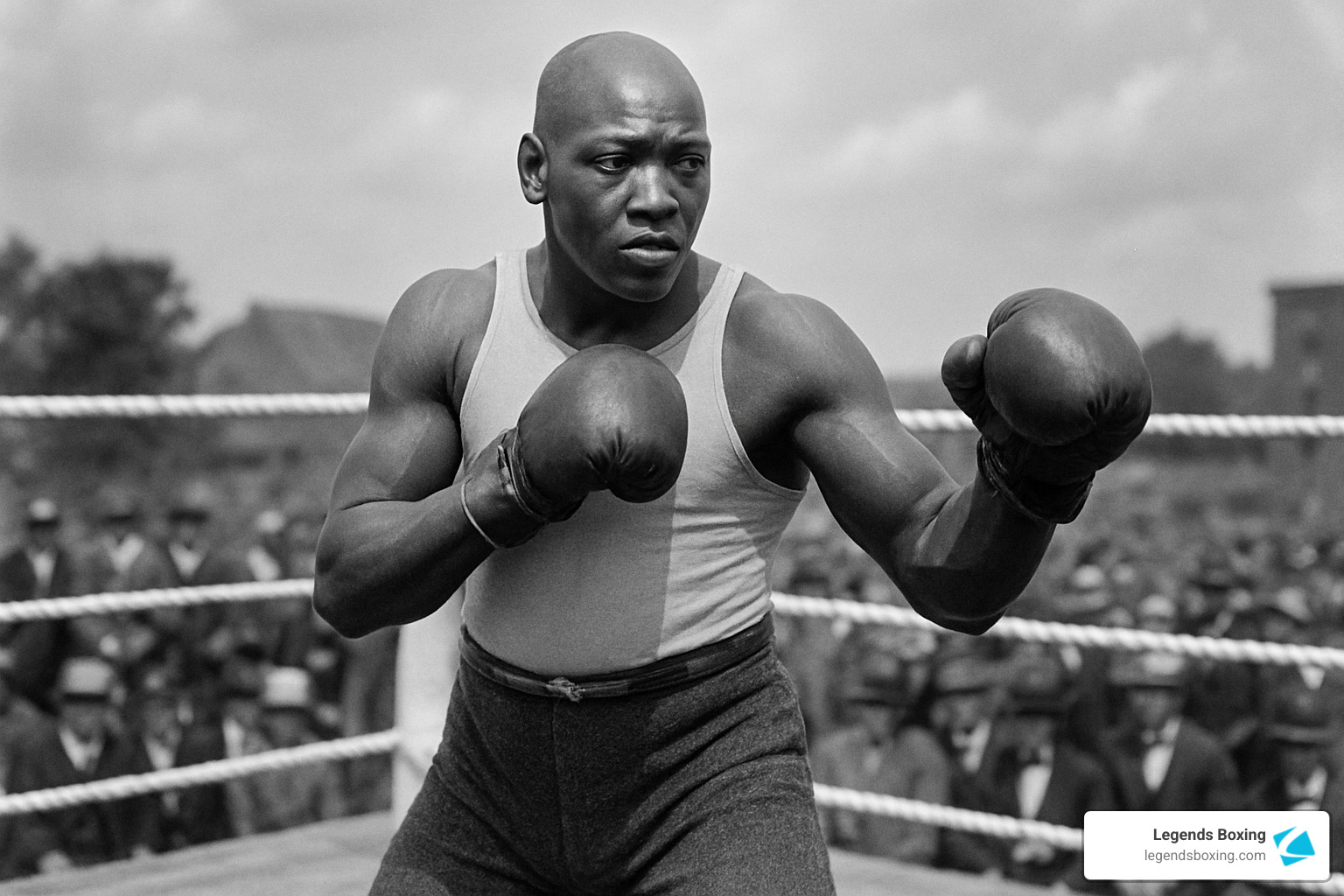
In 1908, Jack Johnson became the first African American heavyweight champion, defying racial barriers and holding the title for seven years despite fierce social backlash. His dominance proved talent transcends prejudice and set the stage for future generations.
Legends of the 20th Century and Beyond
| Champion | Era | Legacy |
|---|---|---|
| Joe Louis | 1937–1949 | Unified a nation; symbolic 1938 victory over Max Schmeling |
| Sugar Ray Robinson | 1940s–1950s | Redefined pound-for-pound greatness through dazzling speed and ring IQ |
| Rocky Marciano | 1952–1956 | Retired 49-0 — the only undefeated heavyweight champion in history |
| Muhammad Ali | 1964–1981 | Blended supreme skill with cultural activism; "The Greatest" |
| Mike Tyson | 1985–1990s | Ushered boxing into the pay-per-view era with record-breaking knockouts |
| Floyd Mayweather Jr. | 1998–2017 | 50-0; defensive mastery redefined the sport's technical ceiling |
| Manny Pacquiao | 1995–2021 | Eight-division world champion; speed and volume punching like no other |
The 2015 Mayweather–Pacquiao bout generated over $600 million, proving the sweet science still thrills global audiences.
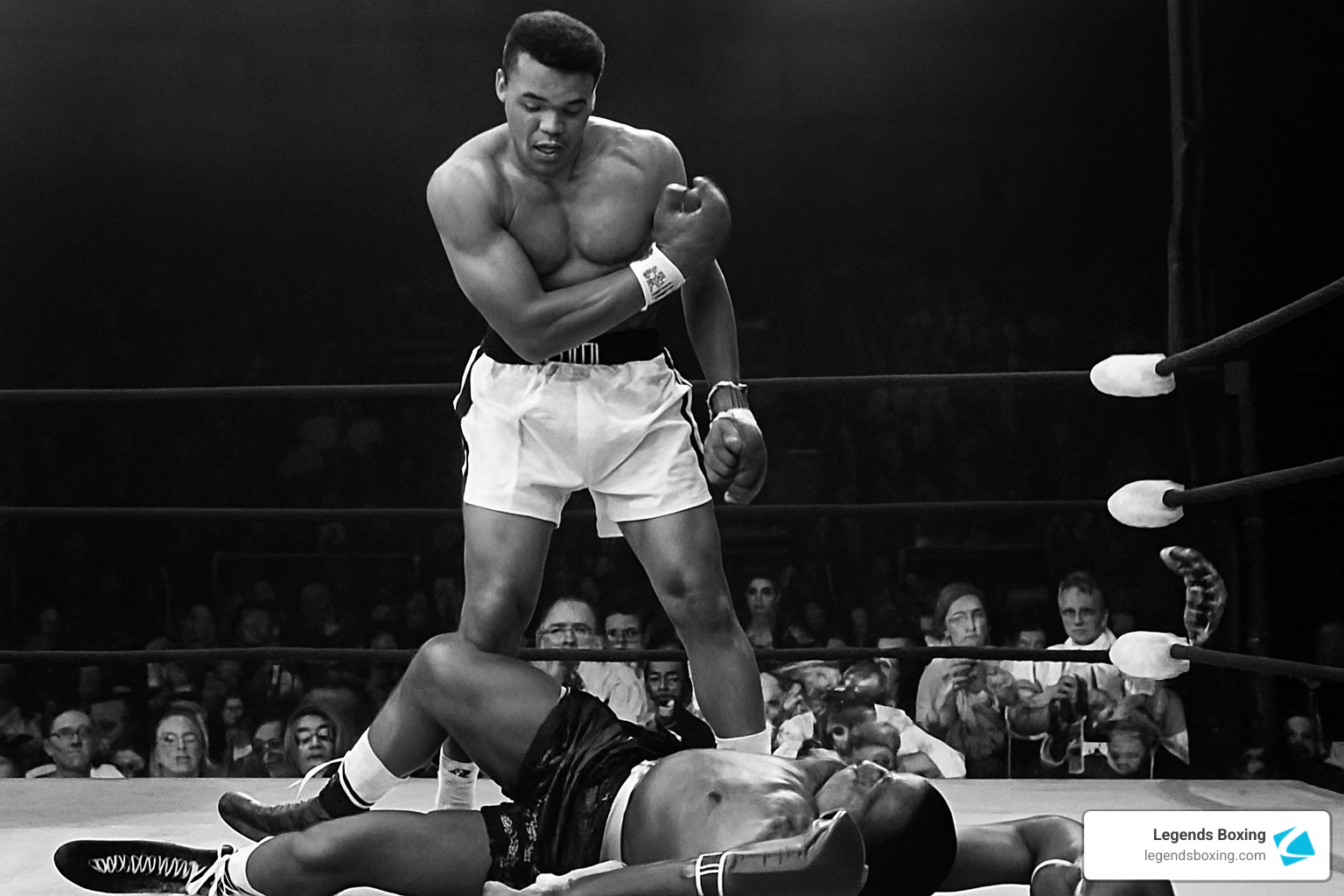
The Enduring Legacy of Boxing
Boxing history reaches far beyond the ropes. Films like Rocky, Raging Bull, and Million Dollar Baby keep its narratives alive, celebrating perseverance and resilience. Literature from Norman Mailer to Joyce Carol Oates mines the ring for deeper human truths.
More importantly, boxing remains a ladder of opportunity. Legends such as Muhammad Ali, Sugar Ray Leonard, and Oscar De La Hoya used the sport to rise from poverty, while community gyms worldwide still teach discipline, respect, and self-belief.
The Evolution of Boxing Training
Early fighters relied on manual labor conditioning and word-of-mouth tips. The transformation from that era to today is staggering:
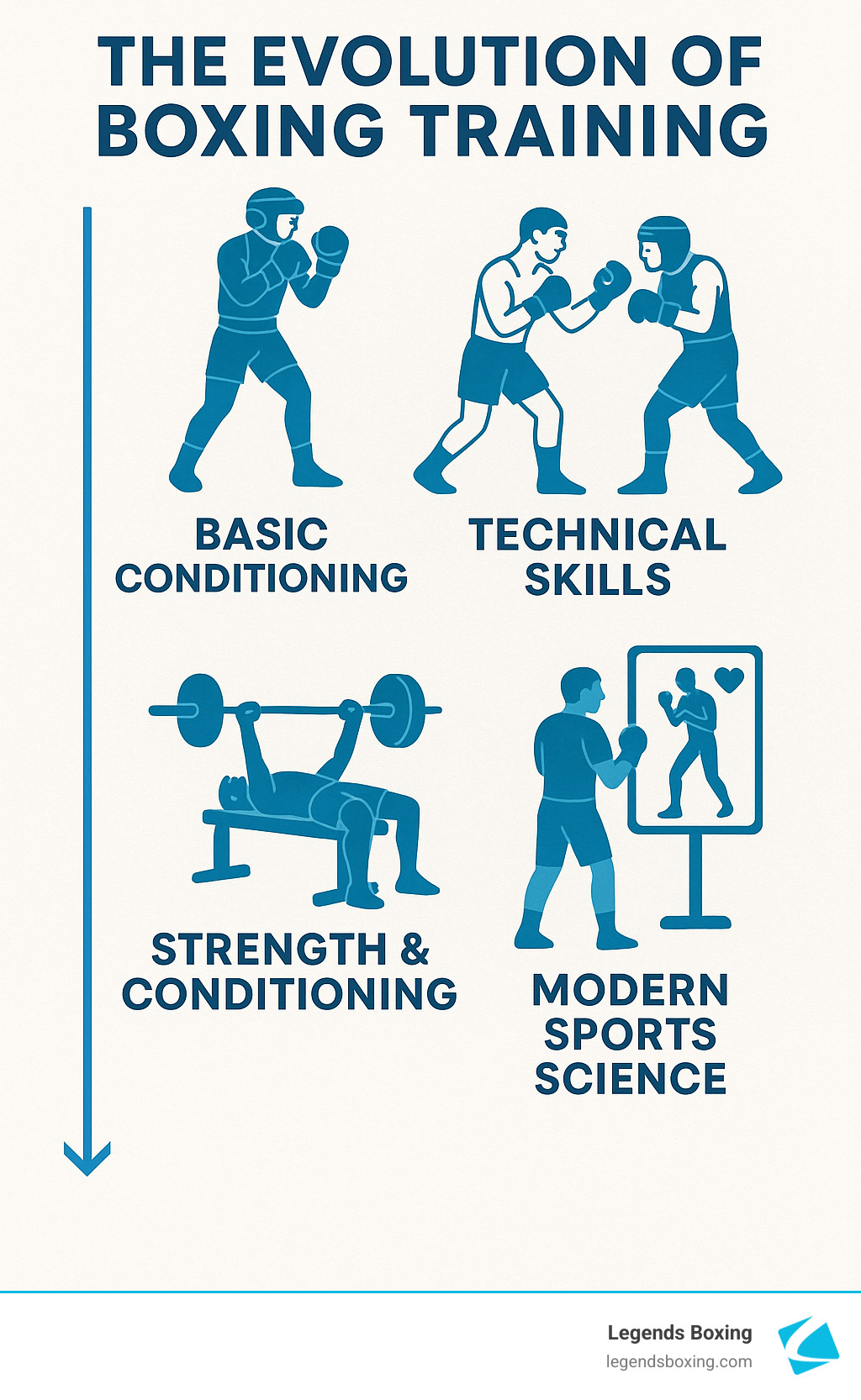
Today's boxers drill advanced footwork patterns, defensive maneuvers, and combination punching while following evidence-based strength, mobility, and recovery plans. Visualization, tactical analysis, and targeted nutrition complete the modern toolkit — transforming boxing into a synthesis of art and science.
At Legends Boxing, we blend proven fight fundamentals with safe, high-energy workouts so anyone can experience the sport's power. See what to expect in a modern boxing class and start your own chapter of this 5,000-year story.
Frequently Asked Questions about Boxing History
What was the most important rule change in boxing history?
The Marquess of Queensberry Rules (1867) — they mandated padded gloves, three-minute rounds with one-minute rests, and a 10-second count for knockdowns, replacing chaotic brawls with a structured contest that rewards technique over brute strength. Every professional boxing match you watch today operates under rules descended directly from this 1867 document.
Who is considered the first boxing champion?
James Figg became England's acknowledged bare-knuckle champion in 1719. Beyond winning bouts, he promoted fights and opened a boxing school, earning the title "Father of Modern Boxing." He was the first to turn boxing from street violence into organized entertainment.
How has public perception of boxing changed over time?
Once viewed as illicit violence, boxing gained legitimacy through safety rules and media exposure. The sport peaked in mid-20th-century pop culture, later faced competition from mixed martial arts, and today enjoys renewed popularity through fitness programs that highlight its conditioning benefits while promoting safe participation.
The Story Isn't Over — It Includes You
The story of boxing history is truly remarkable — a journey spanning from ancient warriors training for battle to world-class athletes competing on the global stage. What started as raw, brutal combat in the streets of 18th-century London transformed into something beautiful: a sport that celebrates skill, strategy, and the incredible potential of human athleticism.
Boxing has reinvented itself countless times. Ancient Greeks used it to train soldiers. Romans turned it into deadly spectacle. The English revived it as prizefighting. And visionaries like Jack Broughton and the Marquess of Queensberry shaped it into the sweet science we know today.
The champions who made this history — from James Figg's showmanship to Muhammad Ali's poetry in motion — remind us why this sport captures our imagination. They weren't just athletes; they were artists. Their stories of overcoming odds, facing fears, and achieving greatness speak to something deep in all of us.
What's remarkable is how boxing's core values have remained constant throughout the centuries. Discipline. Respect. Perseverance. Mental toughness. These qualities that made ancient Greek fighters formidable are the same ones that help people transform their lives in boxing gyms today.
At Legends Boxing, we're proud to carry this incredible legacy forward — taking authentic training methods that have shaped champions for generations and making them accessible to everyone. When you throw your first jab or master your first combination, you're not just getting fit. You're connecting with thousands of years of human achievement.
Boxing's story is still being written. And the next chapter might just include you.
Find a Legends Boxing location near you and start your journey. Or book your first free workout today — no prior experience required.