
Decoding the Ring: Your Complete Guide to Boxing Odds History
Boxing odds history tells the most dramatic stories in sports — from 42-to-1 underdogs shocking the world to legendary champions falling when they seemed unbeatable. This guide traces the sport's betting history from 18th-century bare-knuckle wagers to modern mobile apps, chronicles the five greatest upsets ever recorded, and explains how oddsmakers work, how technology transformed the industry, and why the numbers always tell a deeper human story.
The Story Behind Every Great Boxing Upset
Boxing odds history tells the most dramatic stories in sports — from 42-to-1 underdogs shocking the world to legendary champions falling when they seemed unbeatable. These numbers freeze moments of pure sporting magic in time.
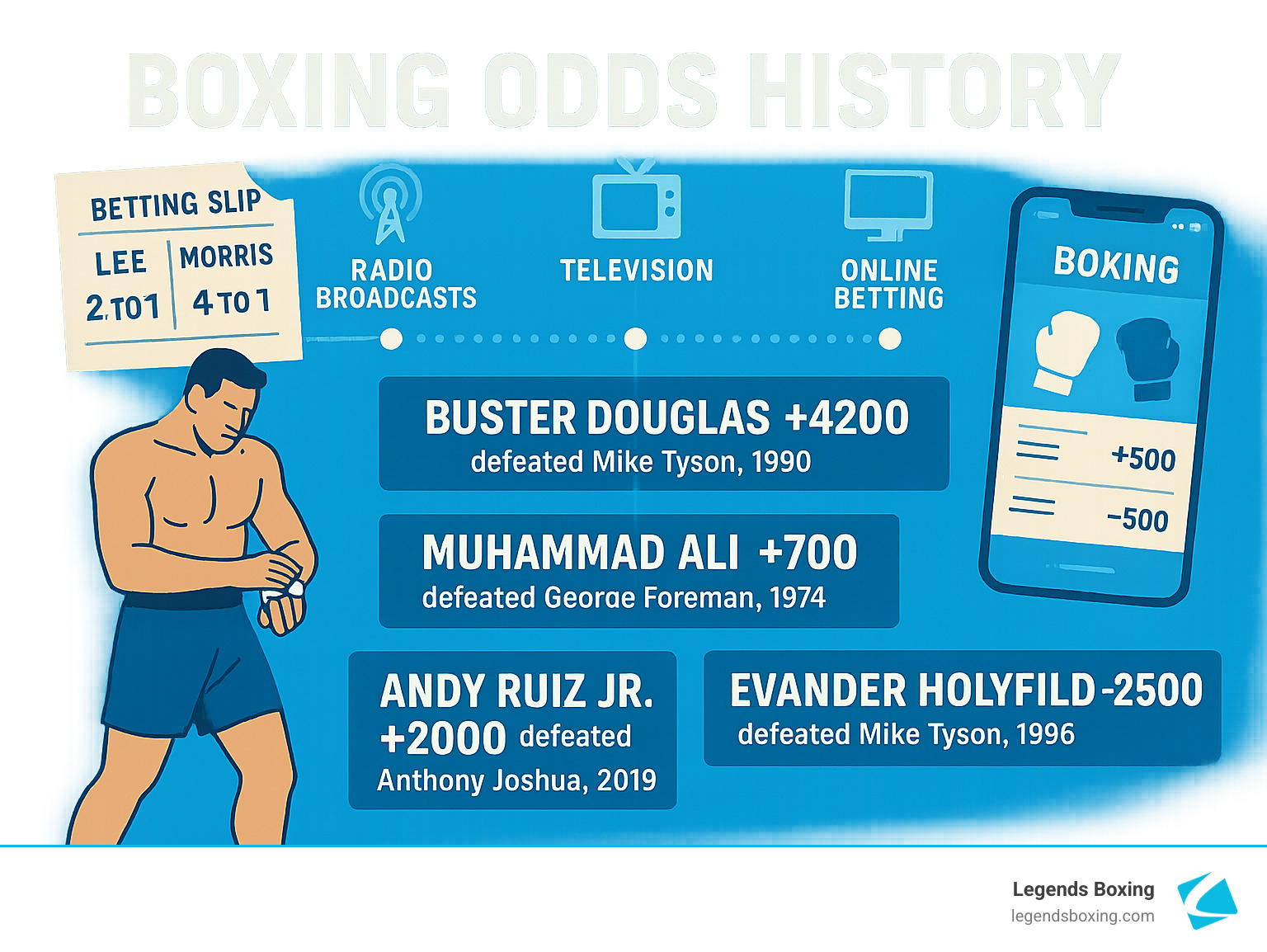
Key moments in boxing odds history:
| Fighter | Odds | Opponent | Year | Venue |
|---|---|---|---|---|
| Buster Douglas | +4200 | Mike Tyson | 1990 | Tokyo Dome |
| Muhammad Ali | +700 | George Foreman | 1974 | Kinshasa, Zaire |
| Andy Ruiz Jr. | +2000 | Anthony Joshua | 2019 | Madison Square Garden |
| Evander Holyfield | +2500 | Mike Tyson | 1996 | MGM Grand |
| James Braddock | +1000 | Max Baer | 1935 | Long Island City |
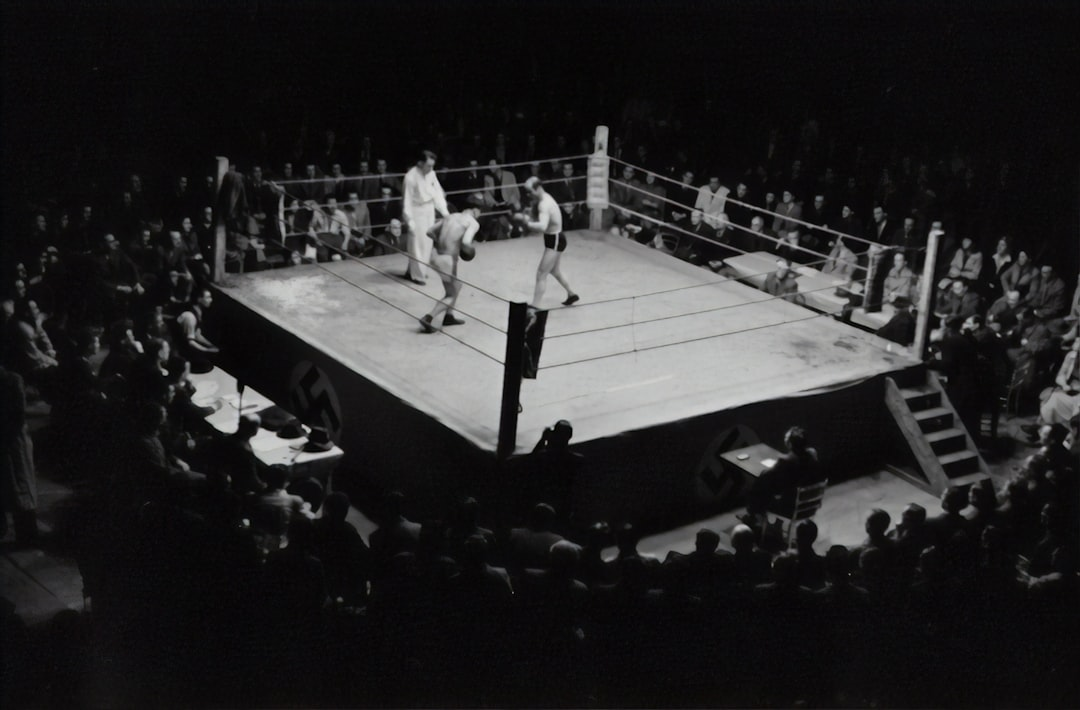
From 18th-century bare-knuckle brawls to today's global mega-fights, boxing and betting have always been linked. The odds capture the fear, hope, and raw emotion that makes boxing the ultimate human drama. Every massive upset reminds us why we love this sport. The numbers tell stories that Hollywood couldn't write better.
I'm Robby Welch, National Head Coach at Legends Boxing. My passion for boxing odds history stems from seeing how the sport's greatest upsets mirror the resilience we build in our members every day.
The Early Days: From Ringside Wagers to Regulated Betting
In 18th-century England, the birth of boxing odds history began with raw, simple wagers on bare-knuckle brawls. The Marquess of Queensberry Rules in the mid-1800s brought structure with rounds and gloves, making fights more predictable and attracting serious betting. Bookmakers evolved from shouting numbers to studying fighters' records and balancing their books to ensure a profit.
When boxing boomed in early 20th-century America, newspaper odds reporting brought betting to the masses. Media narratives became powerful, shaping a fighter's odds based on their backstory as much as their skill. The press didn't just report the fights — they shaped how people bet on them.
The Bookmaker's Role in Shaping Boxing History
Oddsmakers are the real experts in boxing, turning analysis into mathematics. They set an opening line by weighing everything from recent performance to a fighter's personal life. Their main goal is balancing the book — adjusting odds to get equal money on both sides, managing risk.
When too much public money favors one fighter, they make the underdog more attractive. Conversely, sharp money from professional bettors can cause major line shifts, because bookies respect informed opinion. The result is a living, breathing market that reflects the full weight of public knowledge and emotion.
Weight Classes and Betting Interest
The heavyweight division's dominance in betting is undeniable — names like Ali and Tyson moved mountains of money. However, "glamour divisions" like welterweight also generate serious action with their mix of skill and power.
Championship stakes amplify betting volume significantly. A title on the line turns a fight into a legacy-defining event, capturing far more interest than non-title bouts. The bigger the story, the more money flows — and the more the odds reflect narrative as much as reality.
5 of the Biggest Upsets in Boxing Odds History
The magic of boxing odds history lies in the jaw-dropping upset — the moment an underdog shatters the myth of a champion's invincibility. While the favorite carries the weight of expectation, the longshot fights with the freedom of having nothing to lose. When oddsmakers set lines of 20-to-1 or higher, they declare a fight a foregone conclusion. Boxing has a way of humbling everyone.
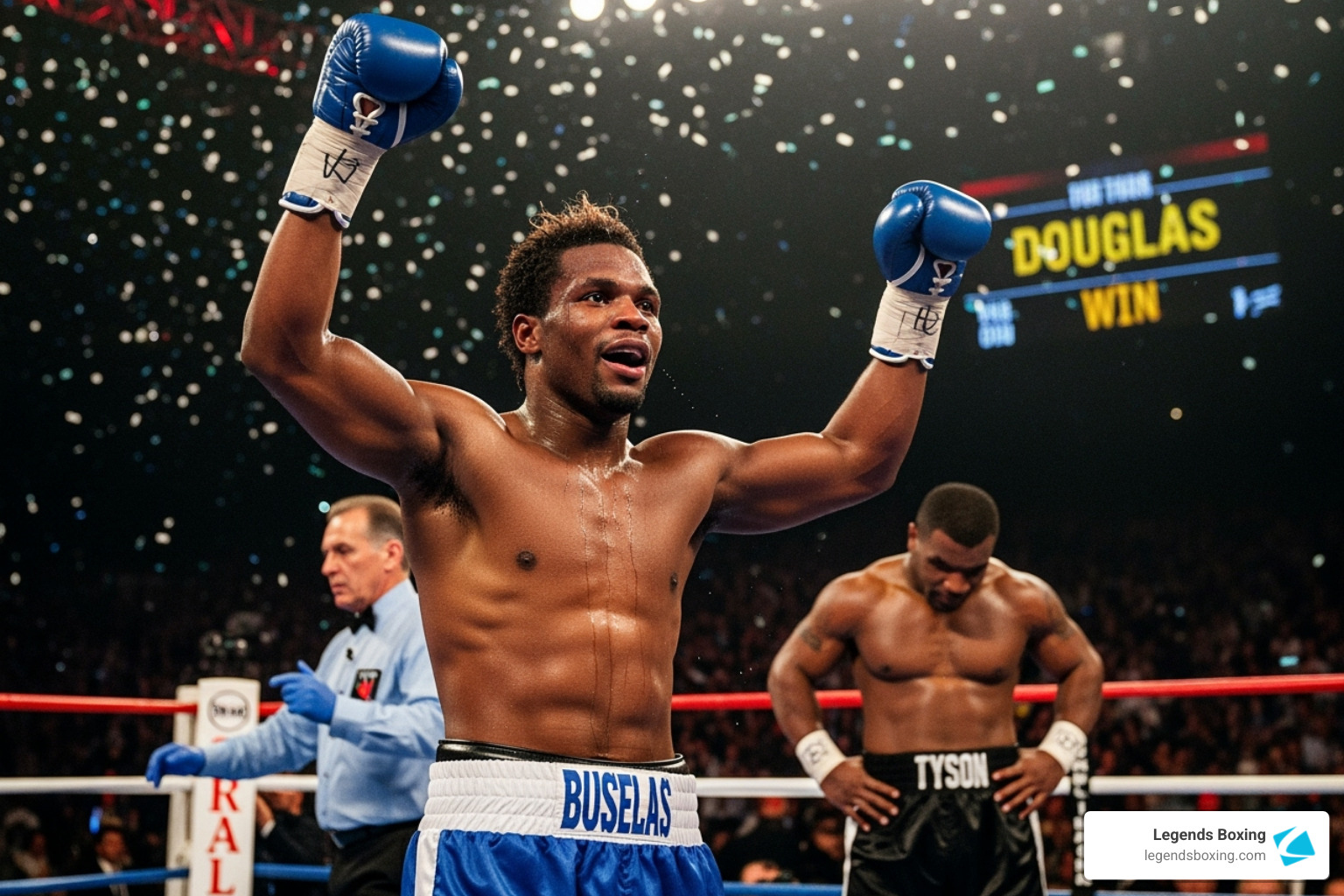
1. James "Buster" Douglas (+4200) vs. Mike Tyson (−4200)
February 11, 1990. Tokyo Dome. The night that changed everything.
Mike Tyson was more than a champion — he was a force of nature. As "The Baddest Man on the Planet," he had crushed 37 straight opponents, often breaking their spirits before the first bell rang. The boxing odds history reflected this: Tyson was a crushing −4200 favorite. A $4,200 bet was needed to win just $100. James "Buster" Douglas was a staggering +4200 underdog.
Douglas wasn't supposed to compete, let alone win. This was meant to be another Tyson demolition job.
But in Tokyo, Douglas — fueled by a determination no one saw coming — did the impossible. He survived Tyson's early assault and fired back with crisp jabs and powerful combinations. Then came the 10th round. Douglas landed a perfect combination that sent Tyson crashing to the canvas. The referee waved it off. The boxing world went silent.
This wasn't just an upset — it was the single biggest shock in sports history. For Tyson, the loss shattered his aura of invincibility. For Douglas, those 42-to-1 odds became the sweetest numbers in boxing odds history.
2. Muhammad Ali (+700) vs. George Foreman (−700)
October 30, 1974. Kinshasa, Zaire. The Rumble in the Jungle.
George Foreman was one of the most feared fighters ever. His devastating power had destroyed Joe Frazier and Ken Norton — two men who had given Ali trouble — and at 25, he seemed unstoppable. Oddsmakers made Foreman a commanding −700 favorite.
Muhammad Ali, at 32, was seen as yesterday's man. At +700, many believed his best days were behind him and that Foreman's raw power would be too much.
But Ali possessed pure boxing genius. As the crowd chanted "Ali, boma ye!" (Ali, kill him!), he unveiled his legendary Rope-a-Dope strategy — leaning against the ropes, absorbing Foreman's punches while whispering taunts like, "Is that all you got, George?" By the eighth round, the mighty Foreman was spent. Ali struck with a perfect combination that sent Foreman to the canvas.
Ali had outsmarted the odds through sheer brilliance, proving that experience and ring intelligence could triumph over youth and power.
3. James "Cinderella Man" Braddock (+1000) vs. Max Baer (−1000)
June 13, 1935. A real-life fairy tale in the depths of the Great Depression.
Max Baer was a powerful, intimidating heavyweight champion known for his lethal right hand. A crushing −1000 favorite, he lived a glamorous life outside the ring.
James J. Braddock was a former contender whose career had crumbled. Forced to work on the docks to feed his family, he even had to accept government relief money. As a +1000 longshot, virtually nobody gave the washed-up dock worker a chance.
That night, Braddock fought like a man possessed. He absorbed Baer's best shots and outboxed the champion over a grueling 15 rounds. When his hand was raised, it was a symbol of hope for an entire nation — proof that the human spirit could triumph against impossible odds.
The victory earned Braddock the nickname "Cinderella Man," inspiring a Hollywood film decades later. In dark times, Braddock showed that sometimes the longest shots are worth taking.
4. Evander Holyfield (+2500) vs. Mike Tyson (−2500)
November 9, 1996. MGM Grand, Las Vegas.
Fresh out of prison, Mike Tyson was back with a vengeance, destroying opponents on his comeback trail. Bookmakers made him a massive −2500 favorite. Evander Holyfield at +2500 was seen as a faded warrior past his prime — many critics feared for his safety.
But Holyfield had other plans. From the opening bell, he stood toe-to-toe with Tyson, matching his aggression punch for punch. His brilliant game plan unfolded round by round: clinching inside, landing clean shots, never showing fear, and systematically breaking down the invincible Tyson.
In the 11th round, a perfectly timed combination sent Tyson stumbling, and the referee stepped in. The MGM Grand erupted. This victory set up one of boxing's most infamous sequels — the notorious "Bite Fight" — but on this night, it was pure boxing magic.
5. Andy Ruiz Jr. (+2000) vs. Anthony Joshua (−2400)
June 1, 2019. Madison Square Garden, New York.
Anthony Joshua, the undefeated unified heavyweight champion, was boxing's golden boy. Making his US debut with a perfect 22-0 record, he was an overwhelming −2400 favorite. After Joshua's original opponent failed a drug test, Andy Ruiz Jr. stepped in as a +2000 underdog and late replacement.
Ruiz, with his soft physique, didn't look the part. The 20-to-1 odds seemed generous. But boxing doesn't care what you look like — only what you can do when the bell rings.
What followed was chaos. Ruiz's lightning-fast hands caught Joshua early and often. The champion hit the canvas four times before the fight was stopped in the 7th round via TKO.
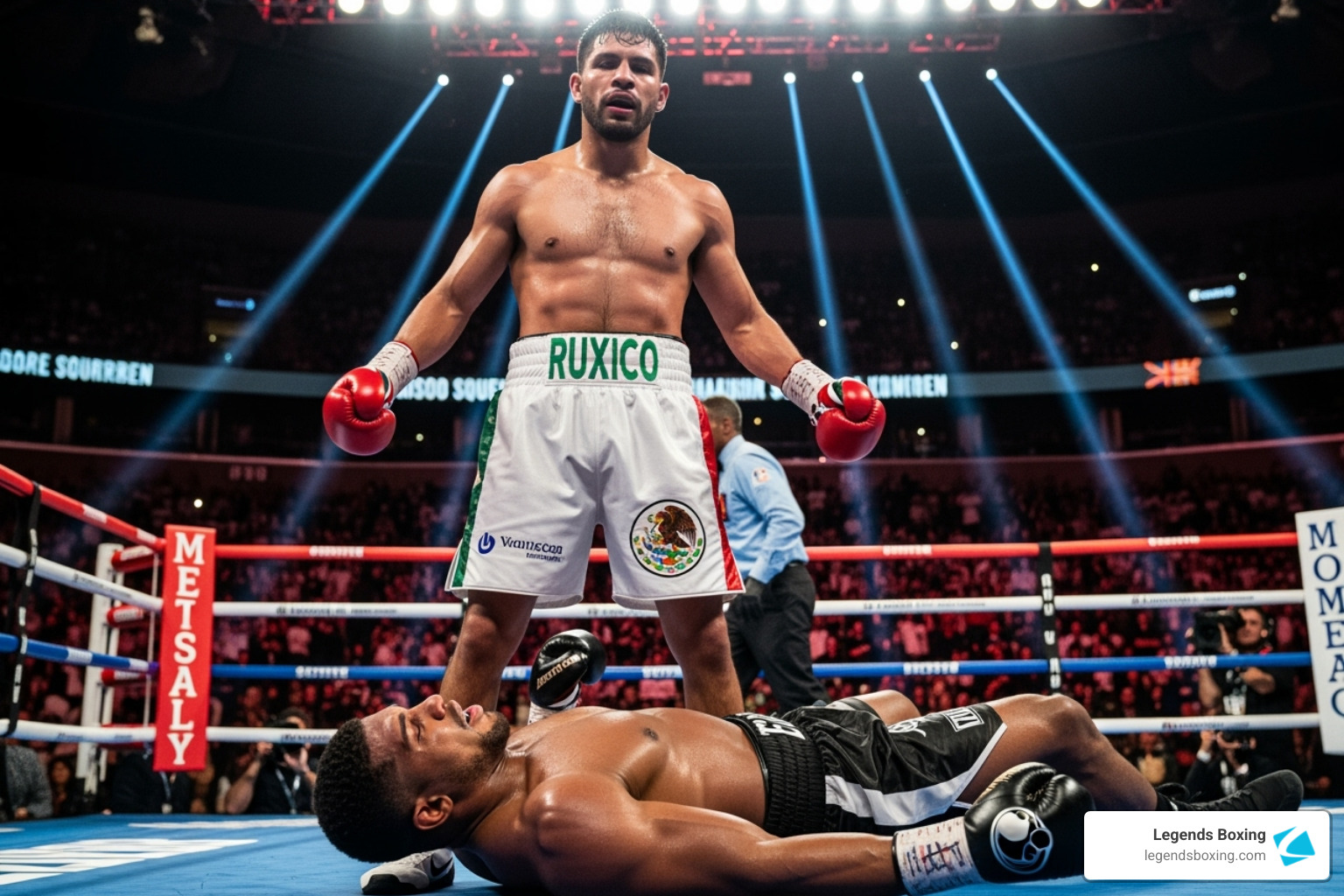
As Ruiz said after the fight: "This is what dreams are made of."
The Evolution of Boxing Bets and Technology
A century ago, betting on boxing meant finding a local bookie. Today, you can place complex bets from your phone. The journey of boxing odds history has moved from handshake deals to high-tech algorithms.
From Moneyline to Prop Bets: A Bettor's Toolkit
In the past, moneyline betting — simply picking a winner — was the standard. Now the options are vast:
| Bet Type | What You're Wagering On |
|---|---|
| Moneyline | Who wins the fight |
| Over/Under rounds | Whether the fight goes longer or shorter than a set number of rounds |
| Method of victory | How the winner wins: KO, TKO, or decision |
| Round betting | The exact round the fight ends — high reward, high risk |
| Prop bets | Specific events: knockdowns, total punches, point deductions |
Prop bets have been the biggest innovation, allowing wagers on specific in-fight events that reward deep analysis. These detailed wagers have added rich new chapters to boxing odds history.
The Digital Age of the Sweet Science
The evolution of betting mirrors the sport's own technological journey:
- Radio broadcasts — created a national audience and fueled mass betting interest for the first time
- Television — brought fights into living rooms and made boxing's biggest stars household names, amplifying the money behind every major bout
- Online sportsbooks — made betting accessible to millions regardless of geography
- Mobile betting apps — made it possible to place a bet from anywhere with a tap
- Live (in-play) betting — the latest innovation, allowing wagers as the action unfolds round by round
This digital age also provides unprecedented access to historical data, with deep archives of historical boxing odds available to anyone. What started as shouted bets at ringside has become a sophisticated, data-driven ecosystem that has changed how we understand and appreciate the sweet science itself.
Frequently Asked Questions
What was the single biggest betting upset in boxing?
While Buster Douglas's 42-to-1 (+4200) victory over Mike Tyson is the most famous upset, some fights have featured even longer odds — Dejan Zlaticanin was a −10000 favorite when he lost to Roberto Ramirez in 2018. The Douglas-Tyson fight remains the most legendary because the story behind the numbers matters most: a personal tragedy, a dismissed challenger, and a world-changing knockout that nobody saw coming.
How do oddsmakers determine the lines for a fight?
Oddsmakers analyze fighter records, style matchups, age, recent performances, and training camp reports. They also watch where the money flows, adjusting lines to balance their books and encourage action on the underdog. Their goal is to manage risk, not predict the winner — the perfect line is one where they profit regardless of outcome.
How has media coverage influenced boxing odds history?
Media has always been boxing's hype machine, directly influencing odds. In the past, newspapers shaped public opinion. Today, shows like HBO's 24/7 and social media create powerful narratives that can sway public betting, causing odds to shift based on perception rather than reality. This creates opportunities for savvy bettors who can separate hype from fact — and it's why the largest line movements in history have often preceded the sport's biggest upsets.
The Story Behind the Numbers
Boxing odds history isn't just about numbers — it's the DNA of the sport, capturing every moment of shock and glory. When Buster Douglas faced Mike Tyson as a 42-to-1 underdog, the odds told a story of impossibility. But boxing has always been about more than predictions.
The discipline and heart of a fighter can defy all expectations. We see this truth again and again, from Muhammad Ali outsmarting George Foreman to Andy Ruiz Jr. stunning Anthony Joshua. The human spirit has an amazing ability to flip the script.
From bare-knuckle brawls to modern mobile betting, the link between boxing and its fans has never wavered. The technology changed, but the core excitement of watching someone overcome impossible odds remains the same.
At Legends Boxing, we see that same spirit every day. Our members — often brand new to the sport — find a strength they never knew they had, just like those legendary underdogs. No boxing experience required. Just the will to surprise yourself.
The odds might have counted out Douglas, Ali, and Ruiz — but they found their power anyway. Ready to find yours? Book a free class at Legends Boxing and start writing your own comeback story. Find a location near you across Utah, Texas, and Florida.