
Beyond the Basics: Heavy Bag Technique Drills and Tips to Sharpen Your Boxing Skills
Heavy bag technique drills transform a simple workout into a skill-building powerhouse. This guide covers the fundamentals you need before throwing a punch, essential drills for beginners through advanced boxers, a complete 30-minute structured workout, the most common mistakes to avoid, and the full-body benefits that make heavy bag training the most versatile tool in boxing.

Why Heavy Bag Training Goes Beyond Basic Cardio
Heavy bag technique drills are the foundation of effective boxing training, transforming a simple workout into a skill-building powerhouse. While many people see heavy bags as just cardio equipment, they're actually precision tools for developing power, speed, accuracy, and defensive skills.
Essential Heavy Bag Technique Drills at a Glance:
- Power drills — Building explosive force through proper hip rotation and core engagement
- Speed combinations — Developing hand speed with rapid-fire punch sequences
- Footwork patterns — Moving around the bag to practice angles and distance
- Defensive counters — Slip, duck, and counter-attack combinations
- Endurance circuits — High-volume punching to build stamina and mental toughness
The research shows that heavy bag training improves cardiovascular health, builds functional strength, improves coordination, and serves as powerful stress relief. As one expert puts it: "When it comes to fight training, there is no other basic staple quite like the use of a heavy bag."
The key difference between random bag hitting and structured drills? Technique drills teach you to punch with purpose — combining proper form with strategic combinations that translate to real boxing skills.
I'm Robby Welch, National Head Coach at Legends Boxing, where I've developed comprehensive heavy bag technique drills used across our nationwide locations. Through coaching thousands of members and competing as an amateur boxer, I've seen how proper heavy bag training transforms both fitness and confidence.
Why Train with a Heavy Bag? The Full-Body Benefits
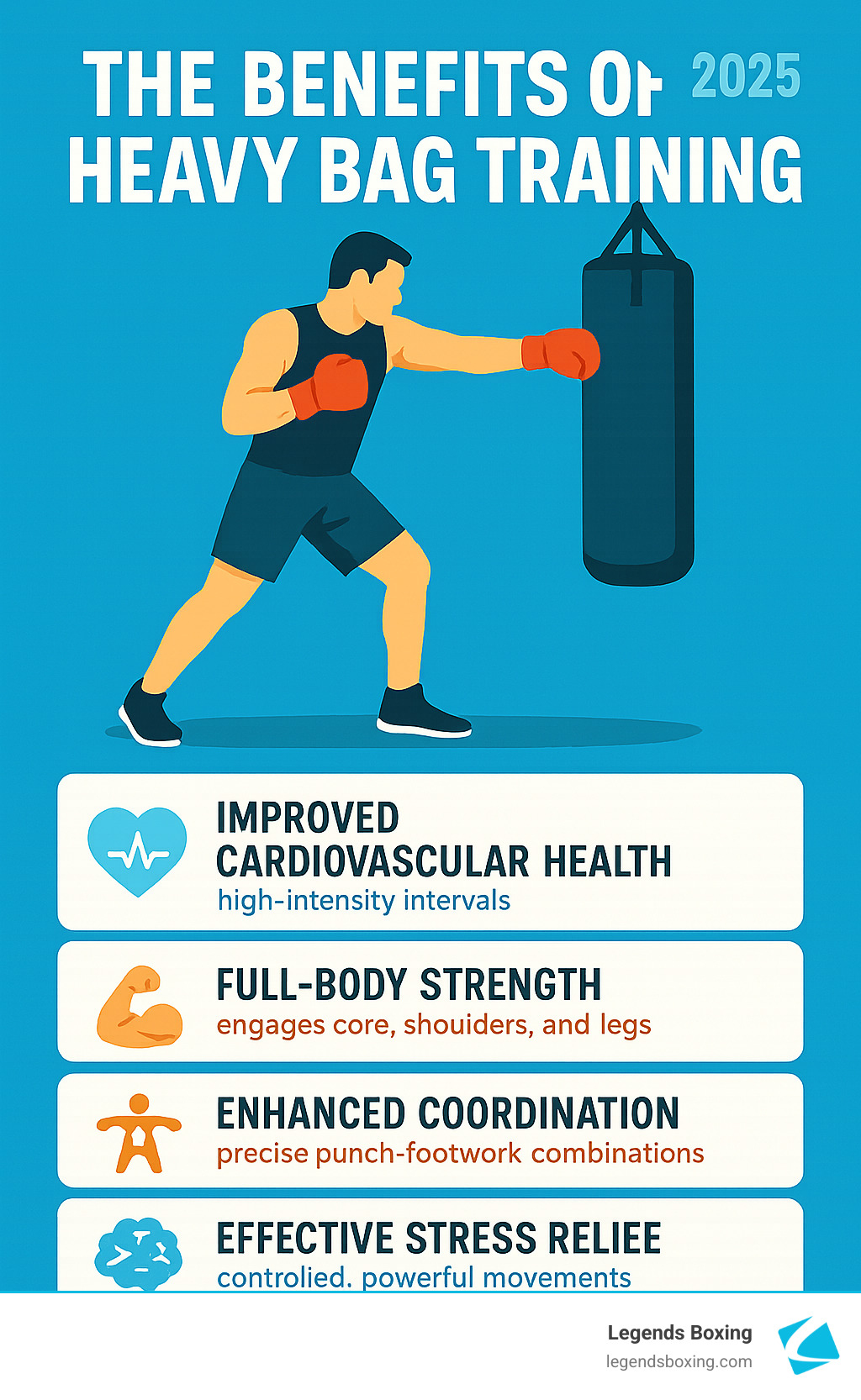
Improved Cardiovascular Health: Heavy bag technique drills deliver high-intensity interval training that strengthens your heart, improves stamina, and burns calories more efficiently than traditional steady-state cardio.
Full-Body Strength: Every punch is a chain reaction — power starts in your feet, travels through your legs and core, and explodes out your fist. Your shoulders, back, arms, core, and legs all develop functional strength simultaneously.
Enhanced Coordination: Targeting specific areas of the bag while moving your feet forces your brain and body to work in sync. This precision training sharpens reflexes and hand-eye coordination that carry over into everyday life.
Effective Stress Relief: The physical exertion combined with rhythmic punching offers a powerful therapeutic release. Walking into a class stressed and walking out refreshed is something our Legends Boxing members describe every single day.
Mastering the Fundamentals: Before You Throw a Punch
Think of learning heavy bag technique drills like learning to drive a car. Before you hit the highway, you need to know where the brakes are. The same goes for boxing — before you start throwing combinations, you need to master the basics that will keep you safe and help you hit with real power.
Your Proper Boxing Stance
Your stance is your home base. Stand with your feet about shoulder-width apart, with your non-dominant foot slightly forward. Your weight should be evenly distributed, knees slightly bent like you're ready to spring into action. Keep your hands up protecting your face, with your elbows tucked in to guard your ribs.
This might feel awkward at first, but this stance is your foundation for everything that follows. It gives you balance when you throw punches, keeps you ready to move, and helps you generate real power from the ground up.
Hand Protection Is Non-Negotiable
Hand wraps are your first line of defense. They support all the small bones and joints in your hands and wrists that weren't designed to punch heavy objects repeatedly. Think of them as a hug for your hands — they keep everything snug and aligned.
Boxing gloves are your armor. For heavy bag work, you'll want 14–16 oz gloves. They absorb impact and protect your knuckles. As one experienced boxer put it: "You should never be bending your wrist when you punch." Good gloves and wraps help you maintain that straight, strong wrist position.
The 6 Basic Punches: Your Complete Offensive Toolkit
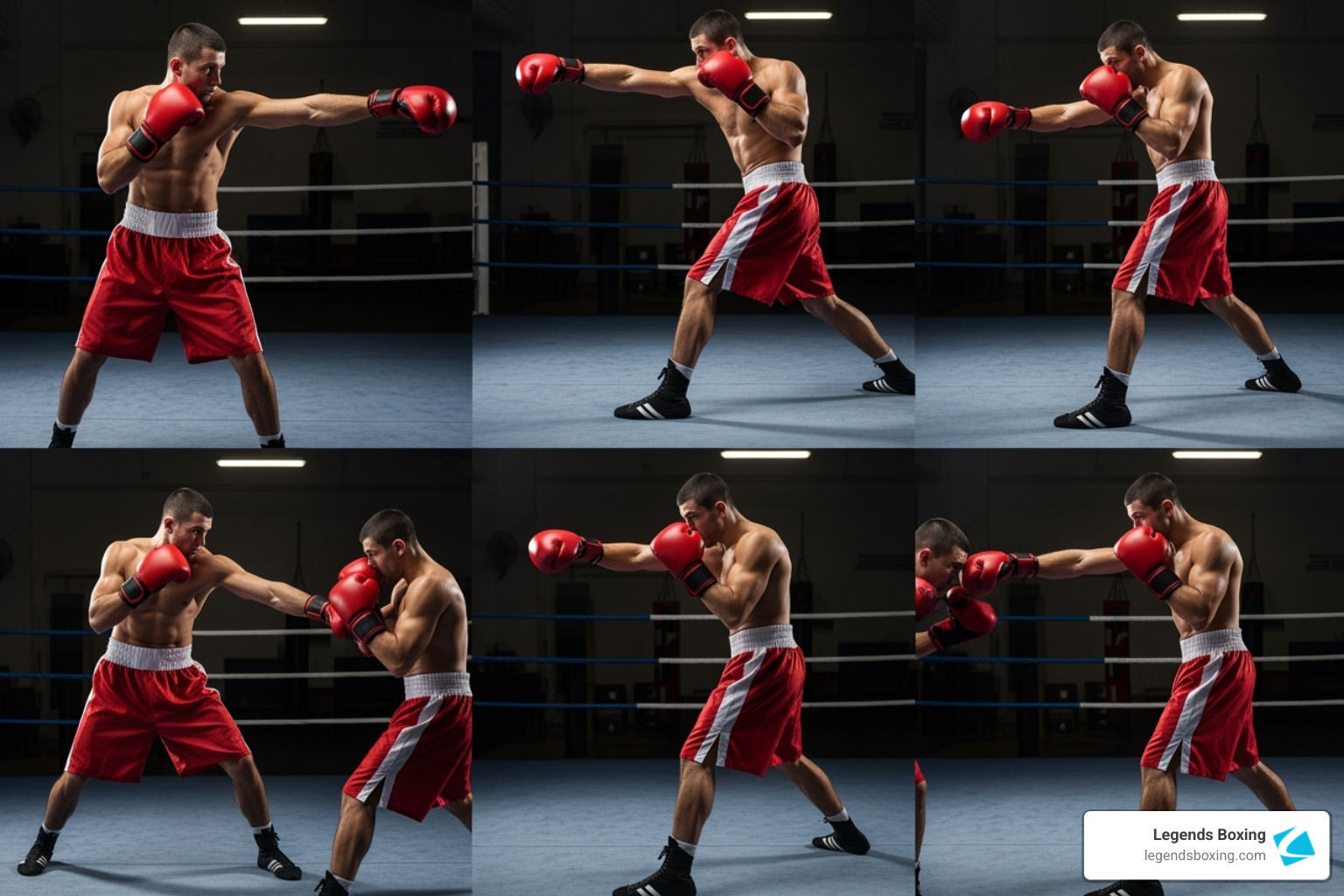
- The Jab (1): Your most reliable punch — quick, straight from your chin with your lead hand. Use it to measure distance, set up bigger punches, and control the rhythm of the round.
- The Cross (2): Your power punch, thrown with your rear hand. The magic happens when you rotate your hips and pivot your back foot, sending all that power through your fist.
- Lead Hook (3) and Rear Hook (4): The curveballs of boxing. Instead of going straight, these punches arc around to hit the side of the bag. Keep your elbow bent at about 90 degrees — like you're swinging a door closed, but with a lot more power.
- Lead Uppercut (5) and Rear Uppercut (6): Your upward strikes. Drop your shoulder slightly, then drive your fist upward like you're trying to punch through the ceiling. Perfect for close-range work and mixing up your attack angles.
The secret that separates real boxers from people just hitting stuff: your arms are just the delivery system. The real power starts from your feet, travels up through your legs, explodes through your hips and core, and snaps out through your fist. Every punch is a full-body event.
Breathing technique is equally critical. Exhale sharply on impact with each strike — it sounds like a quick "tss" or "shh." This isn't just for show; it adds power to your punches, helps you maintain rhythm, and keeps you from getting winded too quickly.
Essential Heavy Bag Technique Drills: From Beginner to Advanced
Think of heavy bag technique drills as your boxing toolkit — each one builds specific skills that transform you from someone who just hits the bag into someone who truly boxes it. We start with simple, controlled movements and gradually add layers of complexity, speed, and power.
Foundational Drills for Beginners
When you're just starting out, resist the urge to go full Rocky Balboa on that bag. Focus on control first — power will come naturally once your technique is solid.
The Jab & Move Drill
Throw a crisp jab, then immediately shift your feet. Step left, step right, step back, or step forward — but never stay planted in one spot. This drill teaches you to punch and move simultaneously, which is crucial for real boxing. Standing still makes you a sitting duck, even against a bag that can't hit back.
Circling the Bag
Without throwing a single punch, simply move around the heavy bag like you're dancing with it. Keep your hands up, maintain your boxing stance, and focus on smooth footwork. Change directions, practice your angles, and always stay the same distance from the bag. This builds the foundation for all future movement patterns.
The Classic 1-2 (Jab-Cross)
Boxing's bread and butter. Your jab sets up the cross by gauging distance and creating an opening. After throwing your cross, immediately snap both hands back to your guard position — this habit could save you from getting countered in sparring. Practice this combo until it flows like water, focusing on the transition between punches rather than individual power.
The Power Punch Drill
Pick either your cross or a hook, and spend an entire round throwing only that punch. Load up from your legs, rotate through your hips, and drive through the bag with perfect form. This isn't about speed — it's about isolating your power mechanics to perfection.
Advanced Heavy Bag Technique Drills to Sharpen Reflexes and Power
Once you've mastered the basics, it's time to increase complexity and challenge your limits.
The Counter-Puncher Drill
Imagine an opponent throwing a jab at your face — slip to the right and fire back with a cross. Picture a hook coming at your head — duck under it and explode upward with an uppercut-hook combination. This drill teaches you to turn defense into offense, making every evasive movement a setup for your counter-attack.
Speed & Endurance Burnouts (Tabata Intervals)
Work for 15 seconds of all-out, rapid-fire punching — jabs, crosses, light hooks flying as fast as your hands can move. Then rest completely for 15 seconds before exploding again. Focus on speed over power during these bursts. Your muscles will burn, your heart will pound, but your punching speed will skyrocket.
Changing Levels: Head to Body
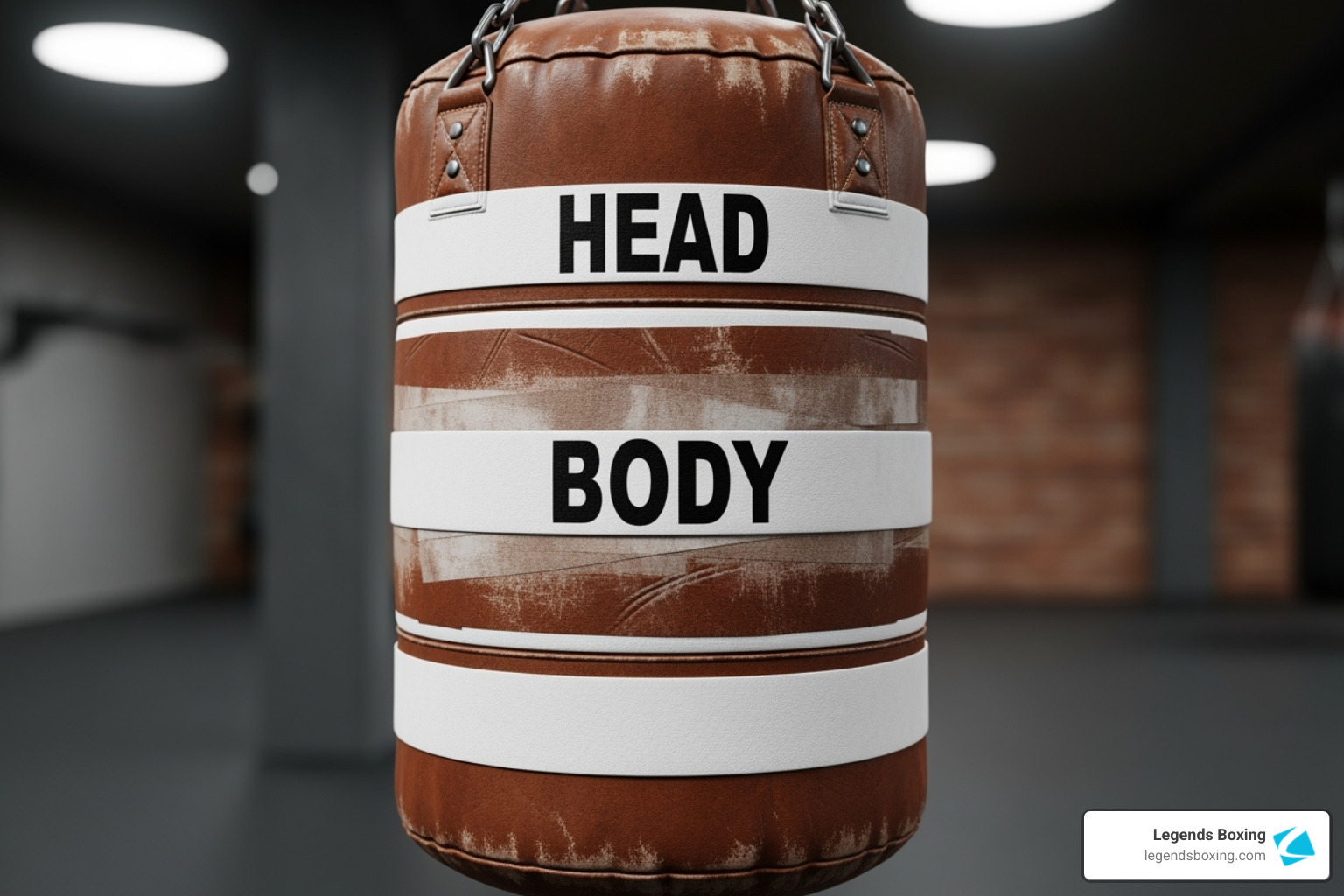
Throw a jab to where the head would be, drop your cross to body level, then bring a lead hook back up to the head. This constant level change forces you to adjust your stance and aim while building incredible core strength from all that dipping and rotating. It also makes your combinations unpredictable and devastatingly effective.
The "Snap" Principle
Legends Boxing coaches always emphasize the snap in your punches. Think whip, not battering ram. Your fist should explode out and snap back home to your guard. Visualize a real opponent — see their head, body, and reactions. This mental imagery transforms mindless bag beating into purposeful boxing practice.
How to Structure Your Heavy Bag Workout
Getting the most from your heavy bag technique drills isn't about randomly throwing punches until you're exhausted. A well-structured workout builds your skills systematically while keeping you engaged and injury-free.
The 5-Minute Warm-Up
Never skip your warm-up — it prepares your body for peak performance and prevents injury:
- Jump rope (2 minutes): Wakes up your cardiovascular system and gets your feet moving in rhythm. No rope? Light jogging or marching in place works too.
- Shadowboxing (2 minutes): Throw punches in the air while focusing on perfect form. Loosens your shoulders, gets your muscles firing, and mentally prepares you for the bag.
- Dynamic stretches (1 minute): Arm circles, torso twists, and leg swings to prepare your joints for their full range of motion.
A Complete 30-Minute Workout Plan
This workout follows the classic boxing format of 3-minute rounds with 1-minute rest between them — the same timing used in amateur and professional boxing.
| Session | Focus | Key Goal |
|---|---|---|
| Warm-up (5 min) | Jump rope + shadowboxing + dynamic stretches | Prepare body and mind |
| Round 1 (3 min) | Jabs and Footwork | Establish distance, find your rhythm, stay light on your feet |
| Round 2 (3 min) | 1-2-3 Combinations | Link jab-cross-lead hook with real hip rotation; snap hands back to guard |
| Round 3 (3 min) | Defense + Counter | Slip or duck imaginary punches, then counter with a sharp 1-2 or power shot |
| Round 4 (3 min) | Speed & Endurance Burnout | 15 sec all-out rapid-fire → 15 sec light footwork, repeat throughout the round |
| Round 5 (3 min) | Freestyle | Combine everything — movement, combinations, defense — in your natural rhythm |
| Cool-down (5 min) | Light shadowboxing + static stretches | Lower heart rate; stretch shoulders, back, core, and legs |
The Essential Cool-Down
A proper cool-down is not optional — it improves recovery and prevents injury:
- Light shadowboxing (2 minutes): Slow your movements down, focusing on fluid form.
- Static stretching (3 minutes): Hold stretches for your major muscle groups — shoulders, arms, chest, back, core, and legs.
- Hydration and recovery: Drink plenty of water and consider a protein-rich snack to help your muscles repair and grow stronger.
Common Mistakes to Avoid During Heavy Bag Technique Drills
Even with the best intentions, it's easy to develop bad habits on the heavy bag. These mistakes can limit your progress or lead to injury.
Dropping your hands after punching is like leaving your front door wide open. After every punch, your hands should snap right back to guard position. This habit becomes automatic with practice, but you have to be conscious about it in the beginning. Hands up, chin down, always.
Pushing instead of snapping is the most common technical error. You want to hear a satisfying "pop" or "thwack," not a dull thud. Real power comes from speed and technique, not brute force. Think of your punches like a whip — quick extension and immediate retraction.
Standing still turns you into a statue. Even though the heavy bag can't hit back, you should constantly move your feet, circle the bag, and practice head movement. This keeps your footwork sharp and builds habits you'd need in an actual boxing match.
Improper wrist alignment can sideline your training with painful injuries. Your wrist should be straight and locked at impact, with your knuckles making contact first. If your wrists hurt, your technique may need adjustment. Quality hand wraps and gloves help, but proper form is your best protection.
Holding your breath sabotages both your power and endurance. Exhale sharply with every punch — this "hiss" or "shh" sound helps you maintain rhythm while keeping your muscles properly oxygenated.
Focusing only on power while ignoring technique, speed, and accuracy is like trying to drive with just the gas pedal. Power matters, but not at the expense of everything else. The heavy bag is your tool for developing complete boxing skills, not just your ability to hit hard.
Frequently Asked Questions about Heavy Bag Training
How often should I train on the heavy bag?
For beginners, 2–3 times per week is ideal. This frequency builds skills and conditioning without overtraining. It's much better to do consistent, focused workouts than infrequent, grueling sessions that leave you burnt out.
Listen to your body. If you're feeling overly sore or fatigued, take an extra rest day — your muscles need time to repair and grow stronger. Balance your heavy bag technique drills with shadowboxing, jump rope, or strength training and adequate rest for the best long-term results.
What's the difference between a heavy bag and other bags?
| Bag Type | Primary Benefits | How It's Used |
|---|---|---|
| Heavy Bag | Power, strength, endurance, combination practice | Everything from power development to quickness and explosiveness |
| Double-End Bag | Speed, accuracy, timing, reflexes, defensive movement | Sharpens hand-eye coordination and teaches you to hit a moving target |
The heavy bag is the most versatile tool in boxing. Unlike the double-end bag that emphasizes accuracy, the heavy bag lets you work on everything from raw power to complex combinations. It's forgiving enough for beginners to learn proper form, yet challenging enough for advanced practitioners to build serious strength and technique.
Do I need boxing gloves for heavy bag training?
Absolutely — hand protection is non-negotiable. Skipping proper gear is like driving without a seatbelt.
- Hand wraps: Stabilize the small bones in your hands and provide wrist support under your gloves. Always wrap before you glove up.
- Boxing gloves (14–16 oz): Heavier gloves provide more padding and protection while adding resistance that builds arm strength over time.
At Legends Boxing, we make sure all our members understand the importance of proper equipment before they throw their first punch.
Transform Your Fitness with the Right Drills
Heavy bag technique drills boost cardio, build full-body strength, sharpen coordination, and deliver serious stress relief. You now have the fundamentals, a complete drill library from beginner to advanced, a structured 30-minute workout, and the common mistakes to avoid from day one.
The punching bag is an ideal training partner — always available, endlessly patient, and never judgmental. Consistency is the secret sauce. Show up regularly, prioritize clean technique over raw power, and listen to your body. The physical changes will come, but the confidence and mental toughness you gain are the real prize.
At Legends Boxing, we incorporate these principles into high-energy, fun classes. Our expert coaches help you perfect your technique, push past plateaus, and celebrate your progress — no boxing experience required.
Ready to experience these heavy bag technique drills with a coach by your side? Book a free class at Legends Boxing and let us guide you from your very first punch. Find a location near you across Utah, Texas, and Florida — and discover why so many people are trading their traditional gym memberships for the results, community, and excitement of boxing fitness.