
Speed Bag Secrets: 10-Minute Drills for Rapid Improvement
A speed bag drill is a focused exercise where you rhythmically strike a small, air-filled bag to build hand-eye coordination, timing, and punch endurance. This guide covers the triplet rhythm foundation, a complete 10-minute workout, a beginner progression, 5 core drills, and advanced techniques for when the basics become second nature.
Why Speed Bag Drills Transform Your Boxing Fitness
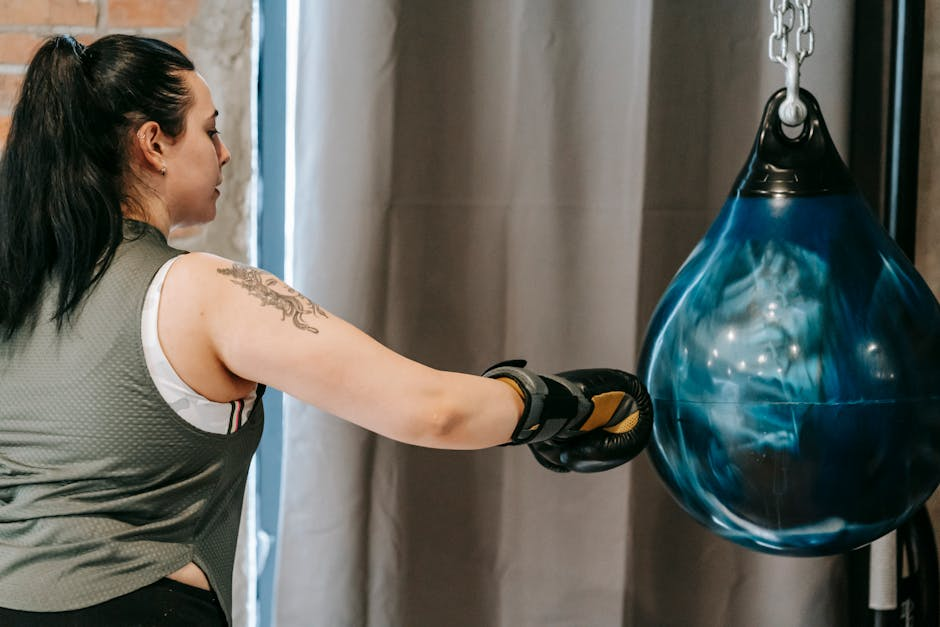
A speed bag drill is a focused exercise where you rhythmically strike a small, air-filled bag to improve hand-eye coordination, timing, and punch endurance. Walk into any boxing gym and you'll hear its unmistakable rat-a-tat-tat. While it looks simple, mastering the bag's rhythm is a challenge that separates good boxers from great ones.
Quick essentials:
| Element | Detail |
|---|---|
| Basic rhythm | Hit the bag and let it rebound 3 times before striking again (the "triplet rhythm") |
| Starting position | Stand square, feet shoulder-width apart, bag bottom at chin level |
| Beginner pattern | Right-Right-Left-Left for consistent rhythm |
| Key focus | Control over power — hit softly and build speed gradually |
| Practice schedule | 10–15 minute sessions, 2–3 times per week |
You don't need years of experience to see rapid improvement. Consistent practice builds the muscle memory, coordination, and endurance that sharpens your entire boxing game. The benefits extend far beyond the bag itself: stronger shoulders, faster hands, better cardiovascular health, and the mental focus to push through challenging workouts.
I'm Robby Welch, National Head Coach at Legends Boxing. I've seen how this simple tool transforms not just boxing skills but overall fitness confidence. These 10-minute drills will give you a workout that's anything but boring.
Why Every Boxer Needs the Speed Bag
Every boxing gym has three main bags: the heavy bag for power, the double-end bag for timing against a moving target, and the speed bag for precision. The speed bag hangs from a platform on a swivel, creating a short, rapid-fire rebound that demands split-second timing and laser focus. There's no room for sloppy technique — the bag will humble you, but it will also transform your skills faster than almost any other tool.
Here's how consistent speed bag drill practice lifts your game:
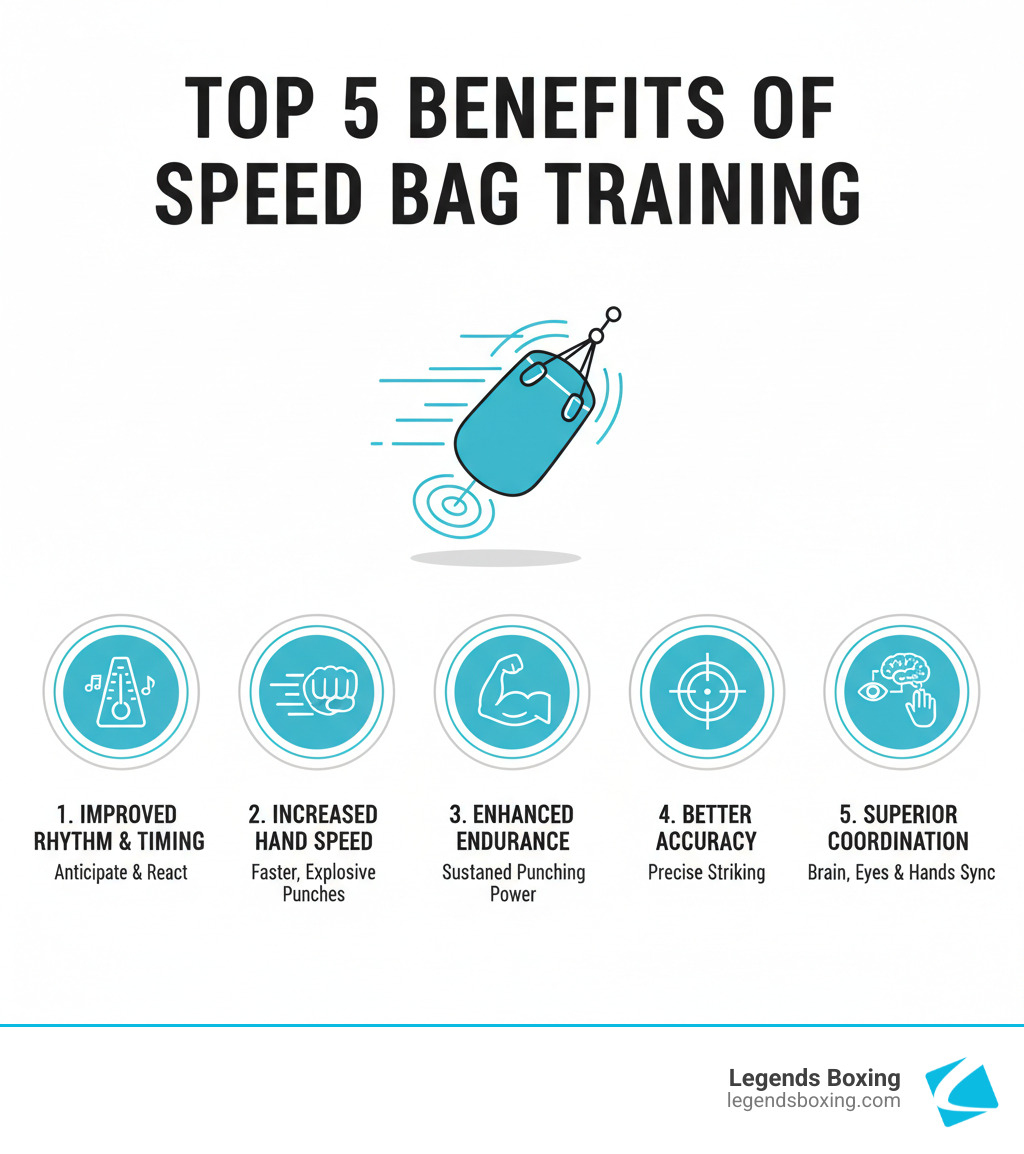
- Elite coordination, rhythm, and timing — your brain, eyes, and hands must sync perfectly to track the bag's movement and respond instantly; this translates directly to landing cleaner punches and finding openings in an opponent's rhythm
- Shoulder endurance and hand speed — the drill keeps your arms lifted and moving, conditioning your shoulders to maintain your guard and throw punches round after round; you learn to relax and snap your punches with minimal movement, building faster, sharper strikes
- Cardiovascular health and mental focus — the constant arm movement provides high-intensity cardio, strengthening your heart and lungs; the speed bag demands complete attention, sharpening mental discipline in a form of moving meditation
Gearing Up: Your Speed Bag Essentials
Getting your equipment right makes the difference between frustration and a satisfying rhythm.
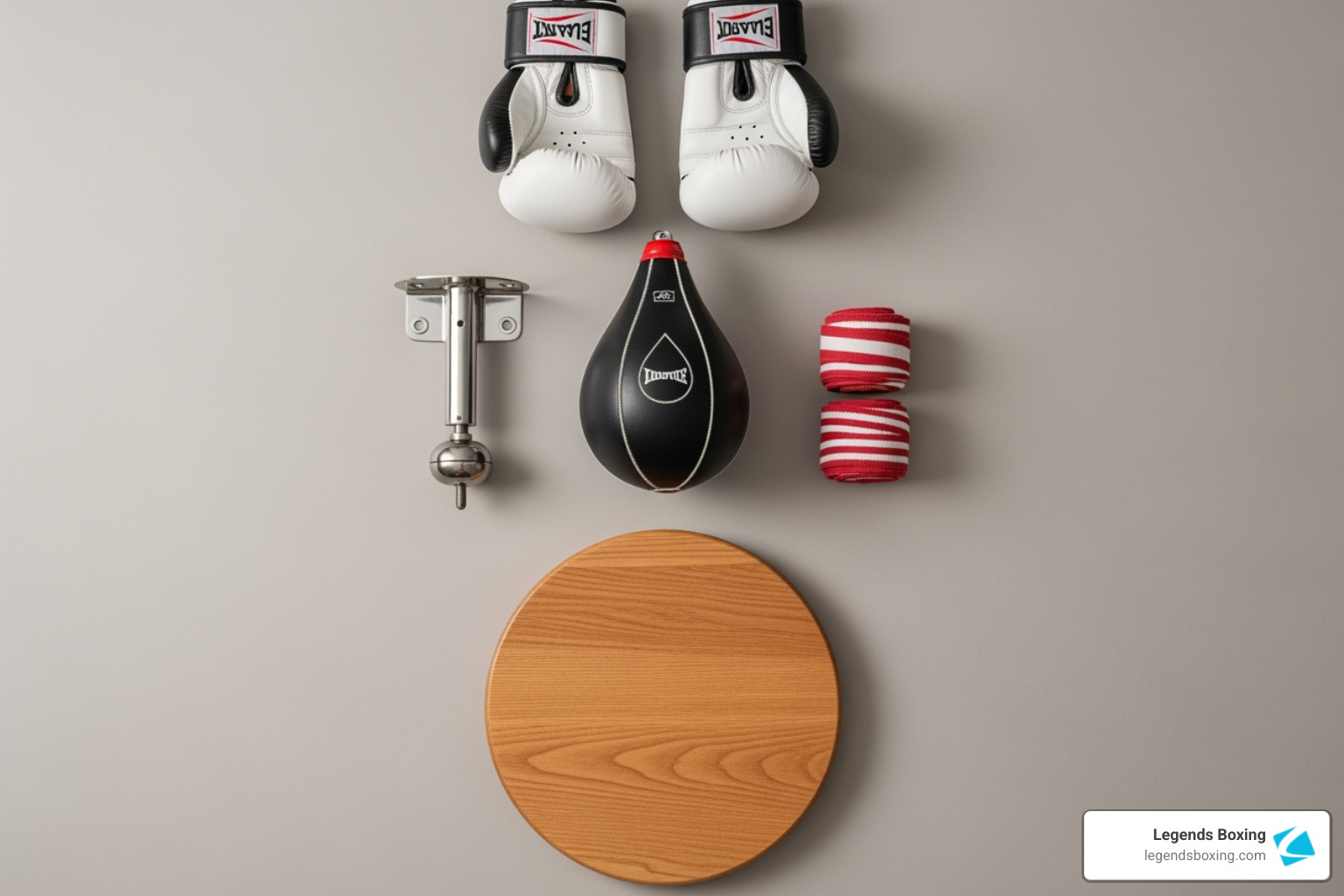
- Speed bag platform and swivel — a sturdy, securely mounted platform is non-negotiable; a wobbly base will ruin your rhythm; the swivel connects the bag to the platform and a quality, fast-moving swivel is essential for smooth action
- The speed bag — beginners should start with a larger bag (8–10 inches); its slower movement gives you time to find your rhythm; as you improve, graduate to smaller, faster bags; ensure the bladder is properly inflated
- Hand wraps and gloves — hand wraps are essential to protect your knuckles and wrists from repetitive impact; light bag gloves offer extra cushioning — avoid bulky sparring gloves
- Proper footwear — boxing shoes or comfortable trainers provide the support needed for shifting your weight and staying agile
Mastering the Basics: Rhythm and Form
Forget speed and power. Your only goals as a beginner are rhythm and control.
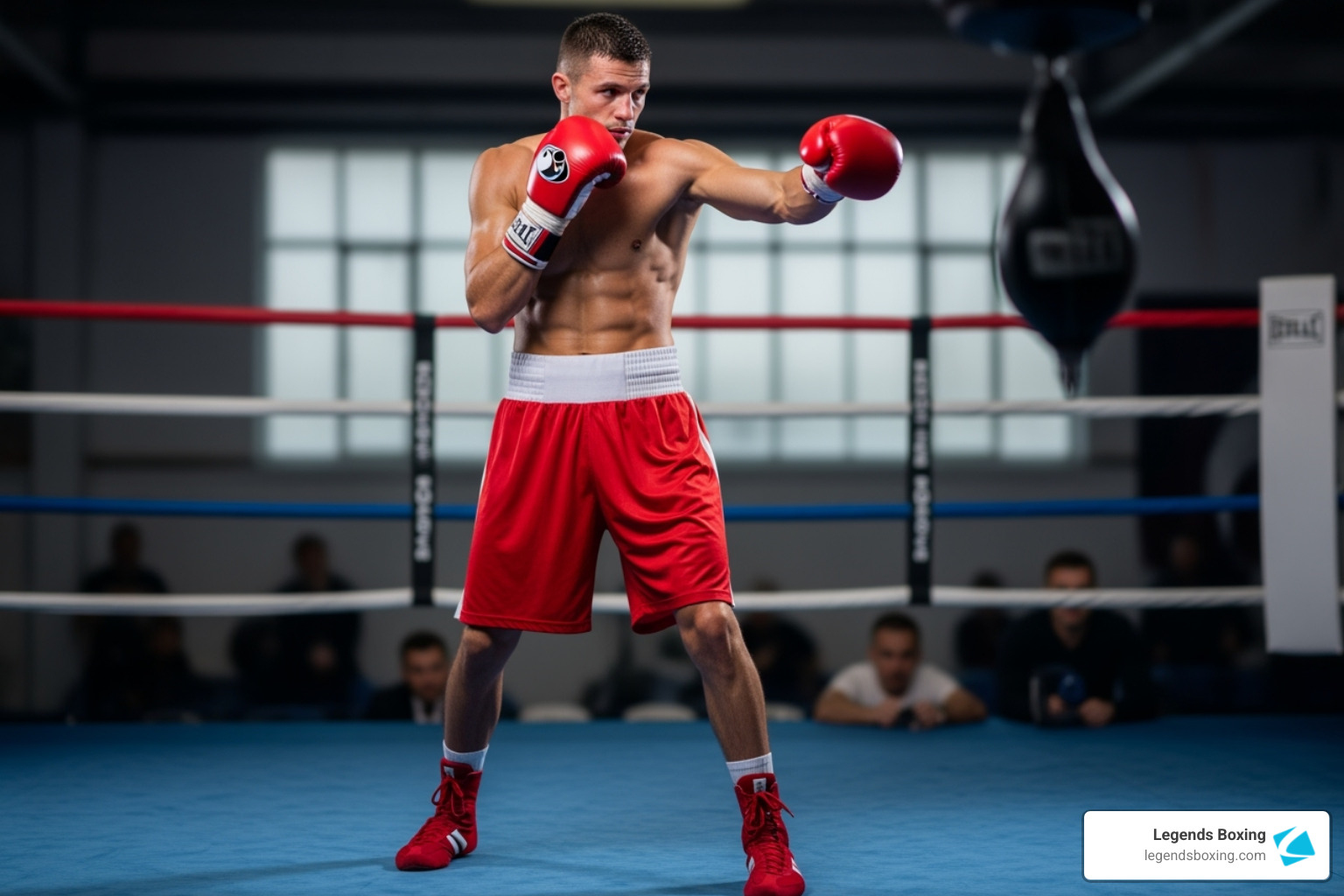
The Triplet Rhythm — this is your foundation. When you hit the bag, it rebounds three times before you hit it again. Count it out: punch-1-2-3-punch. Say it aloud if it helps.
Start slow — hitting the bag too hard sends it flying unpredictably. Use soft taps and focus on control. Speed comes naturally once you have control.
Use small circular motions — guide the bag in small circles rather than hitting it with straight punches; this creates a smoother, more continuous rhythm.
Proper form:
- Stand square to the bag, feet shoulder-width apart, hands up
- The bottom of the bag should align with your chin
- Strike with the side of your fist or heel of your hand
- Keep your hands close to the bag for consistency
Your 10-Minute Speed Bag Drill Workout
This simple workout fits into any fitness routine. Ten minutes of focused work is enough to leave your shoulders burning and your mind sharp. The structure mirrors actual boxing: 3-minute rounds with 1-minute rest periods, training your body and brain for intense bursts of activity.
| Segment | Duration | Focus |
|---|---|---|
| Warm-up | 1–2 min | Light cardio (jumping jacks), shoulder rolls, arm circles |
| Round 1 | 3 min | Basic Rhythm Drill — alternating hands, triplet rhythm, control only |
| Rest | 1 min | Walk around, shake out your arms |
| Round 2 | 3 min | Continue rhythm + add subtle footwork — shift weight, take small steps |
| Rest | 1 min | Catch your breath and reset |
| Cool-down | 1–2 min | Gentle stretches for shoulders, arms, and back |
Aim for 2–3 sessions per week. Consistency matters more than intensity.
Beginner-Friendly Speed Bag Drill Progression
The speed bag is humbling. The biggest mistake is trying to go too fast, too soon. Patience beats frustration. Build your skills one step at a time:
- Hit and stop — hit the bag once and catch it; this helps you feel the impact and response
- Hit and wait — hit the bag and let it swing until it almost stops, then hit again; this teaches timing and patience
- Count the rebounds — hit the bag and count its bounces; start by hitting on the 7th rebound, then the 5th, and work down to the 3rd; this trains your eyes and brain to work together
- Right-Right-Left-Left pattern — hit twice with your right hand (three rebounds between hits), then switch and hit twice with your left; builds muscle memory on both sides
- Single-hand drills — work one hand at a time in short intervals to build individual shoulder strength and control
- Alternating hand patterns — seamlessly switch between right and left hands while maintaining the triplet rhythm; this pulls all basic skills together
The 5 Core Drills for Rapid Improvement
Once you have the basics, these five essential speed bag drills accelerate your progress. Each drill builds on the last, adding complexity while sharpening a specific skill.
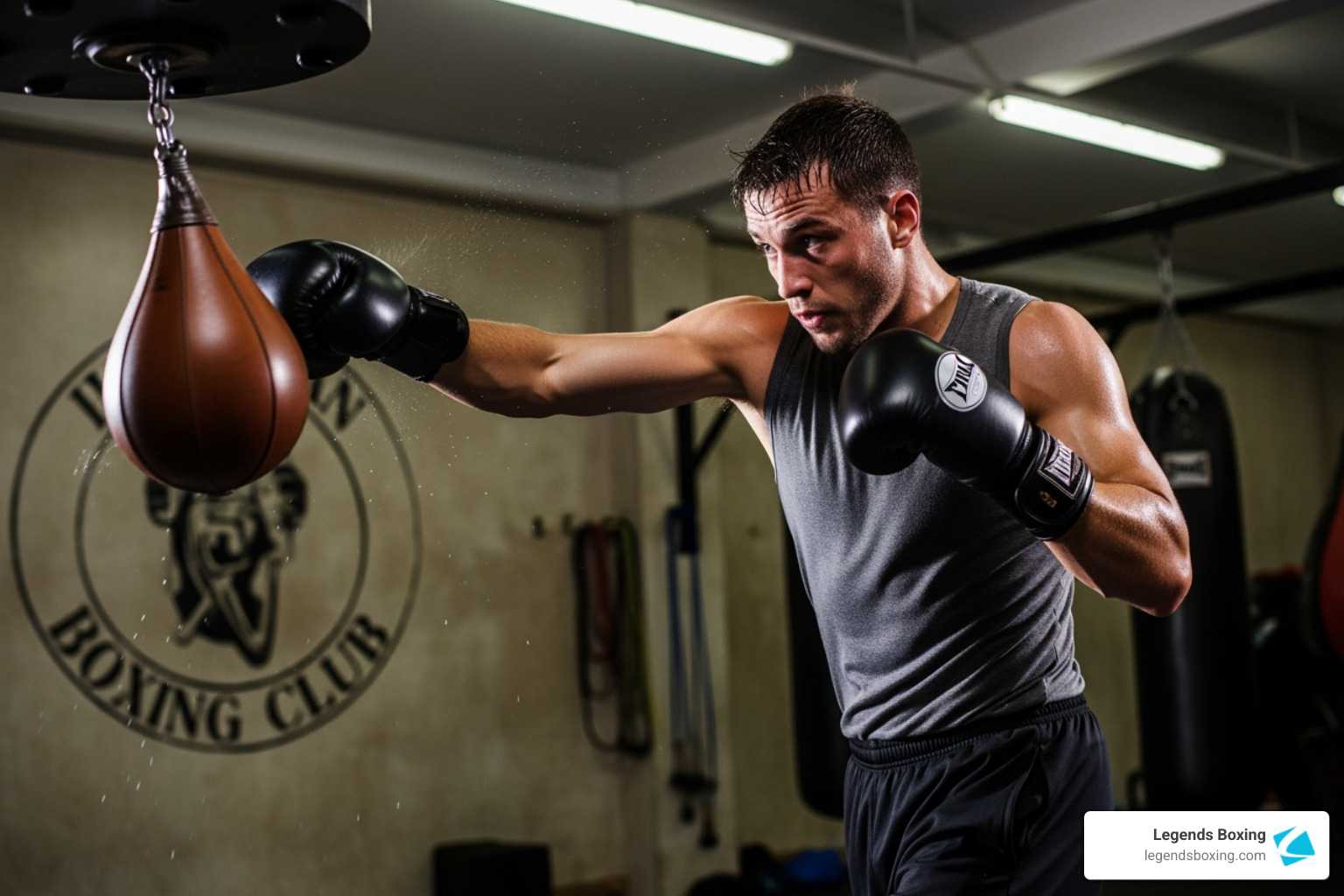
1. The Basic Rhythm Drill (Front Circle Punch)
Stand square and use alternating fists to strike the bag in small, controlled circles, maintaining the triplet rhythm. This drill builds the fundamental muscle memory and hand-eye harmony that everything else is built on.
2. The Alternating Hands Drill
An extension of the basic rhythm, this drill focuses on seamless transitions between your right and left hands. With no hesitation between strikes, you'll strengthen both arms equally and learn to deliver continuous punches.
3. The Double-Tap Drill
Tap the bag twice with the same hand before switching (Right-Right, then Left-Left). These taps must be quick and light. This is a game-changer for improving hand speed and punch combinations.
4. Side-to-Side Hits
Maintain your alternating rhythm while taking small steps left and right. This drill engages your whole body, teaching you to hit a moving target while improving agility, balance, and accuracy on the move.
5. Front Straight Punching
Instead of circular motions, deliver straight shots to the bag and retract your hand quickly. This develops a cleaner, more direct punch and trains your defensive recovery as you pull your hand back to avoid the rebound.
Level Up: Advanced Speed Bag Techniques
Once the basic speed bag drill feels like second nature, it's time to push your skills further. Advanced drills are less about raw speed and more about nuanced control, rhythm variations, and incorporating defensive maneuvers — where you learn to manipulate the bag's movement and simulate the unpredictable nature of a real fight.
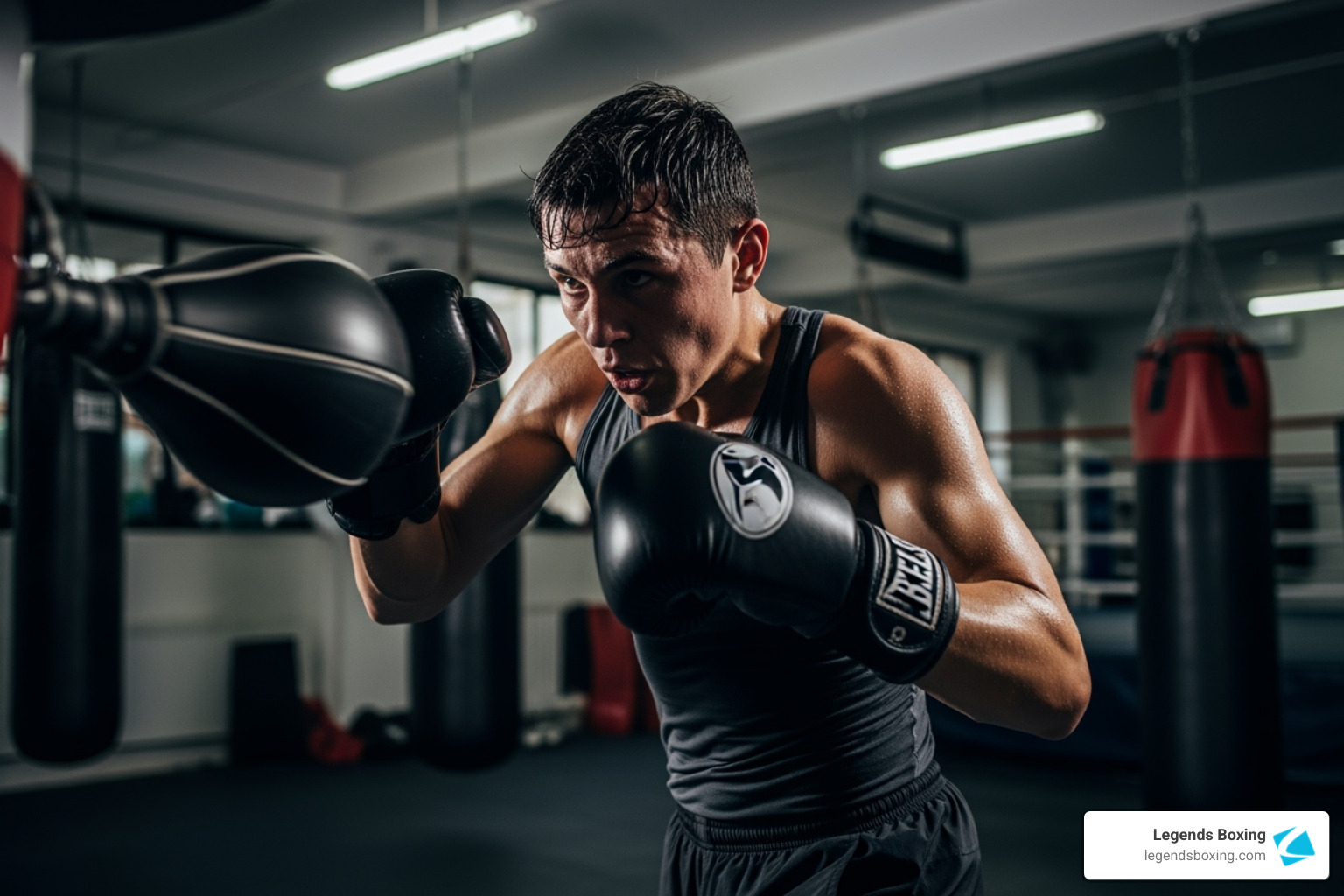
Advanced Combinations
Reverse punching — after a standard front punch, strike the bag as it swings back toward the platform; this reverse strike improves reaction time and teaches you to hit targets from multiple angles.
Elbow strikes — this is about precision, not power; after a fist strike, catch the rebounding bag with an outward, inward, or downward elbow; develops close-range fighting skills and improves body control.
Linking combinations — chain different strikes together in fluid sequences (e.g., front circle punch → reverse double punch → front straight punch); these complex motor patterns build flow between different punch types.
Changing rhythm drills — deliberately vary your timing; instead of always hitting on the third rebound, switch it up — hit on the second, then the fourth, then back to the third; forces constant adaptation and sharpens reflexes for unpredictable opponents.
Interval training with speed bursts — alternate between 30 seconds of maximum-speed hitting and 30 seconds of controlled, recovery-paced rhythm; builds incredible stamina and anaerobic capacity for high-intensity bursts in the ring.
Frequently Asked Questions
How often should I practice speed bag drills to see improvement?
Consistency is more important than duration. Practice 2–3 times per week for 10–15 minutes per session. Start with shorter sessions (5–10 minutes) and gradually increase as your shoulder endurance and timing improve. Focused, regular practice is far more effective than one long, exhausting workout.
Why can't I get the rhythm right?
This is the most common frustration, usually due to a few simple issues:
- You're hitting it too hard — too much force makes the bag's movement unpredictable; hit softly and think "control bag," not "speed bag"
- Your bag is too fast — a small or over-inflated bag moves too quickly for a beginner; use a larger bag (8–10 inches) or let a little air out to slow it down
- Your setup is wrong — the bottom of the bag should be level with your chin; if it's too high or too low, your striking angle will be off
- You're being impatient — the triplet rhythm takes time to internalize; slow down, count the rebounds out loud, and focus on control; the rhythm will come
What are the best speed bag drills for improving hand speed?
Hand speed comes from relaxation and efficiency, not brute force. Three drills that deliver the fastest results:
- The Double-Tap Drill — hitting twice with one hand before switching trains your hand to move faster without overthinking it; start slow and build pace
- Two-handed speed work — hit the bag with both hands in rapid succession, creating a blur of motion; focus on maximizing light strikes in a set time, not power
- Interval training — alternate between bursts of maximum speed (15–30 seconds) and periods of controlled, slower rhythm; trains your fast-twitch muscle fibers for explosive speed
Most importantly, keep your shoulders relaxed — tension is the enemy of speed.
Become a Legend in the Ring
Mastering the speed bag drill mirrors the boxing journey itself. It demands patience, persistence, and humility. But when you stick with it, the rewards extend far beyond the gym: sharper hand-eye coordination, lightning-fast hand speed, rock-solid endurance, and the unwavering mental focus that helps you tackle any obstacle.
At Legends Boxing, we love seeing that "aha!" moment when the rhythm finally clicks. Our boxing-based fitness classes combine real boxing techniques with conditioning and core exercises — no prior boxing experience required. Our professional coaches are here to guide you every step of the way.
Ready to find what you're capable of? Book a free workout at Legends Boxing today and take the first step toward becoming a legend in the ring. Or find a location near you across Utah, Florida, and Texas. The speed bag is waiting.