
From Jab to Uppercut: Decoding the Six Basic Boxing Punches
Boxing is built on six fundamental punches: Jab, Cross, Lead Hook, Rear Hook, Lead Uppercut, and Rear Uppercut. Legends Boxing National Head Coach Robby Welch breaks down each punch, explains how to generate real power from your stance, and shows you how to string them into pro-level combinations.
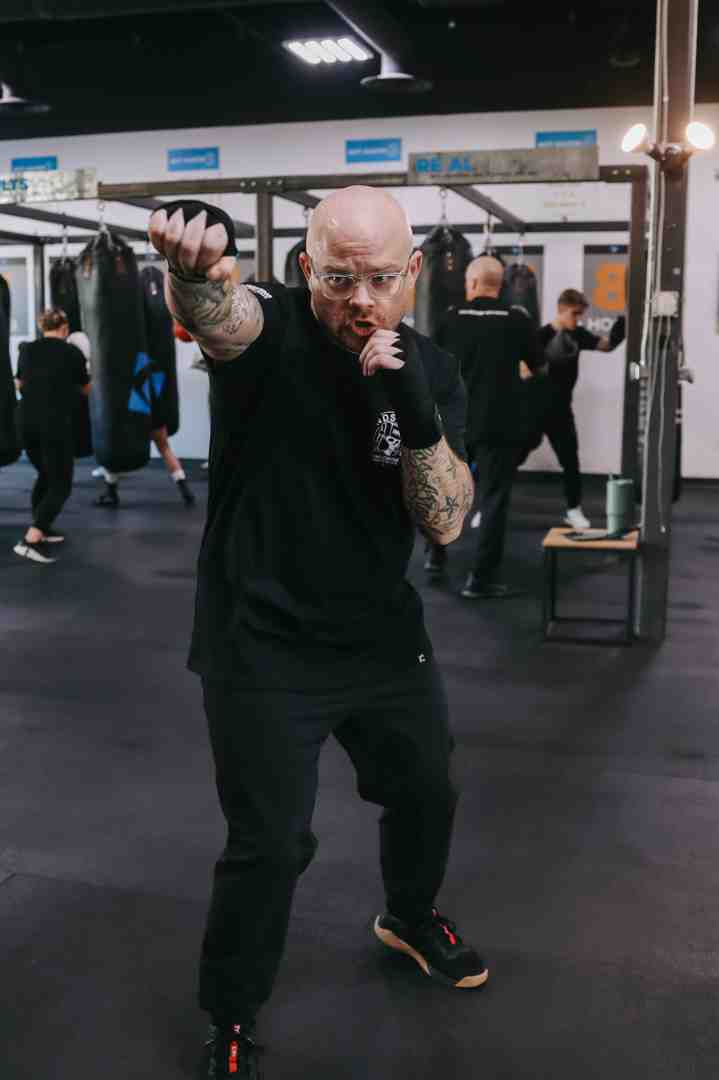
Whether you're new to the gym or looking to refine your technique, understanding the core types of punches is your key to an effective workout. Boxing is a science built on precision and timing, not wild swings. It all starts with six fundamental strikes:
- Jab (1): A quick lead-hand punch to set up combos and control distance.
- Cross (2): A powerful rear-hand punch driven by hip rotation.
- Lead Hook (3): A circular punch from the side with your lead hand.
- Rear Hook (4): A power hook with your rear hand, targeting the head or body.
- Lead Uppercut (5): An upward punch with your lead hand for close-range fighting.
- Rear Uppercut (6): A powerful upward punch with your rear hand.
These six punches form the complete arsenal of boxing. The jab sets the pace, the cross delivers power, hooks attack from unseen angles, and uppercuts break through an opponent's guard. A simple numbering system makes learning combinations like "1-2-3" intuitive, building muscle memory quickly.
I'm Robby Welch, National Head Coach for Legends Boxing. In this guide, we'll break down each punch, explain how to generate real power from your stance, and show you how to combine these strikes like a pro.
The Foundation: Stance, Balance, and Power
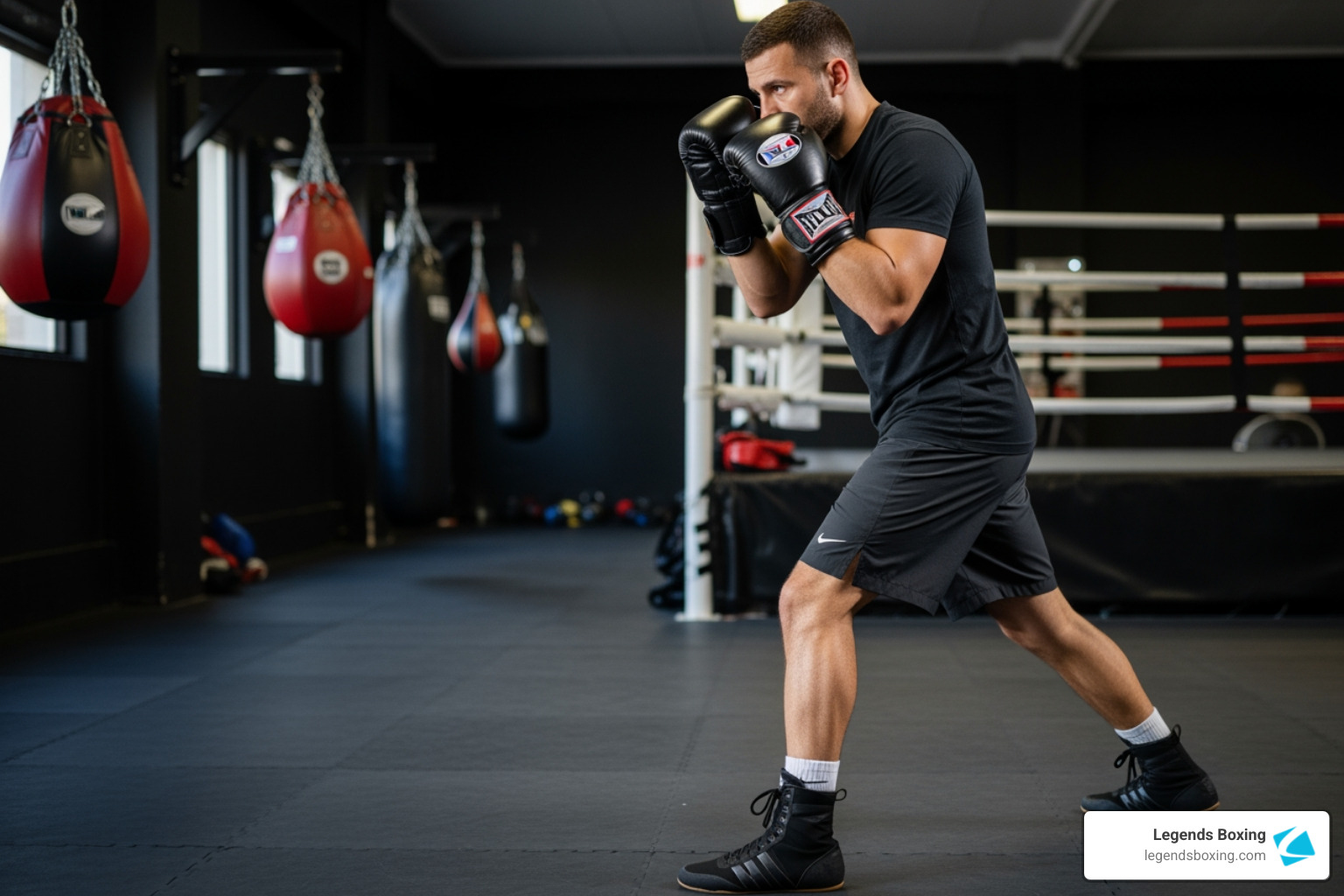
Before mastering the types of punches, you need a solid foundation. Everything in boxing starts with your stance — it's the platform for both power and defense. Stand with your feet shoulder-width apart, one foot forward, and bend your knees slightly. Keep your fists up by your face to protect your chin and your elbows tucked in. This guard position is your first line of defense and creates a stable center of gravity.
Your stance is what allows you to generate power. A balanced position lets you transfer force from the ground up through your body in a kinetic chain. A punch doesn't start in your arm; it starts in your feet. You push off the ground, drive through your legs, rotate your hips, engage your core, and finally the energy explodes through your fist. Poor balance breaks this chain and weakens every punch.
Understanding Orthodox vs. Southpaw
Boxing has two main stances: Orthodox and Southpaw. These terms simply describe which hand and foot you lead with.
- Orthodox: For right-handed fighters. Your left foot is forward, and your left hand is your lead (jab) hand. Your right foot and hand are in the rear, ready to deliver power.
- Southpaw: For left-handed fighters. This is a mirror image of Orthodox, with the right foot and hand forward.
This mirrored stance creates different angles and timing, giving Southpaw fighters a strategic advantage against less experienced Orthodox opponents.
How Stance Creates Power
Punching power comes from using your whole body. With your knees bent and weight distributed, you push off the ground to generate ground-up force. The real power comes from explosive hip rotation and core engagement, which transfers force from your lower body into your arm and fist. Your stance keeps you balanced and ready to reset after every punch.
Cracking the Code: The Boxing Punch Numbering System
Instead of long descriptions, coaches use a simple numbering system to call out punches and combinations. This method builds muscle memory and allows for seamless communication during workouts. Once you learn the numbers, you'll flow through combinations without a second thought.
The pattern is simple: odd numbers are your lead hand, even numbers are your rear hand.
- 1 = Jab — Lead hand straight punch
- 2 = Cross — Rear hand straight power punch
- 3 = Lead Hook — Lead hand circular punch
- 4 = Rear Hook — Rear hand circular power punch
- 5 = Lead Uppercut — Lead hand upward punch
- 6 = Rear Uppercut — Rear hand upward power punch
When a coach calls "1-2-3," you throw a jab-cross-hook without hesitation. Ready to speak the language of boxing? Book a free workout and see how quickly these numbers become second nature.
The Six Essential Types of Punches
Now that you understand the foundation and numbering system, let's explore the six types of punches in your arsenal. Punches fall into two categories: straight punches (jab, cross) that travel in a direct line, or circular punches (hook, uppercut) that attack from an angle.
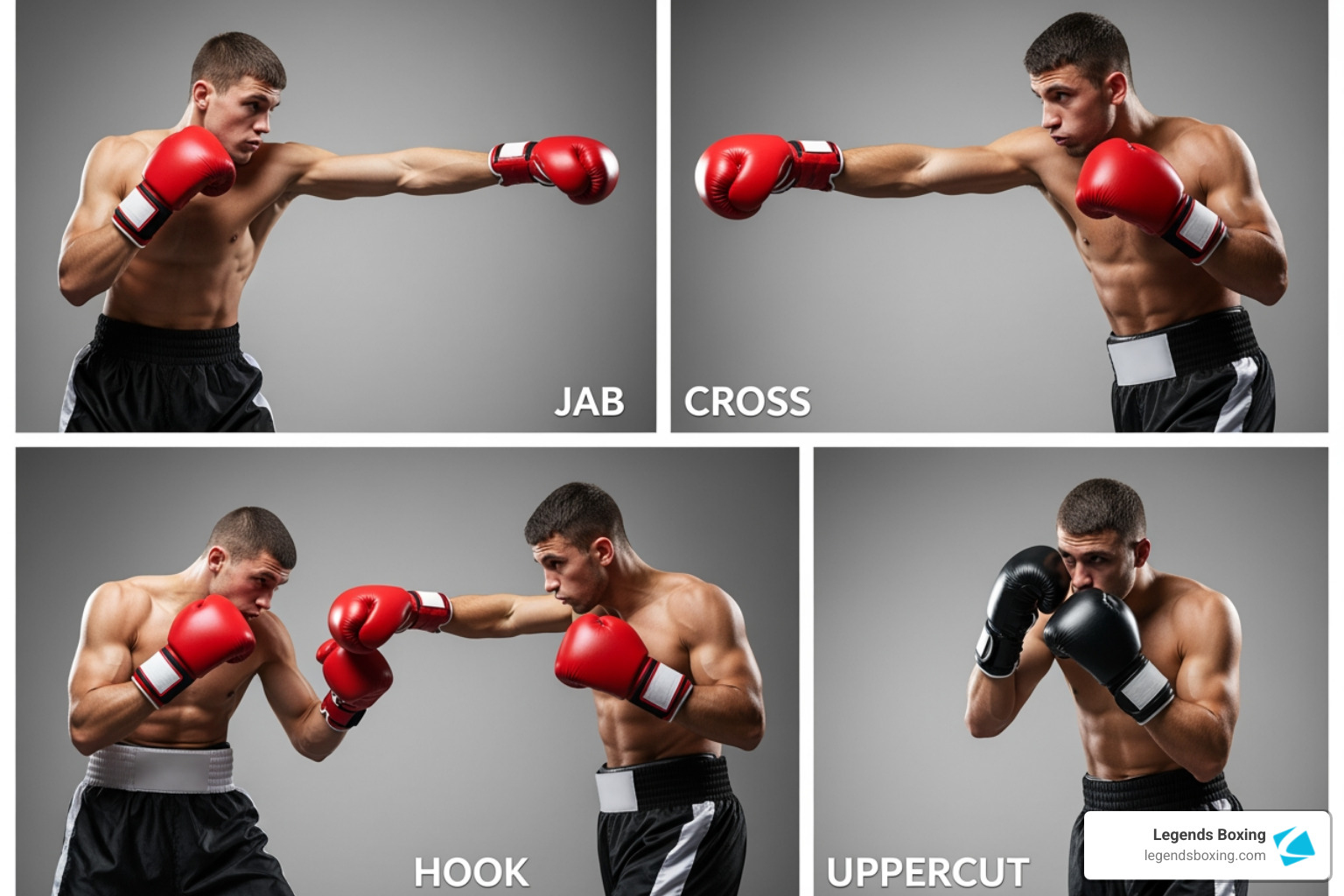
Your lead hand punches (1, 3, and 5) are typically faster and used for setting up combinations. Your rear hand punches (2, 4, and 6) carry more power due to greater body rotation.
1. The Jab
Ask any boxer which punch is most important, and they'll say the jab. This simple lead-hand straight punch is the foundation of all offense. It's not a knockout punch, but it's your most versatile tool — it measures distance, disrupts rhythm, and sets up power shots.
Technique: From your stance, extend your lead arm straight out, rotating your palm to face down at impact. Your shoulder should roll forward for extra snap. Keep your rear hand up to protect your chin, then snap the jab back to your guard as quickly as you threw it.
2. The Cross
If the jab is the setup, the cross is the knockout punch. Thrown with your rear hand, the cross is a straight power punch that delivers maximum force through explosive rotation of your entire body — the full kinetic chain in action.
Technique: Pivot on the ball of your back foot to drive your hip and shoulder rotation. Extend your rear arm straight toward the target, rotating your palm down at impact. Bring your lead shoulder up to protect your chin, then snap your hand back to your guard immediately.
3. The Lead Hook
Unlike the jab and cross, the lead hook is a circular punch designed to attack from the side, getting around an opponent's guard with surprising angles. Its side-on impact makes it a common knockout punch — it often lands from a direction the opponent doesn't anticipate.
Technique: Bring your lead arm up with your elbow bent to 90 degrees. Pivot on your lead foot and rotate your hips to swing your arm in a horizontal arc. The power comes from this rotation, not just your arm. Your thumb should point up at impact. Keep your rear hand glued to your chin throughout.
4. The Rear Hook
If the lead hook is sneaky, the rear hook is a powerhouse. Thrown with your rear hand, this circular punch carries immense knockout potential because it uses the full body rotation of your dominant side — similar to a baseball swing. A well-placed rear hook to the body can result in a liver shot, a debilitating blow that can instantly drop an opponent.
Technique: Bring your rear elbow up to shoulder height, bent at 90 degrees. Pivot hard on your rear foot, driving your hips and torso into the punch. Your arm swings in a horizontal arc as you transfer your weight into the strike. Keep your lead hand up throughout.
5. The Lead Uppercut
In close quarters, the uppercut is your secret weapon. The lead uppercut is a vertical punch designed to slip through a tight guard at close range, devastating when an opponent leans in or drops their hands. A clean uppercut snaps the head back — it's a classic knockout punch.
Technique: Slightly drop your lead shoulder and bend your knees to "load" the punch. Your lead elbow should be bent at roughly 90 degrees, palm facing you. Explode upward with your legs and core, driving your fist in a vertical arc toward the chin or solar plexus. Keep your rear hand glued to your face throughout.
6. The Rear Uppercut
The rear uppercut carries the most power of all uppercuts because it combines a lifting motion with the full rotational force of your dominant side. It excels in close fighting — hard to see coming, and capable of targeting the chin for a knockout or the solar plexus to knock the wind out of someone.
Technique: Bend your knees and drop your rear shoulder slightly to load up. Your elbow should be bent at 90 degrees, palm facing your body. Explode upward by pushing with your legs while pivoting on your back foot and rotating your hips. This combination of lifting and rotating generates immense power. Keep your lead hand up throughout.
Putting It All Together: Training and Combinations
Learning individual punches is the first step — stringing them into combinations is where the real art of boxing begins. At Legends Boxing, we focus on practical training with plenty of time on the heavy bag to build power, endurance, and accuracy. We also incorporate footwork drills so you move around the bag like you're in a real fight, developing hand speed and stamina in one phenomenal full-body workout.
Basic Combinations to Master
- Jab-Cross (1-2): The cornerstone of boxing. A quick jab to set up a powerful cross.
- Jab-Cross-Lead Hook (1-2-3): A classic three-punch combo attacking on two planes.
- Double Jab-Cross (1-1-2): Two fast jabs to close distance, followed by a strong cross.
- Cross-Lead Hook-Cross (2-3-2): A power combination designed to create and exploit openings.
Frequently Asked Questions
What defines a knockout punch? A knockout punch combines force, timing, and accuracy. It typically lands on vulnerable targets like the chin, temple, or jaw, causing the head to snap suddenly and disrupting the brain's function. While powerful punches like the cross and rear uppercut are common knockout blows, any well-timed punch to the right spot can end a fight.
How are boxing punches different from other martial arts? Boxing exclusively uses punches, creating a highly specialized level of skill in hand strikes, footwork, and head movement. Other sports like Kickboxing or Muay Thai incorporate kicks, knees, and elbows. Boxing's singular focus creates a unique depth of expertise.
How can I punch harder and faster? Power and speed come from proper technique, not arm strength. Use your entire body: push off the ground, rotate your hips explosively, and engage your core to link upper and lower body. To improve speed, stay relaxed — tension slows you down. Focus on a quick extension, a snap at impact, and a fast return to your guard. Consistent practice builds the muscle memory for efficient, powerful punches.
Find a Legends Boxing near you and work with our professional coaches to master these techniques in person.
Start Your Boxing Journey
You've learned the fundamentals: six essential punches, the importance of a solid stance, and how to build combinations. Now it's time to put that knowledge into practice.
Mastering these punches builds more than just fitness — it builds confidence, discipline, and mental toughness. Boxing is a full-body workout delivering cardiovascular training, strength building, and stress relief all in one. You don't need to be a fighter to experience its benefits.
At Legends Boxing, we welcome everyone from complete beginners to fitness enthusiasts. Our coaches guide you every step of the way in a fun, supportive environment with zero intimidation.
Ready to see what boxing can do for you? Book a free workout today. Come throw some punches, break a sweat, and find the fighter within.