
Who Packs the Biggest Punch in Boxing History? Meet the KO Legends
Who has the hardest punch in boxing history remains one of boxing's most hotly debated questions. This breakdown covers the top 10 knockout legends, the science of how devastating power is actually generated, what peer testimony from Muhammad Ali and Larry Holmes tells us, and how the biomechanics behind Shavers, Foreman, Tyson, and Wilder compare across eras.
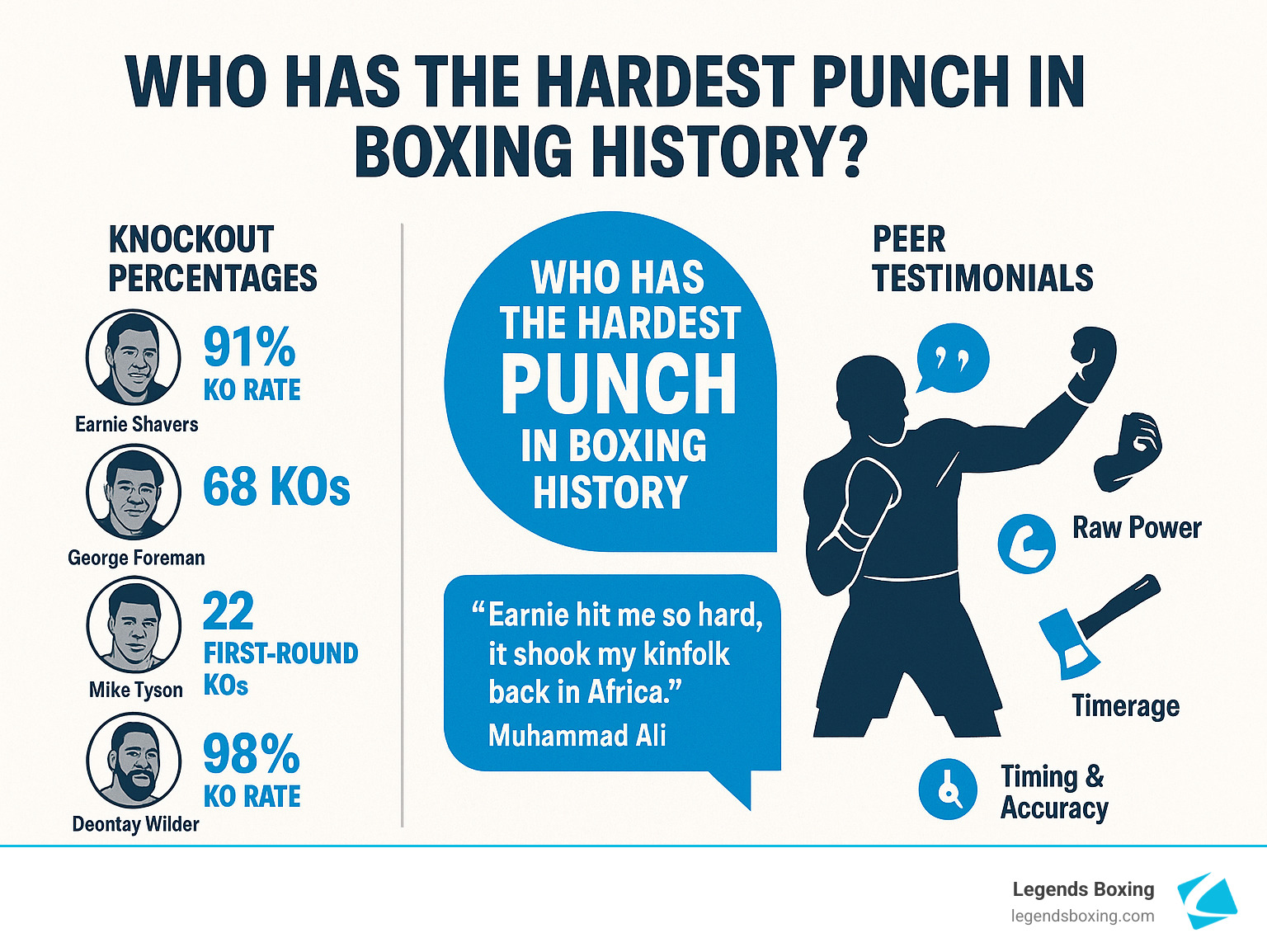
The Great Debate: Boxing's Most Powerful Punchers Throughout History
Who has the hardest punch in boxing history remains one of boxing's most hotly debated questions, with fans and fighters split between legends like Earnie Shavers, George Foreman, and Mike Tyson.
Quick Answer — Top 5 Hardest Punchers:
- Earnie Shavers — 68 KOs in 75 wins, called hardest puncher by Muhammad Ali
- George Foreman — 68 KOs in 76 wins, won title at age 45 by knockout
- Mike Tyson — 44 KOs in 50 wins, 22 first-round knockouts
- Deontay Wilder — 40 KOs in 43 wins, 98% knockout rate
- Sonny Liston — 39 KOs in 50 wins, most feared puncher of his era
When Muhammad Ali said "Earnie hit me so hard, it shook my kinfolk back in Africa," he wasn't exaggerating. The debate has raged for decades, with knockout percentages, peer testimonials, and jaw-dropping highlight reels all playing a part in the discussion.
Some fighters built their entire careers on raw power alone. Others combined devastating force with technical skill and ring IQ. But what separates a hard puncher from a true knockout artist? The answer involves everything from biomechanics and leverage to timing and accuracy.
Robby Welch, National Head Coach at Legends Boxing with over two years of experience studying knockout power and training fighters to develop devastating punches, has analyzed what makes certain fighters rise to the top of this debate across eras.
Defining Knockout Power: What Makes a Punch "The Hardest"?
When boxing fans argue about who has the hardest punch in boxing history, they're really debating what "hardest" even means. Is it the guy who knocks out the most opponents? The one who drops people fastest? Or maybe the fighter other fighters fear most?
True knockout power comes from a perfect storm of factors working together:
Knockout ratio tells us about consistent power. When Earnie Shavers scores 68 knockouts in just 75 wins, that's not luck — that's devastating force delivered over and over again. But raw percentages can mislead if a fighter only fought weak opposition.
One-punch knockouts reveal explosive power in its purest form — shots that drop opponents immediately, no follow-up needed. George Foreman was famous for these; his right hand could end fights with a single clean connection.
First-round finishes show fighters who bring maximum power from the opening bell. Mike Tyson's 22 first-round knockouts demonstrated his ability to release devastating force before opponents could settle in.
Peer testimony often carries more weight than statistics. When Muhammad Ali says Earnie Shavers hit him harder than anyone else — and Ali fought Foreman, Frazier, and Liston — that means something profound.
The biomechanics behind knockout power get fascinating when you dig deeper. Size versus speed creates different types of devastating punchers: George Foreman at 6'4" and 260 pounds was like getting hit by a sledgehammer — pure mass and leverage. Mike Tyson at 5'10" and 220 pounds was more like a hand grenade — compact, explosive, and perfectly timed.
Technique and leverage can turn good punchers into great ones. Rocky Marciano weighed just 188 pounds but knocked out 87.8% of his opponents because he knew how to transfer power from his legs through his entire body.
Accuracy and timing are the multipliers. Wladimir Klitschko earned praise from trainer Emanuel Steward as "the most accurate, single-punch knockout guy" because he could place power shots exactly where they'd do maximum damage. A perfectly timed shot to the chin will always beat a harder punch that lands on the shoulder.
Scientific Gauges of Punching Force
Modern technology has given us new ways to measure what our eyes have always seen. Force sensors can measure punch impact in Newtons; accelerometers track how fast punches travel start to finish. Slow-motion analysis reveals the kinetic chain — power flowing from feet through legs and hips into the core and exploding through the fist.
Francis Ngannou currently holds the record for the most powerful measured punch, though that was in MMA. Research on punch kinetics shows something important: peak force doesn't always equal knockout power. Timing, accuracy, and catching your opponent in the right position matter just as much as raw strength — which explains why some smaller fighters pack tremendous power while bigger guys sometimes can't hurt anyone.
Who Has the Hardest Punch in Boxing History? Top KO Legends
Earnie Shavers: The Punch Most Fighters Fear
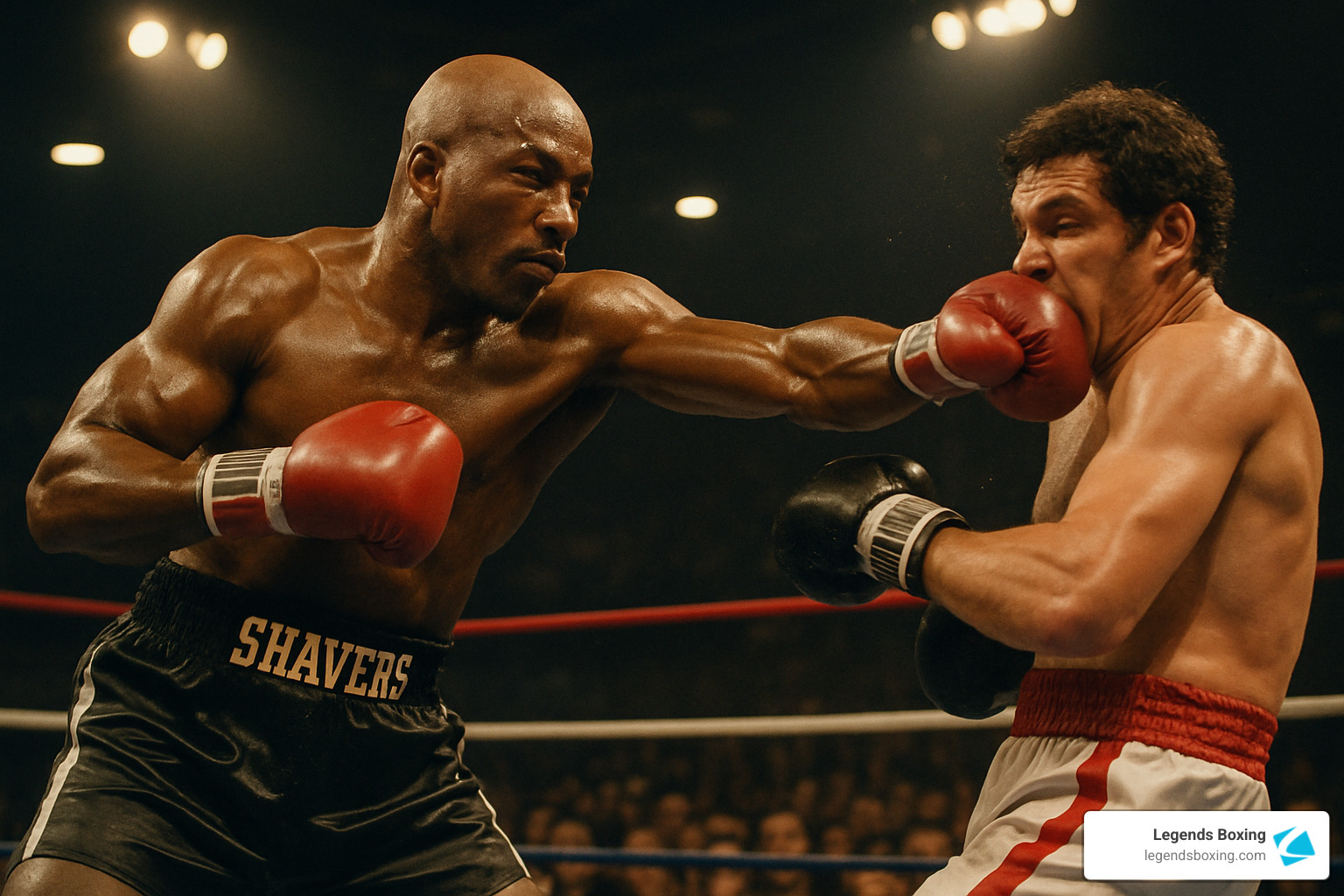
If you're looking for the definitive answer to who has the hardest punch in boxing history, Earnie Shavers is your man. The numbers alone tell an incredible story: 68 knockouts in 75 wins, with a 92% knockout rate that no elite heavyweight has ever matched.
But what makes Shavers special isn't just the statistics — it's what the greatest fighters of all time said after facing him:
- Muhammad Ali: "Earnie hit me so hard, it shook my kinfolk back in Africa."
- Larry Holmes: Called Shavers the hardest puncher he ever faced — remarkable from a man blessed with one of the best chins in heavyweight history
- Ron Lyle: "When Shavers hit me, the ground came up and met me."
- Randall "Tex" Cobb: "If anybody hit harder than Shavers, I'd shoot him."
Shavers earned his power the hard way — chopping wood and farm work that built functional strength you can't replicate in a gym. His right hand was nicknamed "The Acorn" because it looked compact but packed explosive force. The most telling statistic? Shavers scored 68 first-round knockouts — the ability to end fights before opponents could even settle into their rhythm.
The fact that Shavers never won a world title actually strengthens his case. His reputation rests entirely on what he could do with his fists, not political maneuvering or favorable matchmaking. When the greatest fighters in history all agree on something, we should listen.
George Foreman: Crossing Eras with Sledgehammer Fists
George Foreman proved that devastating knockout power doesn't fade with age. His 68 knockouts in 76 wins span two completely different eras of boxing, making him unique among the hardest punchers in history.
In the 1970s, Foreman was a wrecking ball who demolished Joe Frazier and Ken Norton — two fighters who had given Muhammad Ali serious trouble. The way he ragdolled Frazier, dropping him six times in two rounds, remains one of the most dominant power displays ever captured on film.
Then he came back twenty years later and knocked out Michael Moorer to become the oldest heavyweight champion in history at age 45. When you can generate world-class knockout power at that age, you've transcended normal physical limitations.
Mike Tyson himself named George Foreman as the hardest puncher in boxing history. Coming from Iron Mike, that's about as credible an endorsement as exists in the sport.
Mike Tyson: Speed + Ferocity = Explosive Knockouts
Mike Tyson brought a different kind of terror to the heavyweight division. His 44 knockouts in 50 wins included 22 first-round finishes that looked like something out of a video game. Tyson didn't just knock people out — he destroyed them with a combination of speed, accuracy, and raw ferocity.
The peek-a-boo style Tyson perfected allowed him to generate tremendous power from close range. While taller fighters were still trying to establish distance, Tyson was already inside, releasing combinations that ended fights instantly. His knockouts of Michael Spinks, Trevor Berbick, and Larry Holmes demonstrated power that seemed to defy physics.
What made Tyson's power so devastating wasn't just the force — it was the speed. Opponents often didn't see the knockout blow coming. Trainer Teddy Atlas compared Tyson to Mickey Mantle — he could hit powerfully from both sides, with either hand capable of ending a fight. That versatility made him nearly impossible to defend against.
Deontay Wilder: The Modern Era's Answer
Deontay Wilder represents the modern era's answer to the hardest punch debate. His numbers are almost unbelievable: 40 knockouts in 43 wins — a 98% knockout rate virtually unprecedented among world champions.
What separates Wilder from other power punchers is the speed of delivery. At 6'7" with an 83-inch reach, Wilder generates tremendous leverage while maintaining hand speed that smaller fighters would envy. His knockout of Luis Ortiz in their rematch perfectly exemplifies this — he was losing on the scorecards, then ended it with one perfectly placed right hand. His 21 first-round finishes prove that his power is immediate, not just cumulative.
Sonny Liston: The Most Feared Puncher of His Era
Sonny Liston's 39 knockouts in 50 wins don't fully capture why he was so terrifying. Liston possessed a jab that could stop fights on its own — a weapon so powerful it made opponents reluctant to stand and trade. His combination of size, reach, and raw power made him the most intimidating heavyweight of the 1960s. Even Ali admitted that Liston scared him before their first fight.
Why Many Experts Say Shavers is the Answer
The boxing community has reached a rare consensus: Earnie Shavers throws the hardest punch in boxing history. This isn't about championship belts or career achievements — it's purely about raw, devastating power.
The peer consensus is overwhelming. Beyond Ali and Holmes, fighters like Ken Norton, Jimmy Ellis, and Ron Lyle all cited Shavers as the hardest puncher they faced. These weren't casual observers — they were elite athletes who absorbed punishment from the best punchers of multiple generations.
Angelo Dundee, who trained Muhammad Ali and worked with champions across five decades, put it simply: "Earnie wasn't really a good boxer, but God, his power was amazing."
Can today's sluggers claim the title? Modern boxing has produced impressive knockout artists like Wilder, and sports science has given today's fighters better training methods and nutrition. But the eye test and peer testimony still favor the legends. While Wilder's knockout percentage is remarkable, he hasn't faced the depth of elite competition that Shavers encountered nightly. The heavyweight division of the 1970s was stacked with dangerous punchers — surviving and thriving in that environment required a different level of power.
The Science Behind the Sledgehammer
Ever wonder what makes some fighters hit like they're swinging a sledgehammer while others barely rattle their opponents? The answer lies in how the human body creates devastating punching power.
Ground-up power generation is the foundation. Think of your body like a whip — the handle (your feet) creates the initial force, and that energy travels through each section, building speed and power until it explodes at the tip (your fist):
- Feet push against the canvas, driving force up through the legs
- Power transfers through the hips with explosive rotation
- Core muscles engage for stability and additional force
- Energy rockets through shoulders and arms into the target
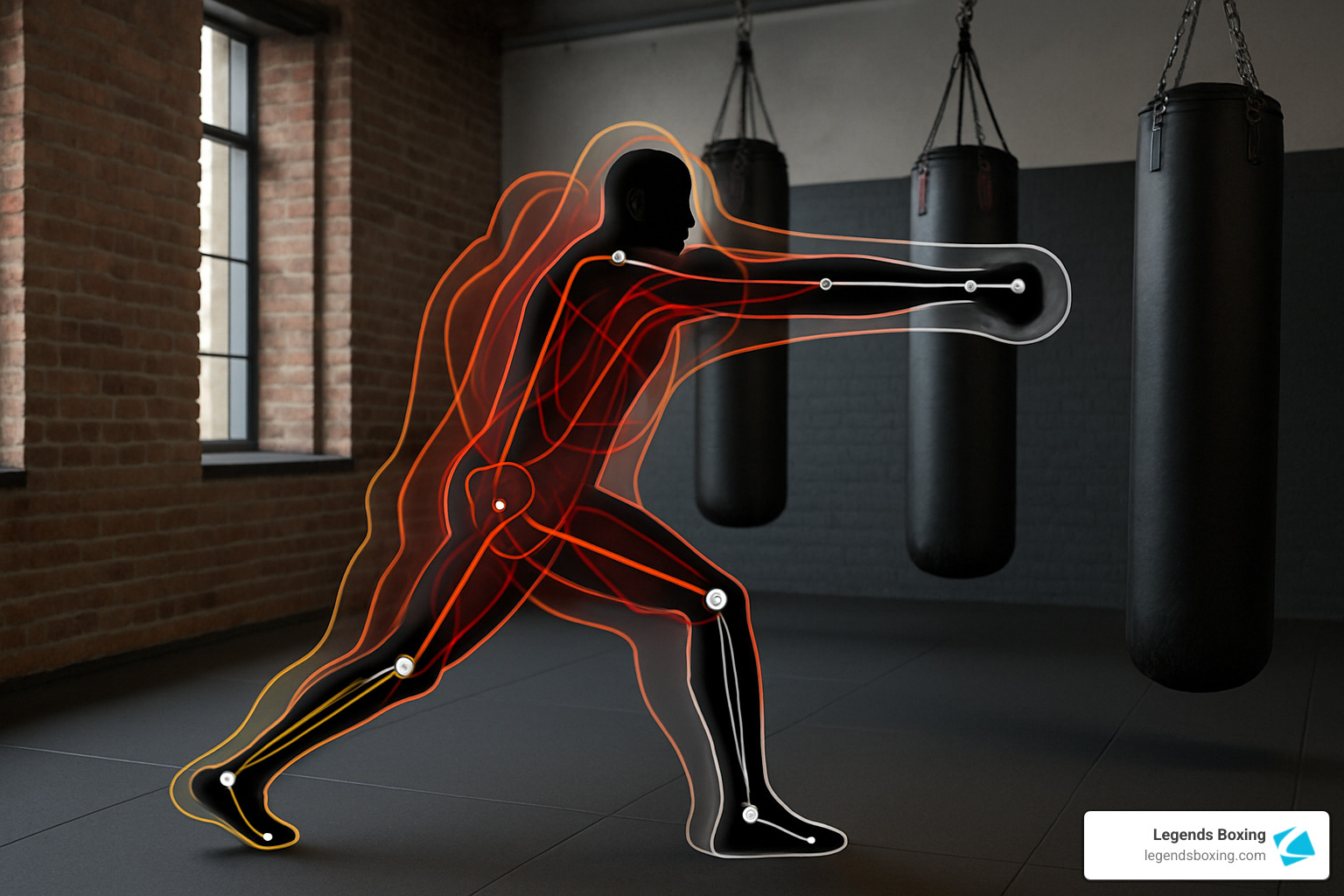
Hip rotation is where the magic happens. When fighters rotate their hips explosively while staying balanced, they create a whip-like effect that multiplies punch force. Mike Tyson's peek-a-boo style was built around maximizing this rotation, letting him generate knockout power even from close range. George Foreman, despite looking slow and plodding, mastered this kinetic chain — that's why he could still knock out world-class fighters at age 45.
Muscle fiber genetics play a huge role. Fast-twitch fibers contract quickly and powerfully, creating the explosive force needed for knockouts. While training can develop these fibers, genetics determines your maximum power ceiling. Some fighters are born with more fast-twitch muscle than others.
Elite muscle recruitment — activating multiple muscle groups at exactly the right moment — separates the legends from everyone else. Studies show elite punchers coordinate muscles throughout their entire body to create maximum force transfer. It's like conducting an orchestra where every instrument hits its note at the perfect time. The hardest punchers also maintain this coordination under fatigue; they can still generate knockout power in round 12 because they've trained their bodies to maintain perfect form when exhausted.
Training for Knockout Power Without a Pro Ring
Here's the good news — you don't need to be a professional fighter to develop serious punching power:
Plyometric exercises are your best friend for building explosive power. Box jumps, medicine ball throws, and explosive push-ups develop the crucial fast-twitch muscle fibers that directly translate to harder punches.
Resistance band training lets you practice the kinetic chain while adding resistance throughout your entire punch motion. Bands develop the rotational power and muscle coordination that separate hard punchers from "arm punchers" who only use their shoulders.
Heavy bag intervals remain the gold standard for power development. Alternating high-intensity combinations with rest periods builds both explosive single-shot power and the endurance to maintain that power throughout an entire workout.
Technique coaching can help you maximize whatever natural power you have. Even without elite physical gifts, proper technique — mastering the kinetic chain, proper weight transfer, and timing — lets you punch way above your weight class. The same principles that made Shavers, Foreman, and Tyson devastating are available to anyone willing to learn and train consistently.
Frequently Asked Questions
Does a higher knockout percentage always mean harder punching power?
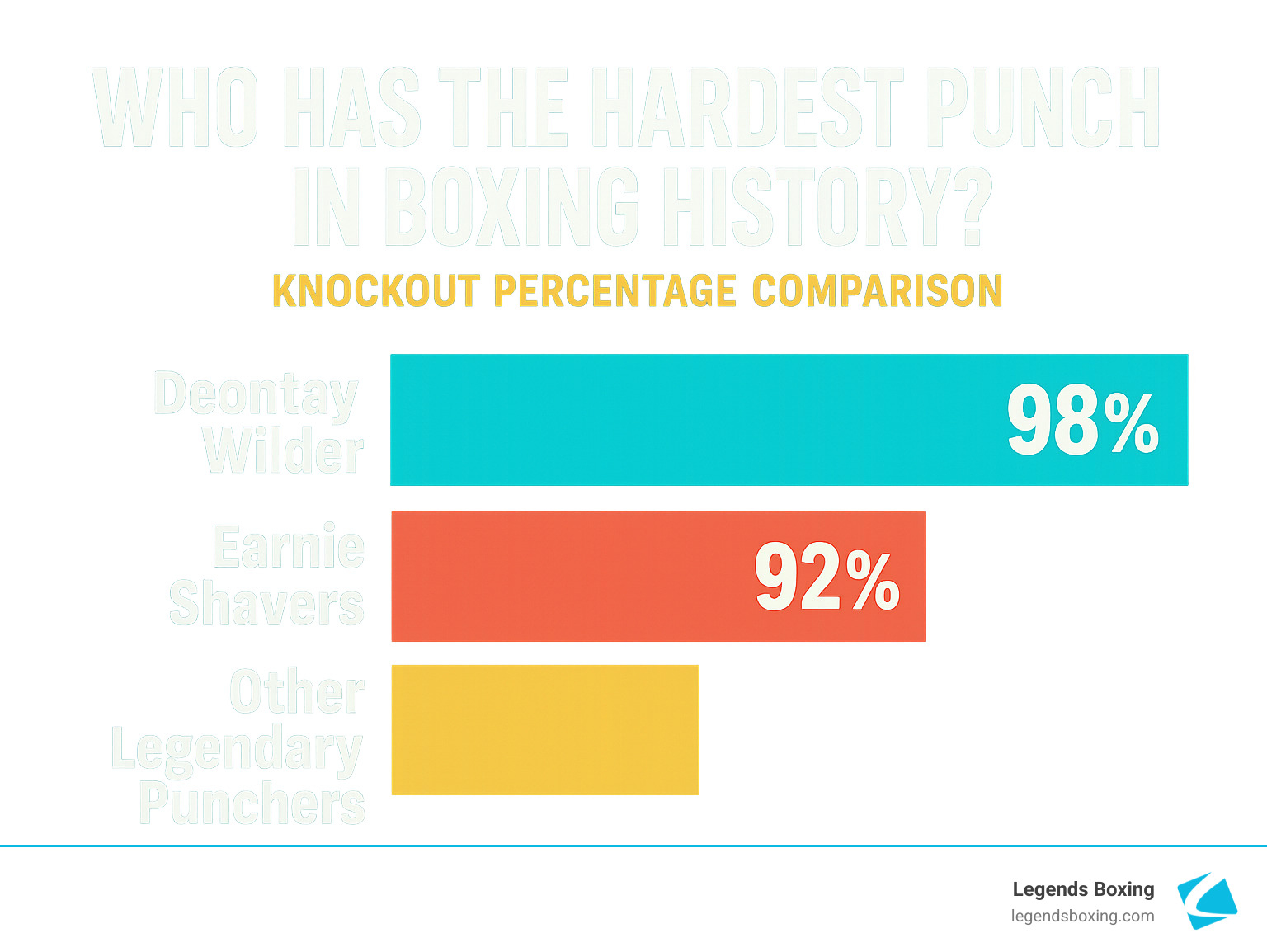
Not exactly. Deontay Wilder's 98% knockout rate sounds unbeatable compared to Earnie Shavers' 92% rate. But Shavers was fighting Muhammad Ali, Ken Norton, and Larry Holmes — fighters who could take a punch and keep coming. Wilder faced solid competition, but not the same murderer's row of elite heavyweights.
First-round knockout percentages often reveal more about pure power than overall knockout rates. When a fighter ends fights before opponents can settle in or make adjustments, that shows devastating one-punch ability. Career length and opponent quality matter too — Joe Louis maintained a 78% knockout rate over 12 years as champion, facing the best heavyweights of his era month after month.
How do lighter-weight punchers like Julian Jackson compare?
Pound-for-pound, some smaller fighters might actually hit harder than heavyweights. Julian Jackson's 89% knockout rate at middleweight included knockouts that looked as brutal as anything Foreman delivered. While heavyweights generate more absolute force due to size, lighter fighters can create incredible force-per-pound through superior speed.
Thomas Hearns could generate devastating power at 147 pounds because his punches arrived so fast opponents never saw them coming. Sergio Martinez dropping Paul Williams with a perfectly timed left hook proved that technique and timing create knockout power regardless of weight class. When we debate who has the hardest punch in boxing history, we usually focus on heavyweights — but pound-for-pound, fighters like Jackson and Hearns deserve serious consideration.
What role do glove weight and era play in judging power?
Different eras make direct comparisons tricky. Early fighters used smaller gloves with less padding, which theoretically made knockouts easier. But modern fighters benefit from superior training methods, nutrition, and strength conditioning.
Today's defensive techniques are also more sophisticated — better head movement, clinching, and survival skills help fighters weather big shots. Medical advances (better mouthpieces, improved corner work, faster stoppage) also affect knockout statistics. Modern referees stop fights when fighters are hurt more quickly than in past decades. What matters most is the eye test: when you watch Earnie Shavers drop opponents, the era doesn't matter. That's pure, devastating power that transcends equipment and rule changes.
The Knockout Power That Transcends Eras
The question of who has the hardest punch in boxing history may never have a fully definitive answer — but that's what makes it so fascinating. After analyzing knockout percentages, peer testimonials, and the science behind devastating power, one thing is crystal clear: true knockout power is incredibly rare.
Earnie Shavers stands as the consensus choice among those who actually stepped into the ring with these legends. When Muhammad Ali and Larry Holmes both say the same fighter hit them harder than anyone else, that carries more weight than any statistic.
George Foreman proved that devastating power can transcend age. Mike Tyson showed us what happens when explosive speed meets perfect technique. Deontay Wilder brought one-punch knockout power into the modern era. What connects them all: knockout power comes from the ground up — proper technique, explosive hip rotation, and the commitment to throw with bad intentions every time.
The beautiful part? You don't need to be a professional fighter to develop impressive punching power. At Legends Boxing, we teach these fundamentals in every class — the kinetic chain, proper weight transfer, and timing that help every member develop real power while getting an incredible workout. No experience required.
Find your nearest Legends Boxing location and discover what proper boxing technique can do for your fitness and confidence — or book your first free class now. Who knows? You might surprise yourself with the power you can develop.